
Theseus and the Thread
A Greek myth for children about entering the dark, facing the monster, and holding fast to the line that leads home.

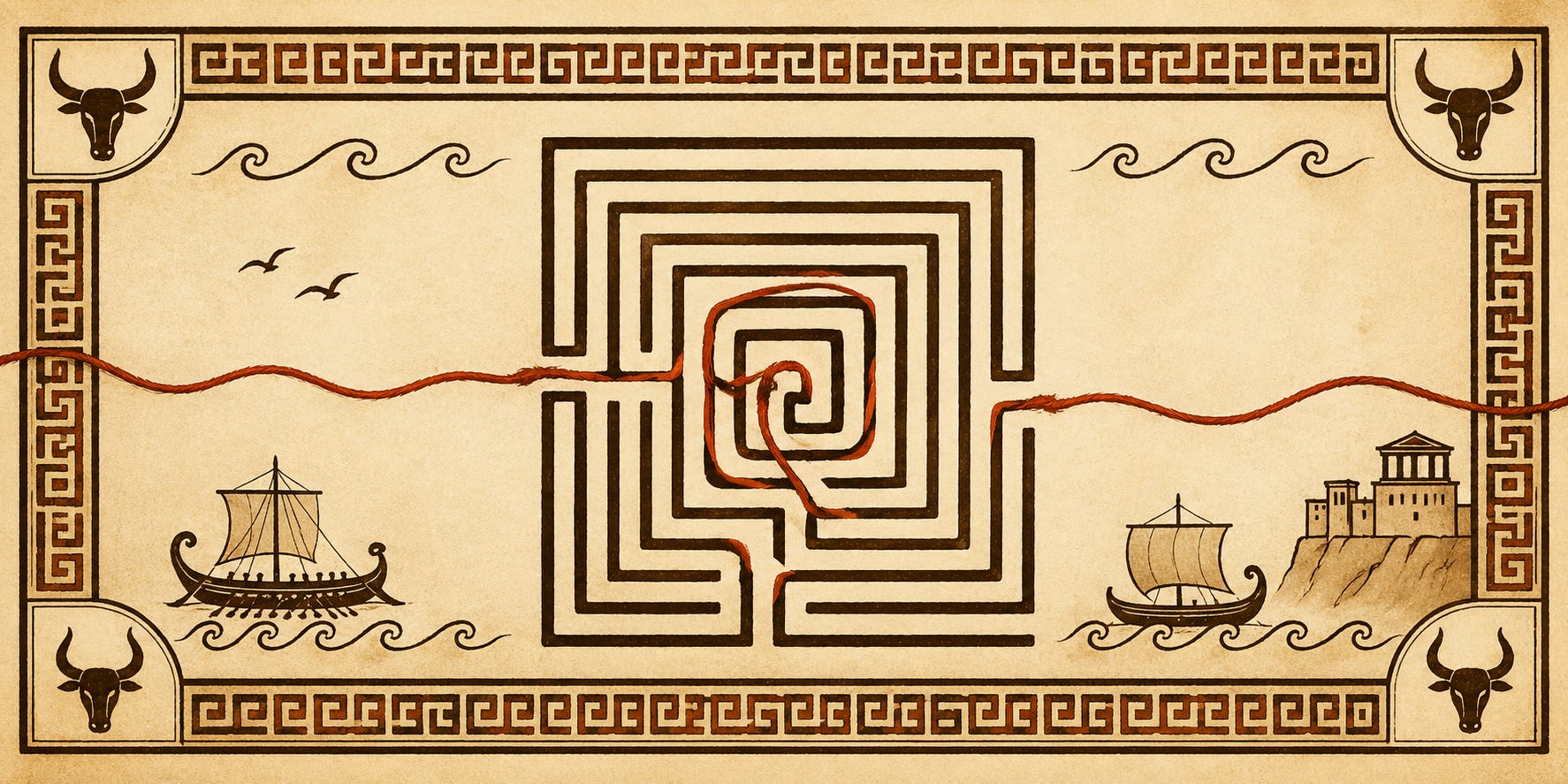
There was a ship in Athens that no one liked to see.
It was not the largest ship in the harbour. It was not the fastest, nor the finest, nor the one with the proudest carving at its prow. But whenever its black sail was raised, the whole city seemed to grow quieter.
Men stopped speaking in the marketplace.
Women came to their doorways and stood with their hands folded.
Children who had been chasing one another between the houses slowed down, because even children know when grown-ups have become afraid.
The ship sailed for Crete.
And every time it sailed, it carried seven Athenian boys and seven Athenian girls away from their homes.
It did not carry them to become servants, or messengers, or guests at some foreign palace. It carried them to the island of King Minos, who had power, wealth, many guards, and a very unpleasant habit of making other people pay for things he called justice.
Long before, Athens had angered Crete. That is the kind of sentence kings use when they do not wish to explain themselves gently. So Minos had demanded a tribute. Every few years, Athens must send fourteen young people across the sea.
They were sent to the Labyrinth.
And in the Labyrinth lived the Minotaur.
You may already have heard that name. If you have, you will know it is not a name that belongs beside a warm fire. The Minotaur was part man, part bull, and wholly dreadful. He had been born into the house of Minos like a secret too terrible to keep in an ordinary room. So Minos had hidden him beneath the palace, in a maze built by Daedalus, the cleverest craftsman in the world.
Daedalus could make wood seem almost alive. He could make statues look as if they might walk away if you turned your back. He could design a building so cunningly that even the person who entered it willingly might never find the door again.
That was the Labyrinth.
It was not only a prison for the Minotaur.
It was a prison for anyone sent in after him.
And so, whenever the black sail rose in Athens, the city remembered that courage is sometimes demanded from people who have not yet had time to grow old enough to choose it.
Theseus saw the ship from the palace steps.
He was young then. Not little, not quite a man, but at that dangerous age when the heart begins to understand injustice before the world has taught it patience.
King Aegeus, Theseus’s father, stood beside him.
Aegeus was king of Athens, and kings are expected to look as if they know what should be done. This is one of the harder parts of being a king, especially when they do not.
“It has come again,” said Theseus.
His father said nothing.
“How long has Athens paid this tribute?”
“Too long.”
“And no one has stopped it?”
Aegeus looked at him then. His face had the tiredness of a man who had imagined stopping something many times and failed each time in a different way.
“No one has come back from the Labyrinth,” he said.
Theseus looked again at the ship.
The black sail moved in the wind, dark against the bright morning. It looked wrong there, among the gulls and ropes and sunlight.
“Then I will go,” said Theseus.
His father turned quickly.
“No.”
“I will go as one of the fourteen.”
“You will not.”
“I am your son,” Theseus said. “If sons and daughters of Athens are being sent, then I will not stand above them and watch.”
This was a brave thing to say.
It was also, as brave things often are, a little unfair to the person who loved him.
Aegeus gripped his shoulder. “You do not know what you are asking.”
“I know enough.”
“No,” said Aegeus. “You know the harbour. You know the ship. You know the sail. You do not know the thing beneath the palace.”
Theseus did not answer at once.
This was one of the better things about him.
He was brave, but he was not foolish enough to think fear was an insult. Fear is sometimes the body telling the truth before the mouth is ready.
At last he said, “Then let me learn it there.”
Aegeus looked at him for a long while.
A father may be king over a city, but he is not king over the courage of his child. He may command armies. He may judge quarrels. He may send messengers across the sea. But when a son stands before him and says, I will go into danger because others must not go alone, the crown suddenly feels rather small.
So Aegeus did what frightened fathers have done since the world was young.
He gave one more instruction, because instruction is sometimes the last shape love can take.
“If you must go,” he said, and the words hurt him, “then remember this. The ship will sail with its black sail, as it always has. But when you return, raise a white one. Let Athens see from far away that its children are coming home.”
“I will,” said Theseus.
He meant it.
Then he went down to the harbour.
The ship left Athens in the morning.
The sea was blue. The sail was black. The oars dipped and rose, dipped and rose, as if the ship itself were breathing sadly.
Theseus sat among the other thirteen.
Some were silent. Some stared at the water. One boy kept touching a small wooden charm his mother had tied around his wrist. A girl with dark plaited hair watched Theseus carefully, not because she expected him to save them, but because she wanted to know whether he was afraid.
He was.
That helped.
A hero who is never afraid is not very useful to the rest of us. He is more like a statue than a companion. Theseus was afraid, and because he was afraid, the others could sit a little nearer to him without feeling ashamed of their own fear.
“What do you think the Labyrinth is like?” one of the boys asked.
“Dark,” said another.
“Big,” said someone else.
“Hungry,” whispered the girl with the plaited hair.
No one spoke for a while after that.
Theseus looked towards the line where the sea met the sky.
“I think,” he said at last, “that if someone built it, then it has walls. If it has walls, then it has passages. If it has passages, then there is a way through.”
The girl frowned. “And if the way through does not lead back?”
“Then we shall have to be very careful where we put our feet.”
This was not much of an answer.
But sometimes not much of an answer is better than no answer at all.
Crete rose from the sea like a sunlit animal.
Its cliffs were pale. Its hills were dry and bright. Above the harbour stood the palace of Knossos, broad and painted and full of columns the colour of dark red earth. It did not look like a place that could hide anything.
That, of course, is how palaces often manage it.
King Minos received the Athenians in a courtyard where everything was too beautiful.
The walls were painted with leaping bulls, blue waves, flowers, dolphins, and young people turning impossible shapes in the air. Bronze bowls shone in the sunlight. Servants moved quickly and silently. Somewhere nearby, a fountain ran with a sound so cheerful it was almost rude.
Minos sat on a carved chair beneath an awning. He had a square beard, heavy rings, and the look of a man who had been obeyed for so long that disagreement seemed to him a kind of bad weather.
“So,” he said, looking over the fourteen young Athenians. “The tribute has come.”
Theseus stepped forward.
“I am Theseus, son of Aegeus, king of Athens.”
A murmur passed through the Cretan court.
Minos raised one eyebrow.
“A prince among the tribute? How noble. Or how foolish. These qualities are sometimes hard to tell apart.”
“They are easier to tell apart from the inside,” said Theseus.
One or two Cretans looked down at the floor, which is what people do when they are trying not to be seen enjoying an answer.
Minos smiled without warmth.
“You will enter the Labyrinth tomorrow.”
The other Athenians drew closer together.
Theseus did not look away.
“Then tomorrow we will see what your Labyrinth can do.”
For the first time, Minos looked truly interested.
“My Labyrinth,” he said softly, “does not need to do anything. That is its genius. Men run. Children cry. Heroes boast. The Labyrinth waits. In the end, everyone inside it belongs to the dark.”
From the edge of the courtyard, someone heard this and did not lower her eyes.
Her name was Ariadne.
She was the daughter of Minos.
Now, princesses in stories are often treated as if they spend their days waiting to be useful to heroes. Ariadne did not. She had grown up in the palace of Crete. She knew where servants whispered, where guards drank too much wine, which doors were locked, and which questions were punished by silence.
She had seen the tribute come before.
She had heard the doors close below.
She knew that her father called the Labyrinth justice because he did not want to call it shame.
That night, while the palace slept uneasily, Ariadne came to the room where the Athenians were guarded.
The guards were at the far end of the passage. One was asleep. The other was pretending not to be. Ariadne had arranged this. Palace servants can move the world more quietly than kings, if one knows how to ask.
She carried a small lamp, a sword wrapped in cloth, and a ball of red thread.
Theseus rose when he saw her.
“You are King Minos’s daughter.”
“Yes.”
“Have you come to see what a foolish Athenian prince looks like before morning?”
“No,” said Ariadne. “I have seen foolish princes before. You are not the worst.”
Despite everything, Theseus nearly smiled.
Ariadne glanced at the sleeping guards and lowered her voice.
“Listen carefully. You cannot defeat the Labyrinth by being brave.”
“I intend to defeat the Minotaur.”
“That is different.”
Theseus was silent.
This, too, was one of the better things about him.
A person who can stop speaking when someone wiser has begun is already less foolish than most heroes.
Ariadne held out the sword.
“You will need this.”
Theseus took it.
Then she held out the ball of red thread.
“And you will need this more.”
The girl with the plaited hair, awake now, stared at it.
“Thread?”
Ariadne nodded.
“The door of the Labyrinth will be shut behind you. Tie one end near the entrance. Let the thread run through your hands as you go. Do not drop it. Do not cut it. Do not think, even for a moment, that you will remember the way without it.”
Theseus looked at the thread.
It seemed too small.
That was its first lesson.
Against a monster, a sword made sense. Against King Minos, perhaps a spear would have been better. Against a maze built by Daedalus himself, red thread looked almost silly.
But Ariadne’s face was serious.
“The Minotaur is not the only danger,” she said. “He is only the danger with breath. The Labyrinth is the danger that remains after courage has done all it can.”
Theseus understood then.
Not fully, perhaps. No one understands the dark before entering it. But he understood enough to take the thread carefully.
“Why are you helping us?” he asked.
Ariadne looked towards the deeper palace, where her father slept above the thing he had buried beneath him.
“Because a house that feeds children to its secret deserves to be disobeyed.”
That was all she said.
It was enough.
Morning came too quickly, as mornings do when one would prefer them to lose their way.
The Athenians were led through the palace, down stairways and along painted corridors. The air grew cooler. The colours faded. The cheerful dolphins disappeared from the walls. The smell of flowers and oil lamps gave way to damp stone.
At last they came to a bronze door.
It was enormous.
No one had painted dolphins on this door.
That seemed wise.
The door was carved with twisting lines that led nowhere, curling back into themselves, turning and crossing until the eye grew tired. Two guards stood beside it. Neither looked happy to be there.
Minos had come to watch.
So had Ariadne, though she stood behind a pillar and kept her hands folded.
The king looked at Theseus.
“You may still beg,” he said.
Theseus tied one end of the red thread to a bronze ring beside the door.
“I am busy.”
Ariadne lowered her head slightly, as if hiding a smile.
The door opened.
The sound it made was deep and slow, like stone remembering an old complaint.
Darkness waited on the other side.
Theseus turned to the thirteen Athenians.
“Stay close. Keep one hand on the wall if you must. If we are separated, call. If you hear something that sounds like me but is not me, do not follow it.”
This was not very comforting.
It was, however, useful.
He stepped inside first.
The others followed.
The door closed behind them.
And the Labyrinth received them.
At first, there was only darkness and the sound of breathing.
Fourteen children breathing.
Then a fifteenth breath, far away.
Or perhaps not far away.
That was one of the Labyrinth’s tricks.
Distance behaved badly there.
A sound might seem to come from the next turn and then from beneath the floor. A passage that sloped downward somehow brought them back to a place that felt higher. The walls were smooth in some places and rough in others. Sometimes the ceiling lowered until even Theseus had to bend. Sometimes it rose so high the lamp flame could not find it.
The thread moved through his fingers.
Soft.
Ordinary.
Alive with Ariadne’s thinking.
They walked.
The passage turned left, then right, then right again, then down seven shallow steps. Theseus counted silently. Then the path split in three.
The left passage smelled of wet stone.
The middle passage was silent.
The right passage carried a faint breath of air.
Theseus chose the right.
“Why that way?” whispered the girl with the plaited hair.
“Because if air enters, there may be space.”
“And if something else breathes there?”
“Then we shall learn that soon enough.”
A little farther on, one of the boys began to shake.
“I can’t,” he said.
Theseus stopped.
Stopping in the Labyrinth felt like giving the dark time to think.
“What is your name?” Theseus asked.
“Lykos.”
“Lykos, put your hand on my shoulder.”
“I can’t go farther.”
“You can come one more turn.”
“No.”
“One more turn,” said Theseus. “Not all the way. Not forever. Only one more turn. That is how people walk through dark places.”
Lykos stared at him.
Then, slowly, he put his hand on Theseus’s shoulder.
They went one more turn.
Then another.
The thread went with them.
Deeper in the Labyrinth, the walls changed.
There were marks on them now. Scratches. Broken lines. Signs made by hands that had tried to remember their way and failed. Some were no more than desperate cuts in the stone. Some looked almost like maps, except every map ended in confusion.
The Athenians saw them.
No one spoke.
Then, from somewhere ahead, came a sound.
Not a roar.
That would have been easier.
A roar tells the body what to do. Run. Hide. Raise the sword. Prepare yourself.
This was a low, rough breathing, heavy with sleep or hunger or both. It moved through the passages like something feeling its way along the walls.
The lamp flame bent.
Theseus wrapped the thread once around his wrist.
Not tightly. Just enough to know it was there.
“Stay behind me,” he said.
The passage opened into a chamber.
It was not large, but it felt large because the light did not reach the edges. The ceiling disappeared above them. Pillars stood in the dark like dead trees. There was a smell of old straw, dust, stone, and animal heat.
At the far side of the chamber, something moved.
The Minotaur stepped into the lamp glow.
He was taller than any man there. His shoulders were huge. His head was the head of a bull, dark and powerful, with horns that caught the light. His eyes were not clever in a human way, but neither were they empty.
That made him worse.
For one strange moment, Theseus thought: He did not build this place.
Then the Minotaur lowered his head.
And pity had to move aside for survival.
“Back,” said Theseus.
The Athenians scattered behind the nearest pillars.
The Minotaur charged.
Stone shook under his hooves.
Theseus threw himself aside. The horn struck the wall where his chest had been a heartbeat before. Dust burst from the stone. Someone cried out.
The sword felt suddenly very small.
From a distance, weapons look decisive. In the hand, facing the thing itself, they feel like an opinion one hopes is correct.
The Minotaur turned again.
Theseus had no shield. No spear. No goddess stood behind him with bright eyes and a plan. He had a sword, a thread, thirteen frightened children, and very little time.
The Minotaur came again.
This time Theseus did not leap away. He stepped behind a pillar at the last moment and struck as the monster passed. The blade cut. The Minotaur bellowed, not in pain only, but in fury that anything inside the Labyrinth had dared answer him.
The sound slammed against the walls.
“Run!” shouted one of the boys.
“No!” said Theseus.
Running without the thread would scatter them. Scattered, they would be lost. Lost, they would belong to the Labyrinth whether the Minotaur found them or not.
The monster turned.
Theseus moved back, then sideways, keeping the thread behind him, keeping the others away from the horns. His foot slipped on loose grit. He caught himself against the wall.
The Minotaur lunged.
Theseus ducked beneath one horn, felt the heat of the creature’s breath, and struck upward with all the strength fear had lent him.
The Minotaur staggered.
The chamber seemed to hold its breath.
Then the creature fell.
The sound of his body striking the stone passed through the Labyrinth like a door closing under the earth.
No one moved.
The lamp flame trembled.
The Minotaur lay still.
Theseus stood over him, shaking.
Not proudly.
Not beautifully.
Just alive.
Behind him, one of the Athenians began to sob, quietly and helplessly. Another sank to the ground. Lykos covered his face with both hands.
The girl with the plaited hair looked at the fallen monster, then at Theseus.
“You did it,” she whispered.
Theseus looked at the sword in his hand.
Then he looked at the dark passages around them.
“No,” he said.
They stared at him.
“Not yet.”
Because the monster was dead.
And they were still in the Labyrinth.
This was the moment when many heroes would have failed.
Victory can make people careless. The loudest danger had fallen. The quiet one was still waiting.
Theseus did not forget.
Perhaps because Ariadne had made him afraid of the right thing.
He lifted his wrist.
The red thread ran from his hand, across the dusty floor, into the passage by which they had come.
Thin.
Dusty.
Unbroken.
“The thread,” said Theseus.
No one laughed at it now.
They began the journey back.
It was harder than entering.
Going into danger can feel like being pulled forward by fear. Coming out requires patience. And patience, after terror, is a difficult kind of courage.
Theseus held the thread and followed it.
Hand over hand.
Turn by turn.
The others stayed close. Lykos kept one hand on Theseus’s shoulder. The girl with the plaited hair carried the lamp when Theseus’s hands were needed. No one spoke unless they had to.
Once, a passage seemed to open on their left, bright with what looked like dawn.
One of the boys gasped. “There!”
Theseus stopped him.
The thread did not go that way.
They watched the false light shimmer for a moment, then fade into stone.
The Labyrinth had not finished trying.
They went on.
Hand over hand.
At one place, the thread had caught beneath a chipped edge of rock. Theseus knelt and freed it carefully, as if it were a living creature with a wound. At another, they found a knot where it had twisted on itself. The girl held the lamp low while Theseus worked the knot loose with fingers that wanted to hurry.
“Do not break it,” she whispered.
“I know.”
“No,” she said. “Know more slowly.”
At last they saw something ahead that was not stone.
A line of bronze.
The door.
For a moment no one trusted it.
Then Lykos laughed.
It was a small laugh, cracked and astonished. But it was the first living sound the Labyrinth had not made for them.
Theseus pulled the thread one last time.
The door opened from the outside.
Light poured in.
The Athenians stumbled out into it.
After the dark, the courtyard seemed impossibly bright. The sky was too blue. The air was too wide. Several of the children dropped to their knees, not because anyone had told them to, but because the world had suddenly become large again and their legs had not been warned.
Ariadne stood near the door.
When she saw them, her face changed.
Not much. She was still a princess of Crete, and princesses learn early that too much feeling can be dangerous in a palace. But her eyes filled with fierce, shining relief.
Theseus held out the thread to her.
It was no longer a neat red ball. It was dusty, frayed in places, stretched thin by stone and fear.
“It brought us back,” he said.
Ariadne took it carefully.
“No,” she said. “You followed it.”
This was true.
A thread cannot save anyone who refuses to hold it.
There was little time after that.
King Minos had not expected the door to open. Kings who build Labyrinths do not enjoy surprises coming out of them alive.
Ariadne knew this better than anyone.
“You must leave now,” she said.
The Athenians ran.
Through the passageways of the palace they went, past painted bulls and blue dolphins and servants who suddenly found important reasons to look the other way. Down to the harbour, where the ship from Athens waited.
The boys and girls climbed aboard. Theseus helped them one by one. Ariadne came with them as far as the quay.
For a moment, she and Theseus stood facing one another with the sea behind him and the palace behind her.
This tale remembers her there.
The princess who looked at a brave boy and understood that courage needed a way home.
“Go,” she said.
Theseus bowed his head.
Then the ship pulled away from Crete.
The oars struck water.
The palace grew smaller. The harbour faded. The island became a bright shape behind them, and the Labyrinth sank back into the earth, holding its silence and its dead.
For a while, no one spoke.
Then the girl with the plaited hair untied the charm from her wrist and held it in both hands.
“I thought I would never see the sea again,” she said.
“You are seeing it,” said Lykos.
“I know,” she said. “That is why I am telling it.”
The others laughed then.
Not loudly. Not yet. But enough.
Theseus stood near the prow, looking back towards Crete.
He was tired beyond anything he had known. His hands were cut from stone and thread. His shoulder ached. His ears still remembered the Minotaur’s breathing. But the ship was moving over open water, and thirteen children were alive because a princess had given him a line and he had trusted it.
The sail above them lifted in the wind.
The sea opened.
Behind them, the Labyrinth kept its darkness.
Before them, Athens waited.
And in Ariadne’s hands, growing smaller across the water, lay the small red thread that had gone where courage alone could not go: into the dark, through fear, past the monster, and back again.