
The Underworld
Before Orpheus descends, a child should know that the Underworld is not only a dark place. It is a kingdom with gates, rivers, rulers, rules, and almost no way home.

Before the Tale
Before Orpheus takes his lyre and walks down toward the dead, a child should know this much: he is not going into a cave, or a dungeon, or a gloomy room beneath the world.
He is going to the place where mortal lives are kept after they have ended.
The Greeks called it the Underworld.
It is not a monster’s house, though a monster waits at its gate. It is not simply a place of punishment, though some punishments are kept there. It is not evil in the way a cruel king may be evil, or a lying enemy, or a beast waiting in the dark.
It is older and stranger than that.
It is the kingdom beneath the earth.
In Greek myth, the dead do not simply vanish. They go below, into the shadowed realm ruled by Hades and Persephone. Kings go there. Shepherds go there. Brave people, foolish people, famous people, forgotten people — all mortal lives, sooner or later, pass toward the same dark country.
That is what makes the Underworld serious.
It is frightening not because it is noisy, but because it is quiet, ancient, and very difficult to leave.
The Short Answer
The Underworld is the Greek realm of the dead.
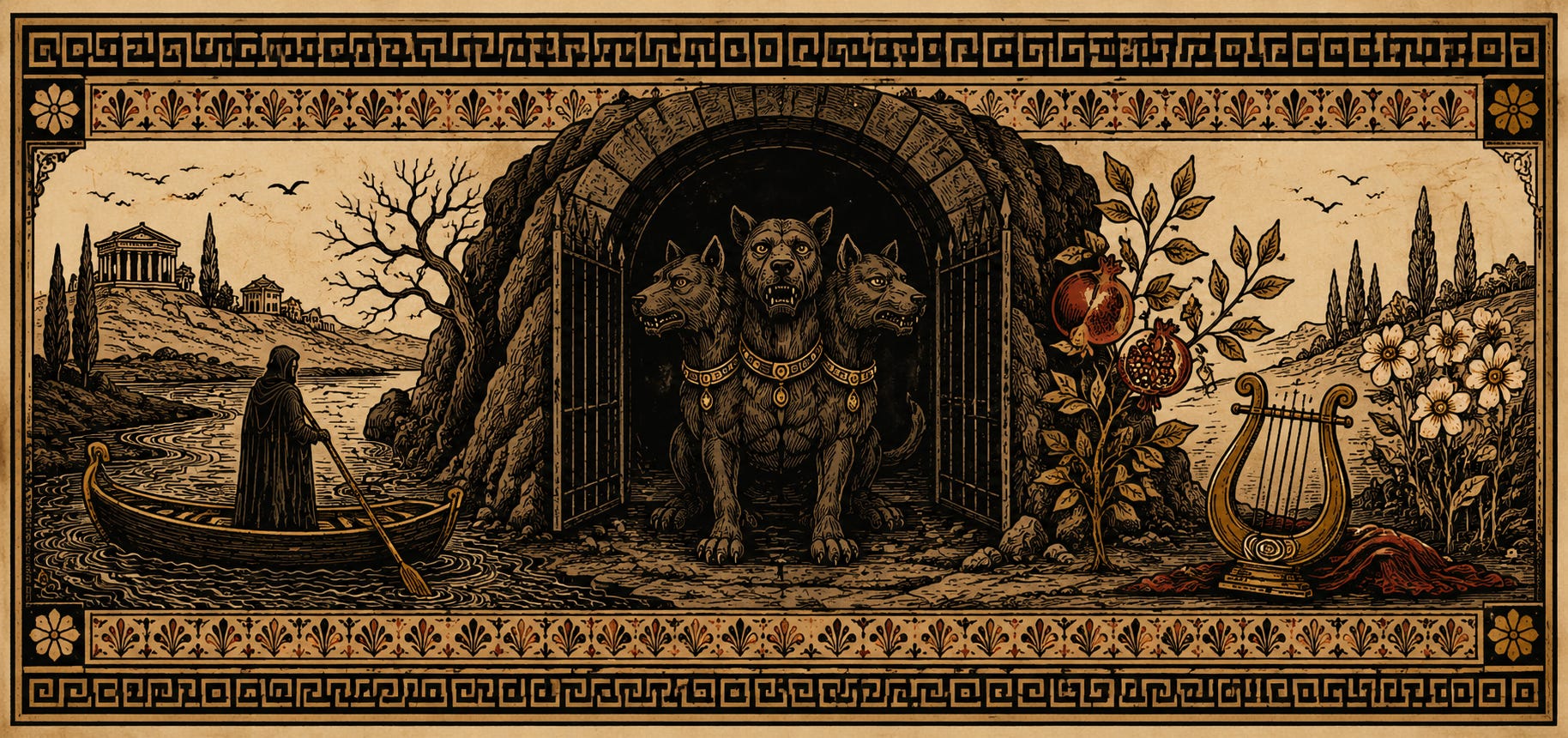
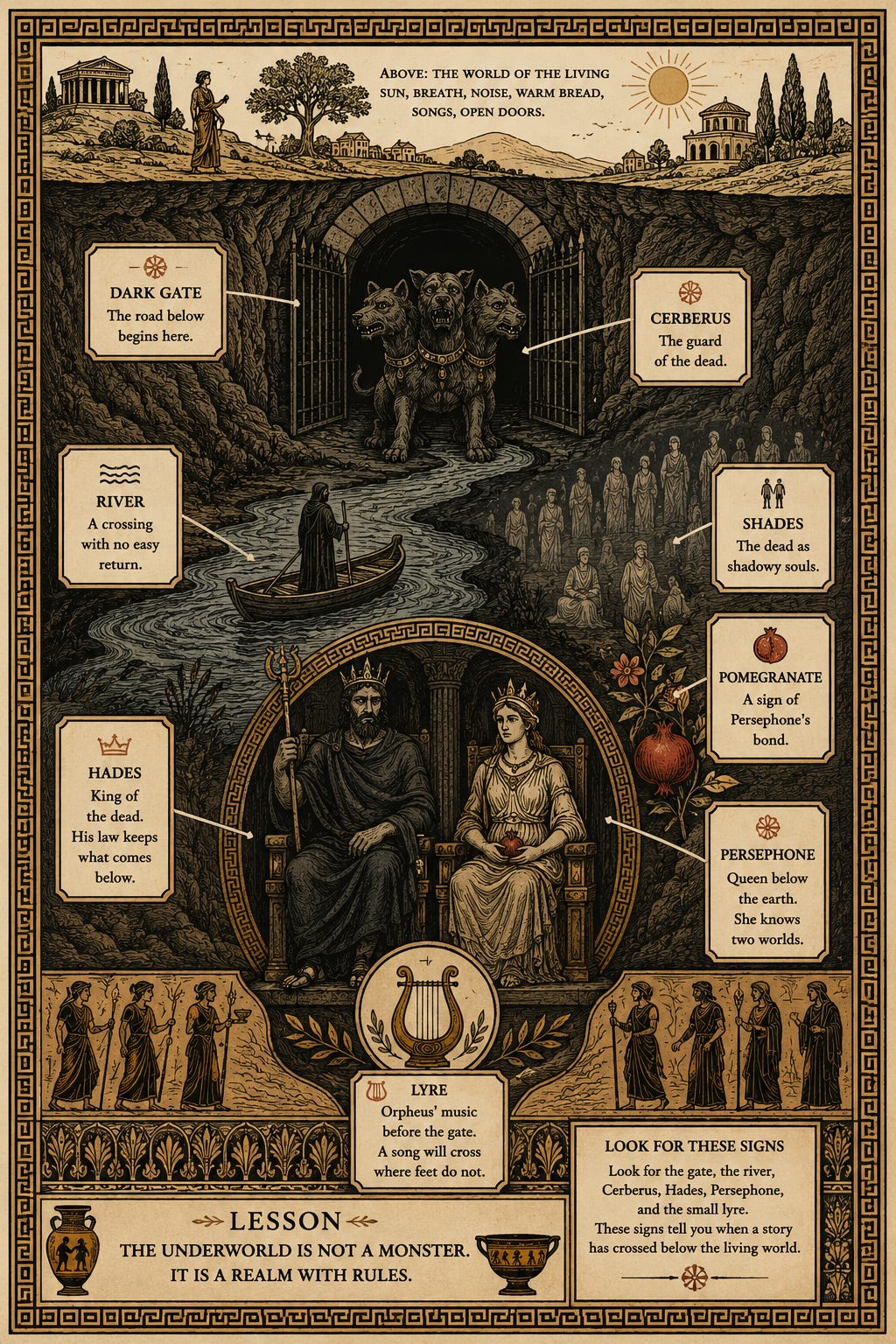
It lies beneath the world of the living. Hades rules there as king, and Persephone sits beside him as queen. The dead become shades: shadowy souls of the people they once were. Rivers mark the way. Gates divide the living from the dead. Cerberus, the great guard dog, watches the entrance.
Most people who enter the Underworld do not come back.
That is why every story of someone going down while still alive feels dangerous.
A living person is not simply travelling to another kingdom. A living person is crossing one of the oldest borders in the world.
What You Need to Know Before the Story
The Underworld belongs below.
Not below like a cellar under a house. Not below like a hole dug in a field. Below in the older, stranger sense: beneath the bright world of sun, breath, harvest, noise, running feet, warm bread, barking dogs, quarrels, songs, and open doors.
Above are the living.
Below are the dead.
Between them are rules.
Greek myth does not always explain these rules gently. The gods themselves are not always gentle, as you may have noticed by now. But the Underworld has a kind of order. It is not wild in the way the sea is wild. It is not stormy like Poseidon’s anger, or bright like Apollo’s arrows, or full of sudden cleverness like Hermes on a road.
The Underworld is still.
It keeps what has come to it.
Hades
Hades is the king of the Underworld.
This does not mean he is the devil. Greek myth does not make him that. Hades is stern, hidden, wealthy, and difficult to persuade. His name is sometimes avoided, because people did not like to call too loudly upon the god who ruled the dead.
That is understandable.
Compared with some gods, Hades is almost restrained. He does not often burst into the upper world with thunder, quarrels, disguises, or demands for admiration.
But restraint is not softness.
His kingdom depends upon one great law: the dead belong below.
So when someone living comes to his gates and asks for the dead to be returned, the request is not small. It asks Hades to loosen the order of his own realm.
No king likes that.
A king of the dead likes it least of all.
Persephone
Persephone is queen of the Underworld.
This is important. The Underworld is not only Hades’ dark hall. Persephone belongs there too, though not all year. Her story is bound to her mother Demeter, to the earth’s growing and resting, and to the pomegranate seeds that tied her to the realm below.
A pomegranate is a beautiful fruit. It is also a dangerous fruit in Greek myth.
Its red seeds look like little jewels. They can also be a bond.
That is the sort of thing Greek myth does very well. It takes something lovely and makes you careful around it.
Persephone changes the Underworld because she belongs to two worlds.
She knows flowers and darkness. She knows her mother’s grief and her husband’s throne. She knows the first green return of spring, and she knows the still halls below the earth.
So when Orpheus sings, he does not sing only before death’s king.
He sings before the queen who knows what return costs.
That matters.
Cerberus
At the gate of the Underworld stands Cerberus.
Cerberus is a great dog, usually said to have three heads. He is not there to chase the dead away. The dead are allowed in.
That is not the problem.
Cerberus guards the other direction.
He keeps the dead from leaving, and he reminds the living that they have come to a place where they do not belong.
A three-headed dog at the gate is a very clear sign. Greek myth is sometimes subtle, but not always. Sometimes it simply puts an enormous impossible animal in front of a door and expects you to understand.
Cerberus means: this is the threshold.
Cerberus means: think carefully before you go further.
Cerberus means: the road down is easier than the road back.
The Rivers Below
The Underworld has rivers.
Different stories name them in different ways, but the important thing for a child to know is this: rivers in the Underworld are not there for scenery. They mark crossings.
One river may be the river of sorrow. Another may be the river of forgetting. Another may be the terrible Styx, by which even gods swear oaths.
A river is already a boundary in the living world. You cannot cross it by accident. You must find a bridge, a ford, a boat, or someone willing to carry you.
In the Underworld, that becomes stranger.
To cross the river is to pass further from the living world. It is to move where ordinary feet do not go. It is to be carried from one condition into another.
That is why some stories remember a ferryman: a silent figure with a boat, an oar, and no need for cheerful conversation.
This is not the sort of journey where people ask, “Are we nearly there?”
They already know the answer is serious.
Shades
The dead in the Underworld are often called shades.
A shade is not quite the person as they were in life. It is the shadow-soul, the thin remaining shape of someone who once walked in the sunlight.
This can feel sad, and it should feel sad.
But for this entry, you do not need to be trapped in sadness. You only need to understand the strangeness. In Greek myth, death is not usually pictured as a cosy sleep or a bright happy ending. It is a going-below, a becoming-shadow, a dwelling in the realm where mortal life has finished.
That is why Orpheus’ journey is so astonishing.
He does not go down because he wants treasure. He does not go down to prove he is brave. He does not go down because a king has ordered him, or because a monster must be fought, or because a golden prize is waiting.
He goes because someone he loves is there.
The Underworld is not moved easily by love.
But Greek myth is willing to ask what might happen if love came singing.
The Signs to Watch For
When you see the Underworld in a Greek myth, look for its signs.
Look for the dark gate.
A gate means there is a boundary. It means one world is ending and another begins.
Look for Cerberus.
The guard dog tells you this is not an ordinary road. The living may enter only in rare and dangerous stories.
Look for the river.
A river below the earth is not just water. It is a crossing between life and death, memory and forgetting, return and no return.
Look for Hades.
He is the hidden king, not a villain to be defeated, but a ruler whose kingdom has laws.
Look for Persephone.
She is the queen below, and her presence reminds us that the Underworld is not only darkness. It is also part of the old order of seasons, seeds, loss, and return.
Look for the pomegranate.
It is beautiful. It is also binding.
Look for pale flowers, dim fields, and quiet crowds of shades.
These are signs that the story has moved beyond ordinary danger. A sword may not be enough here. Strength may not be enough. Cleverness may not be enough.
And in one story, a lyre will be carried toward the gate.
That is Orpheus’ sign.
Living Visitors
Most living people do not enter the Underworld.
That is sensible of them.
But Greek myth remembers a few who went near it, into it, or to its very edge.
Heracles went down and brought Cerberus up as one of his labours. This is exactly the sort of thing Heracles would be asked to do, because if there is a terrifying impossible task somewhere, sooner or later someone will decide that Heracles should try it.
Odysseus spoke with the dead on his long road home. He needed knowledge, and knowledge in Greek myth often waits in uncomfortable places.
Theseus once tried to enter the Underworld for a foolish and dangerous purpose, and the story did not reward him for it.
And Orpheus went down with no weapon in his hand.
Only music.
That is worth noticing.
The living do not go below casually. When a living person enters the Underworld, the story is telling you that the boundary of the world has been tested.
Sometimes by strength.
Sometimes by pride.
Sometimes by need.
Sometimes by love.
Why This Matters Before Orpheus
When you read Orpheus and the Underworld, remember this: Orpheus is not walking into a gloomy room. He is not entering a monster’s cave. He is not taking a shortcut through a dark wood.
He is going below the world.
He is going where the dead belong.
He is going to the kingdom of Hades and Persephone, past the signs of no easy return, toward the place where human wanting usually has no power.
That makes his music stranger.
Orpheus sings where songs should not matter.
He sings where the dead have already crossed.
He sings before the king who keeps them, and the queen who knows what it means to return.
That is why the story is not really asking whether Orpheus can sing beautifully.
Everyone knows he can.
It is asking whether beauty can move a law.
This does not mean the story will become simple. Greek myth rarely rewards anyone for thinking that beauty can make the laws of the world disappear. But it does mean the story can ask one of its deepest questions:
Can music open a door that strength cannot move?
Before the Tale, that is enough to know.
The Underworld has gates.
It has rivers.
It has rulers.
It has a guard.
It has laws.
And Orpheus is going down with a lyre.
One Thing to Remember
The Underworld is frightening because it is not a monster to defeat.
It is a law to cross.