
The Trojan War
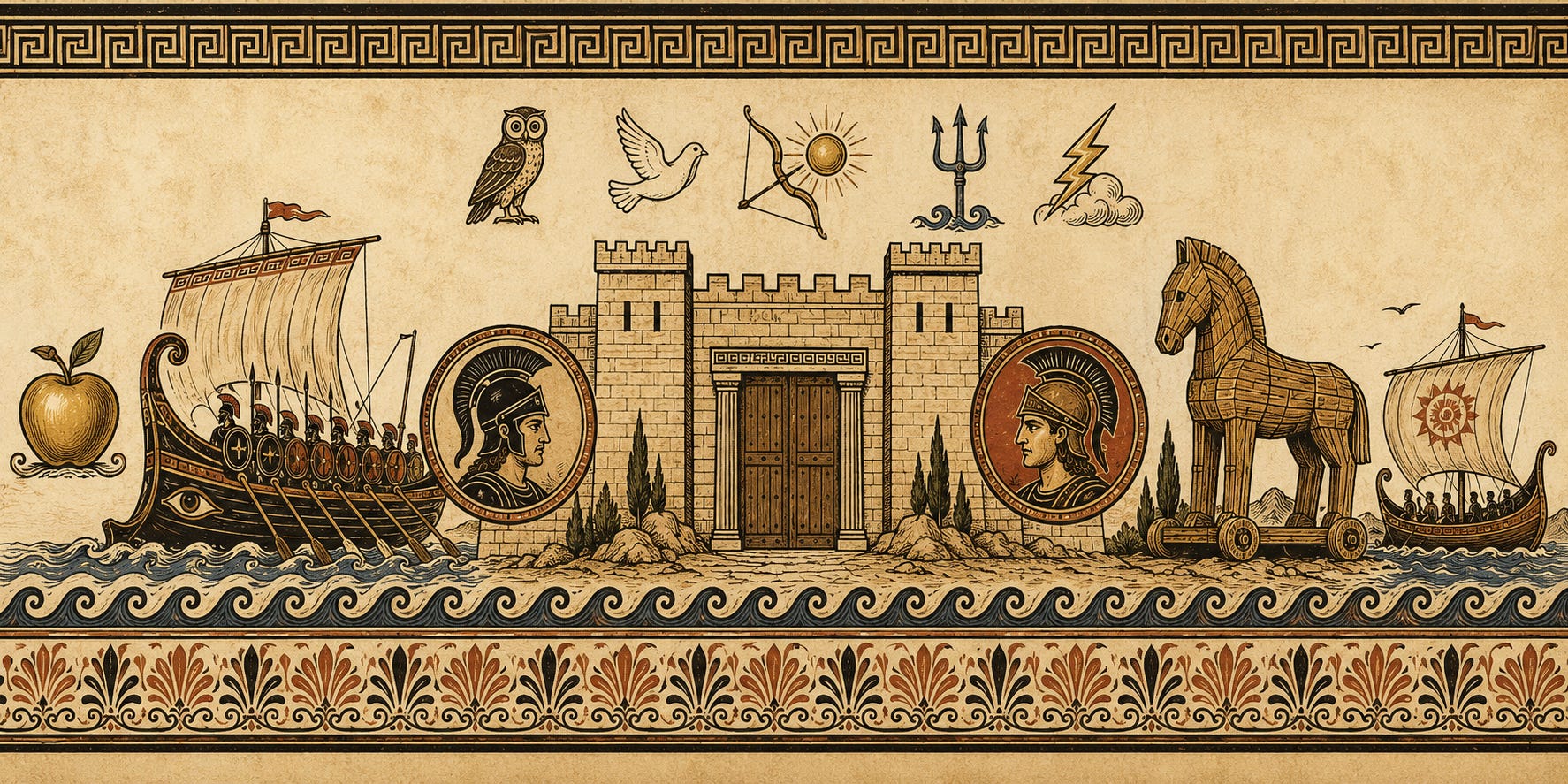
The apple, the ships, the walls, the heroes, the wooden horse—and the long roads home.

After the Tale
Paris has made his choice.
Aphrodite has received the golden apple. Hera and Athena have received an insult, which is not at all the same thing, although it may last considerably longer.
But wars do not spring fully armed from pieces of fruit.
Between the apple and the walls of Troy lie a promise, a marriage, a voyage across the sea, wounded pride, old oaths, powerful kings—and many moments when someone might have stopped what was coming.
No one did.
The quarrel that began among three goddesses would become the greatest war in Greek myth.
The Short Answer
The Trojan War was fought between the Greeks and the people of Troy, a rich city protected by high walls.
Paris was a prince of Troy. Aphrodite had promised him the most beautiful woman in the world because he had declared her the fairest goddess.
That woman was Helen, queen of Sparta.
The difficulty—one of several difficulties Aphrodite had not troubled to mention—was that Helen already had a husband, a home and a life of her own.
Her husband was Menelaus, king of Sparta.
When Paris brought Helen to Troy, Menelaus called upon the other Greek kings to help him bring her back. His brother Agamemnon gathered a great fleet, and the Greeks sailed across the sea.
They surrounded Troy.
The city would not fall.
The stories say the war lasted ten years.
In the end, Troy was defeated not by a stronger weapon, but by a wooden horse and a clever plan.
How the Quarrel Became a War
It began at a wedding.
Eris, the goddess of strife, had not been invited. She came anyway and threw a golden apple among the guests.
Upon it were the words:
FOR THE FAIREST
Hera, Athena and Aphrodite each claimed it.
Zeus was powerful enough to rule the gods but sensible enough not to choose between three angry goddesses. He sent the decision to Paris, a young Trojan prince living on the slopes of Mount Ida.
Each goddess offered Paris a reward.
Hera offered kingship.
Athena offered wisdom and victory.
Aphrodite offered the most beautiful woman in the world.
Paris chose Aphrodite.
The woman she had promised was Helen.
Long before this, many kings and princes had wished to marry Helen. Her family feared that whichever man she chose, the others might begin a war. The suitors were therefore made to swear an oath: they would defend Helen’s marriage and support the man chosen to be her husband.
Helen married Menelaus.
The oath was remembered when Paris came to Sparta and returned to Troy with her.
The old stories differ over whether Helen went willingly. They agree on one thing: the promise was made without asking her.
Menelaus called upon the oath.
The rulers of Greece gathered their ships.
Some came from loyalty. Some came because they had promised. Some came for honour. Some came because great wars attract people who imagine that glory will belong to them and suffering to someone else.
Agamemnon, Menelaus’s powerful brother, became leader of the Greek force.
The sea filled with sails.
Troy closed its gates.
The war began.
Two Sides of the Wall
The Trojan War is not a story of good people fighting bad people.
There is courage on both sides of the wall.
There is also loyalty, love, anger, pride, foolishness and cruelty on both sides.
Inside Troy
Priam is the ageing king of Troy. He has ruled the city for many years. Now he must watch his children defend it.
Hector, one of Priam’s sons, is Troy’s greatest warrior. He is also a husband to Andromache and a father to their small son. Hector fights because the war has reached his home.
Paris is Hector’s younger brother. His choice helped bring the war to Troy, but he is not the warrior Hector is. He can be brave, vain, frightened and reckless—sometimes within a very short space of time.
Helen lives inside the city while two armies argue over what should happen to her. She sees what the war is costing, but she has little power to stop it.
Cassandra, Priam’s daughter, can see what is coming. She has also been cursed so that no one believes her. This is an especially unhelpful combination of gifts.
Among the Greeks
Agamemnon commands the Greek army. He is powerful, proud and accustomed to being obeyed, including on occasions when obedience is the last thing he deserves.
Menelaus is Helen’s husband. The war is fought in his name, although it soon grows far beyond one man’s marriage.
Achilles is the greatest Greek fighter. He is swift, nearly unbeatable and very difficult to command. His anger becomes one of the most important stories within the war.
Odysseus is king of Ithaca. He is not the strongest man at Troy, but he may be the cleverest. When strength fails, people begin looking towards Odysseus.
Around them stand many others: Ajax with his enormous shield, Patroclus beside Achilles, Diomedes daring enough to wound gods, and Aeneas, another defender of Troy whose story continues after the city falls.
Earlier Tales have given us monsters in caves, monsters beside roads and monsters breathing fire.
At Troy, the people on the other side are people too.
That is what makes this war harder.
The Gods Choose Sides
The quarrel among the goddesses does not end when Paris gives away the apple.
Hera and Athena remember that he rejected them. They favour the Greeks.
Aphrodite protects Paris and Helen.
Apollo often stands beside Troy. Poseidon often helps the Greeks. Other gods carry messages, hide warriors, turn weapons aside, send panic and rescue their favourites from dangers those favourites have usually helped to create.
Zeus sits above them all, trying to preserve his authority while nearly every member of his family chooses a side.
The gods could have used their power to shorten the war.
Being Greek gods, they more often use it to make the war larger.
But the gods do not make every choice.
A goddess may offer a reward.
Someone must still accept it.
A god may give a warrior strength.
The warrior must still decide where to strike.
The War in Seven Signs
The Trojan War contains more names and adventures than anyone should be expected to remember at once.
It is easier to begin with seven signs.
1. The Apple
The golden apple does not create jealousy, pride or rivalry.
It gives them a shape.
Once the goddesses begin asking who is fairest, someone must win and someone must lose. Paris’s decision carries their quarrel into the mortal world.
2. The Promise
Aphrodite promises Helen to Paris.
The promise is powerful because it comes from a goddess.
It is dangerous because Helen is treated as though her life were something a goddess could give away.
Many troubles in Greek myth begin when divine gifts arrive in human homes without considering the people already living there.
3. The Ships
The Greeks do not send one warrior to Troy.
They send a fleet.
Kings, soldiers, sailors, horses, weapons, food and tents cross the sea together. The ships show that the quarrel has become larger than Paris, Helen or Menelaus.
A whole world has begun to move.
4. The Walls
Troy’s walls are among the greatest signs of the war.
The Greeks can defeat warriors outside the city. They can raid nearby towns. They can challenge Trojan champions.
But they cannot break the walls.
Year after year, Troy remains standing behind its gates.
The walls turn a voyage into a long absence from home.
5. The Two Heroes
Achilles is the greatest fighter among the Greeks.
Hector is the greatest defender of Troy.
Achilles fights for honour, loyalty and the fierce demands of his own nature.
Hector fights because his parents, wife, child and city stand behind him.
Their meeting becomes one of the central moments of the war.
But neither man is the whole story.
The war is larger than both of them, and it will continue after one has killed the other.
6. The Horse
After ten years, strength has failed.
The walls still stand.
The Greeks therefore turn to cunning.
They build an enormous wooden horse.
What happens next belongs to another Tale, because a wooden horse large enough to hold a secret deserves more than a few hurried sentences.
For now, remember this:
Troy is not conquered because the Greeks become stronger.
It is conquered because Troy is persuaded to open its own gates.
7. The Returning Ships
When Troy falls, the Greek leaders have still not reached the end of their stories.
They must sail home.
Some return quickly.
Some meet storms, angered gods and households changed by ten years of absence.
Some never return at all.
The Greeks win the war.
That does not mean they escape its consequences.
The Iliad Is Not the Whole War
A child opening Homer’s Iliad and expecting the golden apple or the wooden horse may be surprised.
Neither is there.
The Iliad begins after the war has already lasted for years. Achilles is angry with Agamemnon and refuses to fight. That anger spreads through the Greek army and changes the lives of Hector, Patroclus, Priam and many others.
The poem ends with Hector’s funeral.
Troy is still standing.
Achilles is still alive.
The wooden horse has not yet been built.
Homer does not try to tell every story of Troy. He chooses one wound inside the war and shows how far it spreads.
Other ancient poems told the beginning of the war, the death of Achilles, the building of the horse, the fall of Troy and the journeys home.
Many of those poems have been lost.
Their stories survived because people kept telling them.
How Troy Fell
For ten years, the Greeks camp outside Troy.
They fight.
They wait.
They quarrel.
They lose friends and continue fighting.
The city remains behind its walls.
At last, Odysseus helps devise another kind of attack.
The Greeks build an enormous wooden horse and leave it outside Troy. Their camp is deserted. Their ships seem to have sailed away.
The Trojans find the horse.
Some believe it is a gift.
Some believe it is a trap.
Cassandra warns them.
She is not believed.
The Trojans bring the horse inside the city.
That night, the trick opens what ten years of fighting could not.
Troy falls.
Fires rise behind the walls. Families are divided, and many people who survived the long siege do not receive the ending they deserved.
The Greeks have won.
There is very little joy in the victory.
The Roads Home
The fall of Troy ends the siege.
It does not end the story.
The surviving Greeks must cross the sea again, and the gods have not finished with them.
Menelaus wanders before reaching Sparta.
Agamemnon returns to a household filled with old anger and new danger.
Some ships are lost.
Some leaders never see home again.
Odysseus’s voyage lasts another ten years.
He meets storms, monsters, giants, enchantments, strange islands and temptations strong enough to make a weary traveller forget what he once wanted.
His journey becomes the greatest of the homecoming stories.
The Greeks called these return-stories the nostoi.
Some warriors find their doors still open.
Some find strangers waiting.
Some discover that returning is not the same thing as restoring what was lost.
A person may cross the sea, survive a war and sail back to the same shore.
That does not mean the same person has returned.
Why This Matters in the Tales
The Trojan War is too large for one Tale.
It contains stories that must be entered separately.
There is the story of Achilles, who is offered a choice between a long quiet life and a short life remembered for ever.
There is the story of Hector, who knows what may happen to Troy and goes out to defend it anyway.
There is the story of the wooden horse, when the Greeks finally understand that belief may open a gate that strength cannot.
There is the story of Odysseus, who helps end the war and then discovers that cleverness cannot make the sea release him quickly.
There are stories of Cassandra, Helen, Priam, Andromache, Aeneas, Ajax, Agamemnon and many more.
Paris and the Golden Apple opens the doorway.
The Trojan War shows how large the world is beyond it.
One Thing to Remember
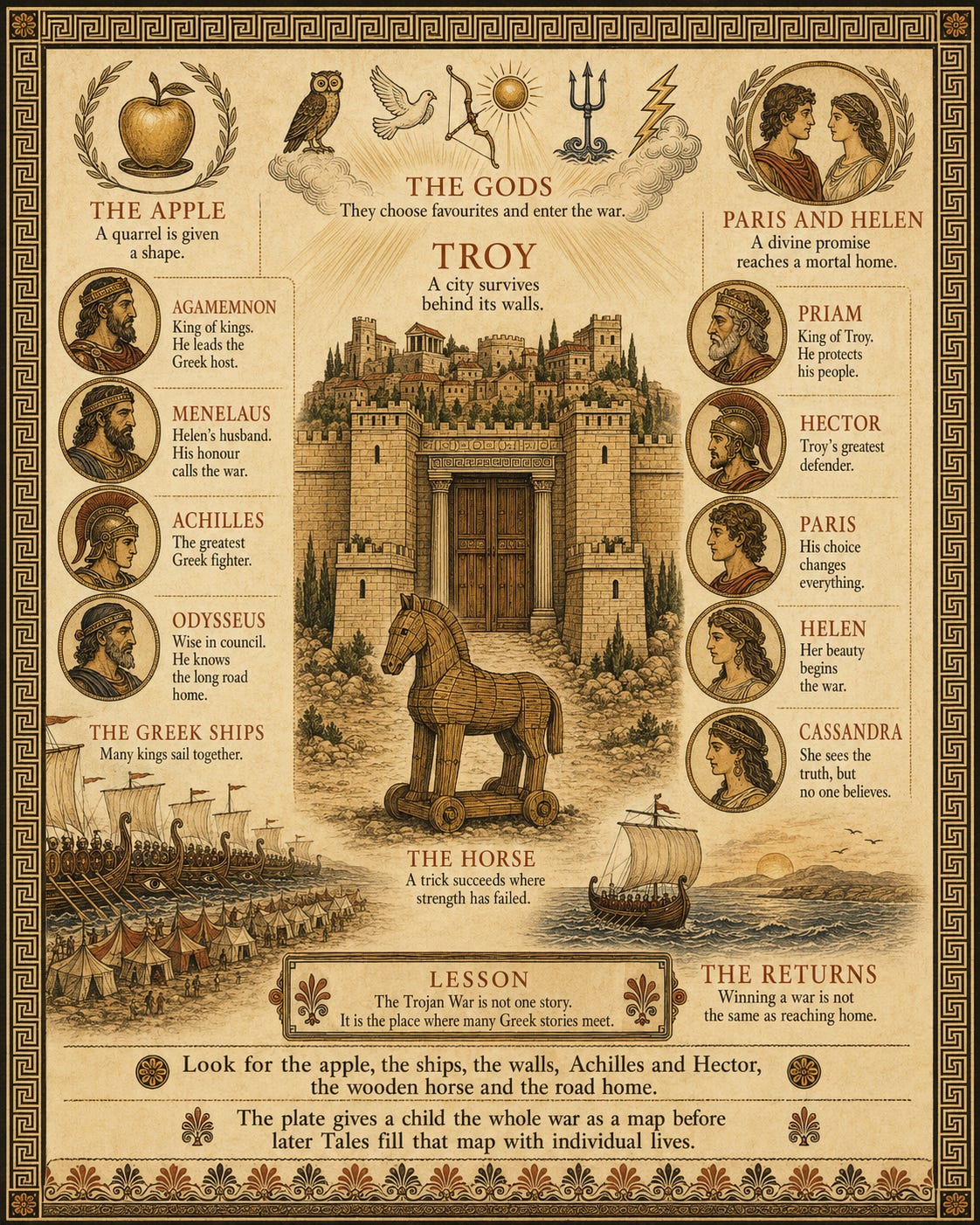
The Trojan War is not one story.
It is the place where many Greek stories meet: the apple, the ships, the walls, Achilles and Hector, the wooden horse and the long roads home.
The war ends at Troy. Its stories do not.