
The Nemean Lion
After Heracles faces the lion, a child-readable guide to the monster no weapon could pierce — and the skin that became Heracles’ first great sign.

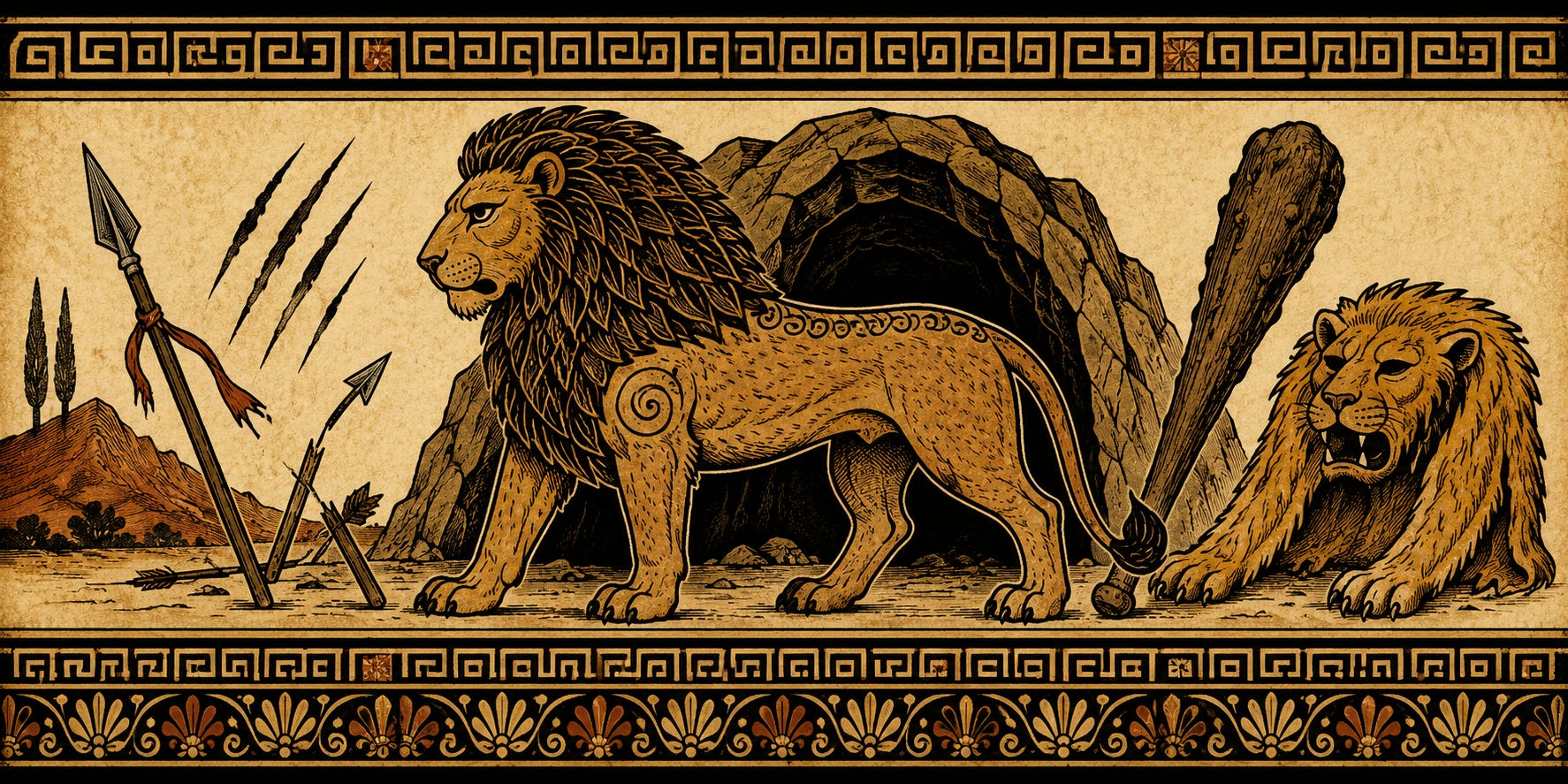
Now that Heracles has gone into the cave and come out again, we can turn back and look more closely at the thing waiting there.
The Nemean Lion was not frightening because it was simply large. Greek myth has plenty of large things: giants, sea monsters, horses no sensible person would try to bridle.
The Nemean Lion was frightening because it changed the rules.
Its hide could not be pierced.
Spears did not work.
Arrows did not work.
Swords did not work.
That meant the usual distance between hero and monster disappeared. A hunter could not stand safely away and send death flying through the air. A warrior could not trust the good bronze edge of a blade. A brave person could not simply strike hard enough and hope.
The lion made courage come close.
The Short Answer
The Nemean Lion was a terrible lion that lived near Nemea, in the northeastern part of the Peloponnese. In Greek myth, it was no ordinary animal. Its claws, teeth, strength, and size were dreadful enough, but its most famous power was its unpierceable hide.
No ordinary weapon could cut it.
Heracles was sent to defeat the lion as the first of his great labours. This mattered. The first labour had to show what kind of hero he was going to be. Not only strong. Not only brave. Not only larger than other men, though he certainly was that too.
Heracles had to meet a danger that did not yield to ordinary answers.
The Nemean Lion became the first impossible thing he overcame.
What the Tale Showed You
In the Tale, the lion is not merely a beast in the hills. It is pressure. It is the fear that has settled over a place and made ordinary life smaller.
A field is no longer simply a field if people are afraid to cross it.
A path is no longer simply a path if something waits beyond the bend.
A cave is no longer simply a cave if it has become the mouth of a monster’s world.
That is what the Nemean Lion does in the story. It changes the land around it. It makes farmers, travellers, hunters, and families remember that not every danger can be reasoned with, avoided, or tidied away.
Then Heracles comes.
At first, he brings what heroes usually bring: weapons. Bow, arrows, sword, strength, confidence. These are not foolish things to bring. In many stories, they would be enough.
But the Nemean Lion is the kind of monster that teaches the hero the rules have changed.
The arrows fail.
The blade fails.
The distance fails.
So Heracles has to enter the cave.
That is the important part.
He does not defeat the lion from a safe place. He does not solve the danger from outside it. He goes where the lion is strongest, where the shadows are close, where there is little room to move, and where courage cannot look grand because there is no one there to admire it.
Some monsters make a hero famous where everyone can see.
The Nemean Lion tests him where no one can admire him.
Why the Hide Matters
The lion’s hide is the part children remember first, and rightly so.
An unpierceable hide is a simple idea. A child can understand it at once. Nothing goes through. Nothing cuts. Nothing works.
But simple ideas in myth are often doors into deeper things.
The hide means that ordinary force has reached its limit. It means the hero cannot solve the problem by doing the expected thing harder. It means Heracles has to discover another kind of strength: strength that can stay near danger when the first plan has failed.
That is why the lion skin matters after the labour is over.
When Heracles wears the hide, he is not merely wearing a trophy. He is wearing the memory of the first impossible thing that closed around him and did not win.
The skin says, without words:
This hero has already met something no weapon could pierce.
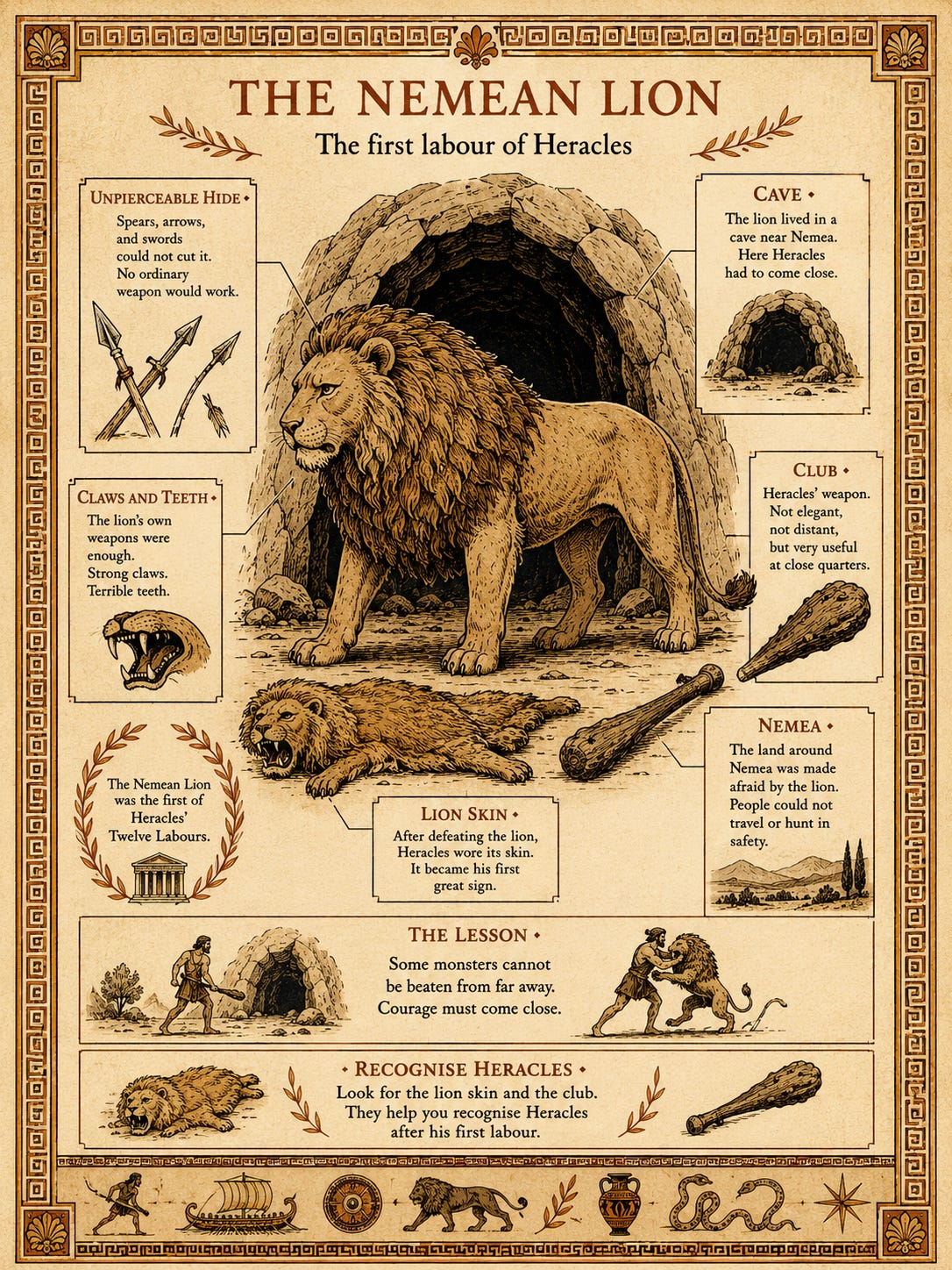
In later art and stories, Heracles is often recognised by this lion skin. It may be draped over his shoulders, tied around him, or worn over his head, with the lion’s jaws forming a kind of terrible hood. Beside it, he often carries a club.
The club and the lion skin together make a kind of picture-language.
The club says: strength.
The lion skin says: impossible danger survived.
Together they say: Heracles.
What Else the Myths Say
The Nemean Lion is usually counted as the first of Heracles’ Twelve Labours.
The labours were a series of almost impossible tasks set for Heracles by King Eurystheus. Some involved monsters. Some involved strange creatures. Some involved journeys, cleverness, patience, and the unpleasant discovery that strength alone does not make the world obedient.
The Nemean Lion came first because it established the pattern.
Heracles would not be given comfortable tasks. He would not be asked to do things anyone sensible would choose. Again and again, he would be sent toward danger, strangeness, and impossible pressure.
The first labour gave him something else too: his most famous visual sign.
Before the lion, Heracles is already strong.
After the lion, he is recognisable.
The skin becomes part of how the old world remembers him. If you see a mighty hero with a lion skin and a club in Greek art, you are almost certainly looking at Heracles.
That is one of the useful things about Greek myth. It gives you signs to notice.
Athena has her owl and shield.
Poseidon has his trident.
Hermes has his winged sandals.
Heracles has the lion skin and the club.
Once you know the signs, the old pictures begin to speak more clearly.
Signs and Symbols
Lion Skin
Heracles’ first great sign. It remembers the monster no weapon could pierce.
Unpierceable Hide
The impossible surface. Spears, arrows, and swords could not cut it.
Cave
The place where distance disappears. Heracles has to meet the danger close.
Club
Strength made plain. Not elegant, not distant, not delicate — but very useful.
Claws and Teeth
The lion’s natural weapons. No sword needed. The monster carries its danger in its own body.
Nemea
The place made afraid by the lion, and the name by which the monster is remembered.
Why This Matters Later
The Nemean Lion matters because it teaches you how to recognise Heracles.
Not just by his size.
Not just by his strength.
Not just because people say his name loudly.
You recognise him by the signs he carries.
The lion skin is not decoration. It is memory. It tells you that this hero has already entered the dark and come back wearing what frightened him.
That does not mean Heracles is always wise. He is not. It does not mean he is always gentle. He is not. It does not mean strength will save him from every sorrow. Greek myth is rarely that tidy.
But it does mean that when the old stories place the lion skin on his shoulders, they are telling you what kind of pressure began his road.
The first labour was not a puzzle.
It was not a trick.
It was not a race.
It was a monster no weapon could pierce, waiting in a cave.
And Heracles went in.
One Thing to Remember
The Nemean Lion was the monster no weapon could pierce.
Heracles went into its cave as a strong man.
He came out carrying the sign by which the old world would remember him.