
The Labyrinth
Before Daedalus makes wings, a child should understand the house of turns he built first.

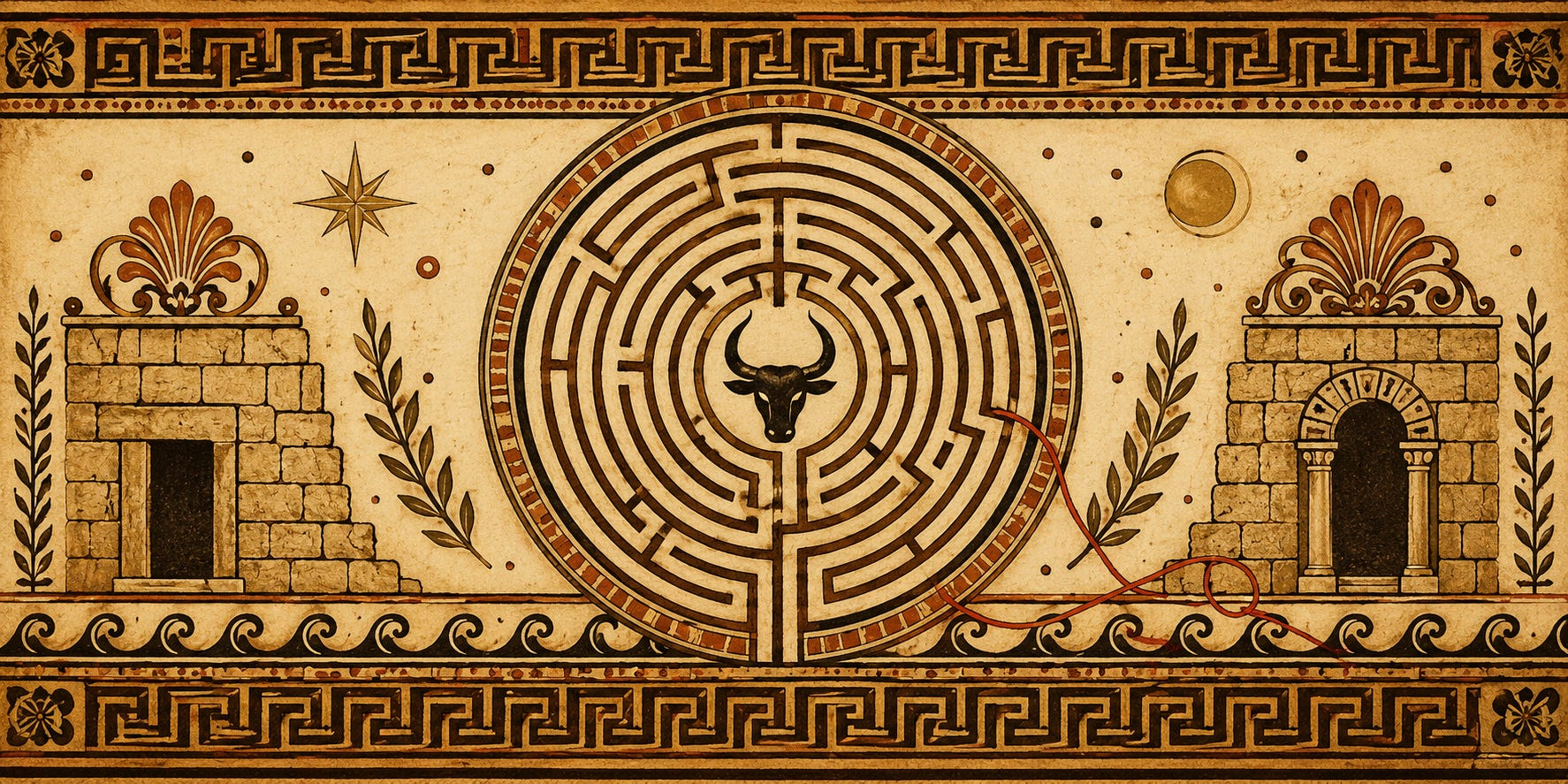
Before the Tale
Before Daedalus made wings, he made something darker.
He made a house of turns.
Not a house for sleeping. Not a palace for feasting. Not a bright hall where people came and went through open doors.
The Labyrinth was built to confuse the feet, trouble the mind, and make return almost impossible. It was a place of passages, blind corners, circling ways, and walls that seemed to know more than the person walking between them.
At the centre waited the Minotaur.
That is why, before we come to Daedalus and the wings, we must first understand the Labyrinth.
For Daedalus was not only the man clever enough to escape Crete.
He was the man clever enough to build the prison.
The Short Answer
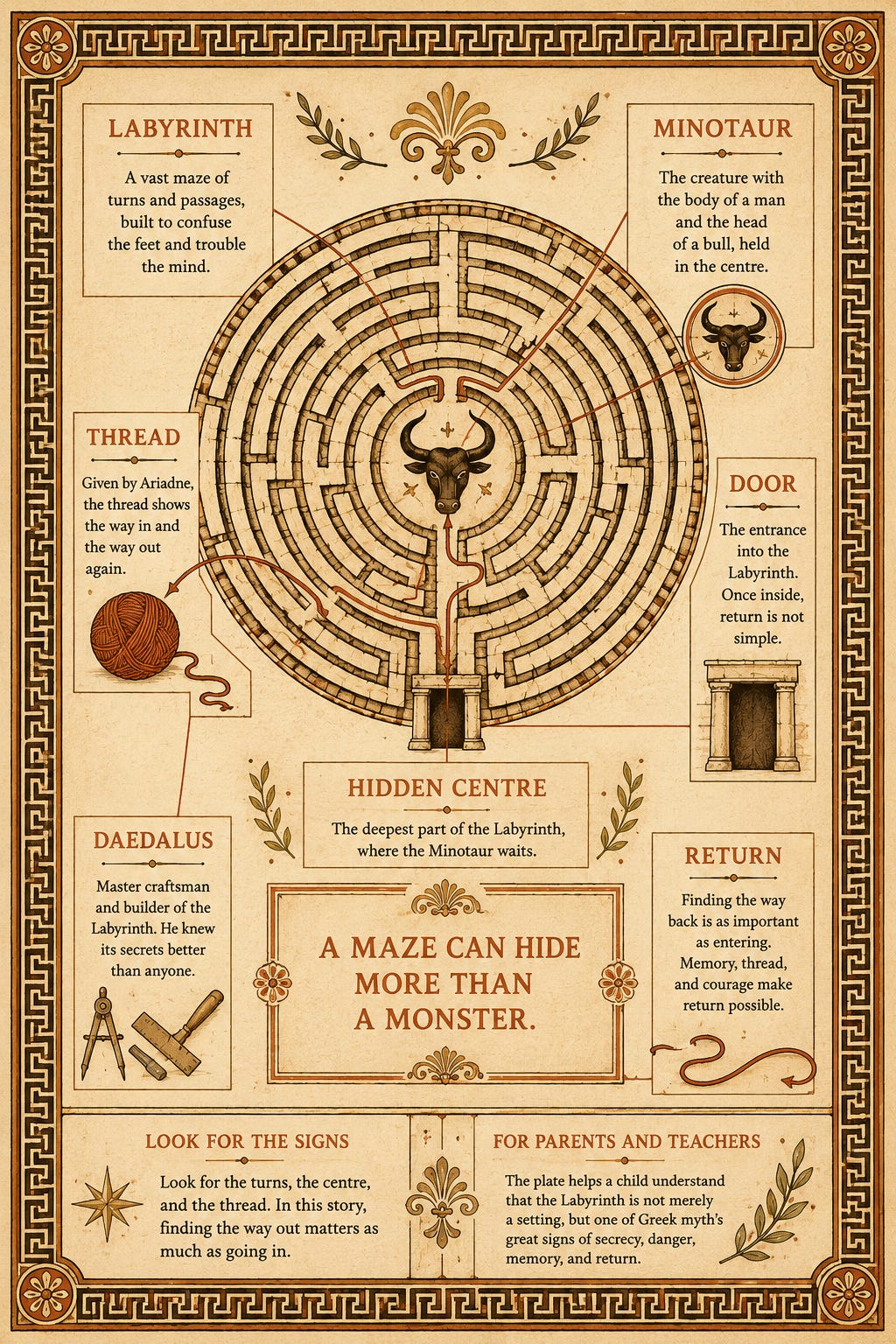
The Labyrinth was the great maze of Crete, built by Daedalus for King Minos.
It was made to hold the Minotaur, the strange and frightening creature with the body of a man and the head of a bull. No ordinary prison would do for such a being. A locked room could be broken. A gate could be opened. A guard could fall asleep, as guards in stories have a habit of doing at the worst possible moment.
Minos needed something more terrible than a cage.
He needed a place where even if the prisoner moved, he would not truly escape.
So Daedalus built the Labyrinth.
What You Need to Know Before the Story
King Minos ruled Crete.
Crete was an island, and Minos was powerful enough to make other people afraid of him. In the old stories, powerful kings are often dangerous not only because they command armies, but because they can order other people to build what they themselves should never have wanted.
Minos had a secret in his house.
That secret was the Minotaur.
The Minotaur was not simply a monster wandering in the wild. He belonged to the royal story of Crete. He was part of the shame of Minos’s house, and Minos did what kings often do when they cannot bear the sight of what has happened.
He hid it.
But some things cannot be hidden by curtains, locked chests, or a guard at the door.
Some things need stone.
So Minos called for Daedalus.
Daedalus was the greatest craftsman of his age. He understood wood, bronze, stone, tools, balance, joints, doors, hinges, walls, and the secret behaviour of objects. He could imagine things other people could not imagine, and then — which is the more dangerous gift — he could make them real.
If something difficult had to be built, people thought of Daedalus.
If something impossible had to be built, they thought of him first.
So when Minos needed a prison that was more than a prison, Daedalus gave him the Labyrinth.
What Kind of Place It Was
A maze and a labyrinth are not always the same thing.
A maze is something you might enter for a challenge. You turn left, turn right, make mistakes, laugh, grumble, try again, and at last find the way out.
The Labyrinth of Crete was not like that.
No one entered it for fun.
It was built to defeat memory.
Imagine walking through a stone passage and thinking, I will remember this turn. Then another turn comes. Then another. Then a corridor bends back upon itself. Then the wall you trusted leads you somewhere you have already been, or somewhere that only seems familiar.
The light changes.
The air thickens.
Every doorway begins to look like a trick.
After a while, the mind becomes less certain than the feet.
That is the real terror of the Labyrinth.
It does not merely shut a person in.
It persuades them that they no longer know how to leave.
At the centre was the Minotaur.
But the centre was not the only danger. The way itself was dangerous. The turns were dangerous. The forgetting was dangerous.
A sword might help against a monster, if you were brave and strong enough to use it.
A sword could not remember the way back.
That is why Ariadne’s thread mattered so much in the tale of Theseus. A thread is a small thing. It cannot fight. It cannot roar. It cannot open a stone wall. But it can do one thing courage cannot always do by itself.
It can remember.
Why Daedalus Matters
Daedalus built the Labyrinth so well that almost no one could escape it.
That tells us something important about him.
He was not merely clever.
He was dangerously clever.
There are people in stories who are strong enough to break a door. There are people brave enough to walk into the dark. There are people swift enough to outrun danger, and people bold enough to face a monster.
Daedalus belonged to a different kind.
He was the kind of person who could look at a problem and change the shape of it.
Minos had a monster.
Daedalus gave the monster walls.
Minos had shame.
Daedalus gave the shame corridors.
This does not mean Daedalus was wicked in the simple way monsters are sometimes wicked. Greek myth is rarely so tidy. Daedalus was a maker. Makers are complicated people in the old stories. They can build ships, shields, toys, traps, temples, statues, doors, wings, and wonders. They can help heroes. They can serve kings. They can make beauty. They can make danger.
Sometimes they do all of those things in the same life.
That is why Daedalus is so interesting.
His hands are brilliant.
But brilliance is not the same as freedom.
Signs to Watch For
When you meet the Labyrinth in Greek myth, watch for these signs.
Turns
The Labyrinth is made of wrong ways, circling ways, and passages that make the walker doubt their own memory.
The Hidden Centre
Something is always waiting at the centre. In Crete, it is the Minotaur.
Bull Horns
The bull belongs to the story of the Minotaur. Horns are a sign of the creature hidden within.
Stone Walls
The Labyrinth is not a forest or a cave. It is made by human hands, which makes it stranger.
Thread
A thread is small, but in this story it becomes the difference between entering and returning.
Daedalus
Where the Labyrinth appears, remember the maker. Someone imagined the prison before anyone was lost inside it.
Return
The most important question in a labyrinth is not only, “Can you enter?” It is, “Can you come back?”
When You Read the Tale
When we come to Daedalus and the Wings, remember the Labyrinth.
Daedalus knows what it means to make something no one can escape.
He knows what it means to serve a king who keeps secrets.
He knows what it means for stone walls to become more than stone walls.
So when Daedalus himself is trapped on Crete with his son Icarus, the story becomes sharper.
A maker of prisons must now become a maker of escape.
He cannot walk out.
He cannot sail away.
He cannot simply open the door and leave, because kings who keep secrets do not usually let their makers wander freely into the world.
So Daedalus looks somewhere else.
Not at the road.
Not at the gate.
Not at the sea.
At the sky.
One Thing to Remember
The Labyrinth was built to keep a monster in.
But it also kept the truth from getting out.