
The Golden Fleece
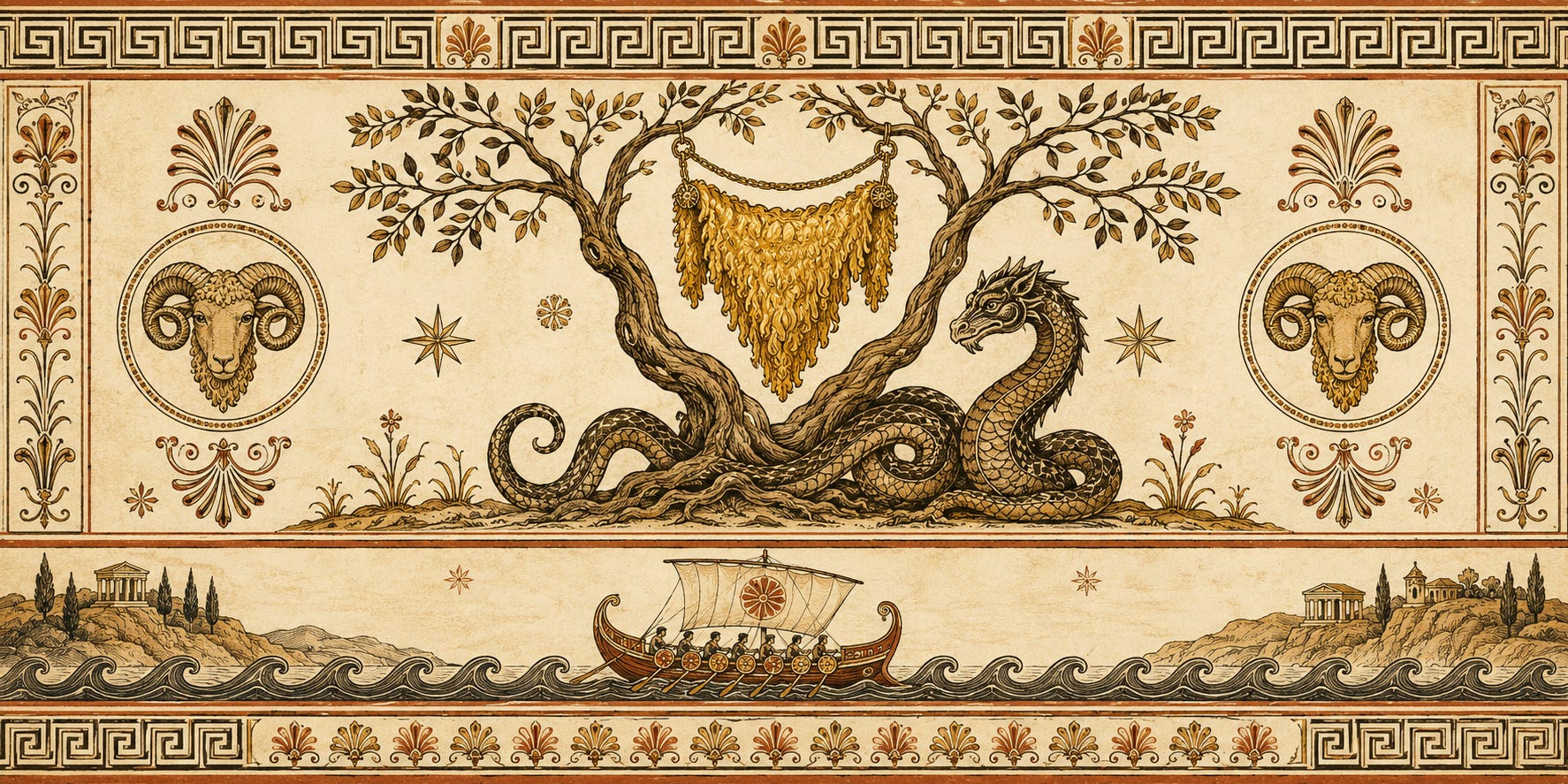
Before Jason sails for Colchis, meet the golden ram’s fleece: a rescued thing, a guarded prize, and the bright object that makes a ship leave shore.

Before the Tale
Before Jason ever sees the fleece, before the Argo pushes away from the shore, before the heroes take their places at the oars and begin the long, difficult business of becoming a crew, there is a golden ram.
That is where this story must begin.
Not with Jason.
Not with the ship.
Not even with the dragon.
With the ram.
Because the Golden Fleece is not simply a shining prize waiting at the end of a quest. It belongs to an older story first: a story of children in danger, sudden rescue, a flight over the sea, and a bright thing left hanging in a far country.
By the time Jason is sent to find it, the fleece is already famous.
That is one of the important rules of Greek myth. A hero often arrives late to the thing he thinks is beginning.
The Short Answer
The Golden Fleece is the fleece of a miraculous golden ram.
In Greek myth, the ram once carried two children away from danger. The fleece was later kept in Colchis, a far country beyond the sea, where it hung in a sacred grove and was guarded by a dragon that did not kindly leave things alone.
Jason is sent to fetch it.
That sounds simple, until you remember that in Greek myth, “fetch this thing from far away” usually means “sail into danger, anger several kings, rely on difficult gods, meet a monster, and discover that the world is much larger and less polite than you hoped.”
The Golden Fleece is treasure.
But it is not only treasure.
It is an object with a story already caught in it.
The Golden Ram
The fleece came from a ram unlike any ram a child would meet in a field.
This ram had golden wool. In some tellings, it could fly. It was not merely beautiful. It was sent when two children were in terrible need.
Their names were Phrixus and Helle.
They were brother and sister, and the danger around them came not from a monster in a cave, but from trouble inside a royal house. That can be worse, because monsters at least usually look like monsters. Dangerous grown-ups do not always do the courtesy of appearing with horns.
The golden ram carried the children away.
Imagine it: two frightened children clinging to a shining ram as it rose above the land, above the roads, above the fields, above the ordinary world that had become unsafe. Below them, the sea opened. Around them, the wind pressed hard. Ahead of them, somewhere beyond the water, there was a shore they had never seen.
The ram flew on.
Helle did not reach the far shore.
The old stories say she fell into the sea. The Greeks remembered the place where she fell, and gave it her name.
That is all we need to say here.
Greek myth does not always let every rescue arrive whole.
Phrixus did reach safety. The ram carried him to Colchis, a land far to the east of the Greek world, where King Aeetes received him. In many tellings, Phrixus honoured the ram, and the golden fleece was kept there as a sacred treasure.
So when Jason later comes looking for the fleece, he is not chasing something empty.
He is chasing the bright remainder of a rescue.
Colchis, the Far Shore
Colchis matters because it is far away.
Not a little far. Not a walk-over-the-hill far. Not even a journey-to-the-next-city far.
It is far in the way places are far in myth: across sea, beyond the familiar shore, outside the safe shape of home.
To reach Colchis, a hero cannot simply pack a bag and set out after breakfast. He needs a ship. He needs companions. He needs courage, yes, but courage alone is not enough. He needs people who can row, steer, sing, speak to kings, endure bad weather, notice danger, and not become completely useless the first time the sea behaves like the sea.
This is why Jason’s story will not belong to Jason alone.
Perseus can fly with divine gifts.
Theseus can enter the Labyrinth with a thread.
Odysseus can stand in the cave with his own cleverness sharpening inside him.
But Jason’s quest needs a shipful of heroes.
The Golden Fleece calls a company into being.
That is one of the things that makes it different.
The Grove and the Dragon
The fleece was not placed politely on a chair.
It was not folded in a chest with a helpful label.
It hung in a sacred grove, often said to belong to Ares, the god of war. That already tells you something. Ares is not the god you choose when you want a quiet afternoon.
The fleece hung from a tree.
Near it, around it, or beneath it, the dragon watched.
Some stories call the creature a dragon. Some imagine a great serpent. The Greeks did not always agree in exactly the same way about every monster, which is one reason their stories are still alive. But the important thing is clear enough: the fleece was guarded by something old, dangerous, and not inclined to hand over sacred treasures because a young man had arrived with a hopeful expression.
The dragon matters because a quest object needs resistance.
If Jason could simply walk into the grove, take the fleece, and walk out again, there would be no quest. There would only be poor security.
The dragon makes the fleece into a threshold.
A threshold is a place where the story asks: are you really coming through?
What Kind of Object Is This?
The Golden Fleece belongs with the great objects of Greek myth.
But not all mythic objects work in the same way.
Athena’s shield helps Perseus survive a monster no one can look at directly.
Ariadne’s thread helps Theseus remember the way back through the dark.
Orpheus’ lyre makes even the Underworld pause and listen.
The Golden Fleece does something else.
It waits.
It waits far away, bright and guarded, until a king decides to use it as an impossible demand. It does not leap into Jason’s hands. It does not protect him. It does not explain itself. It simply shines in the distance, and because it shines there, men build a ship.
Some treasures sit in a chest and wait to be counted.
The Golden Fleece does something stranger.
It makes a quest begin.
That is why it is dangerous to call it only treasure. Treasure is something people want. A quest object is something that changes the world around the wanting.
Once the fleece is named, a young man must sail. A crew must gather. A ship must be built. The sea must open. Kings, gods, strangers, monsters, and difficult choices must come nearer.
The fleece does not move at first.
Everything else moves toward it.
Why Jason Is Sent
Jason is not sent after the Golden Fleece because the journey is sensible.
Very little in Greek myth happens because a king has made a sensible administrative decision.
Jason is sent because of power, fear, family trouble, and the kind of royal cunning that hopes an impossible task will solve an inconvenient person.
That is another rule worth remembering.
When a ruler in Greek myth says, “Bring me this one thing,” the sentence often means, “I would prefer you not to come back.”
The fleece therefore becomes both prize and trap.
If Jason wins it, he proves something about himself.
If he fails, the person who sent him will not be surprised.
This is why the Golden Fleece glows with more than gold. It shines with rescue, loss, command, distance, danger, and the question every quest asks:
Will the hero return?
Signs to Watch For
When you read Jason’s tale, watch for the signs that gather around the fleece.
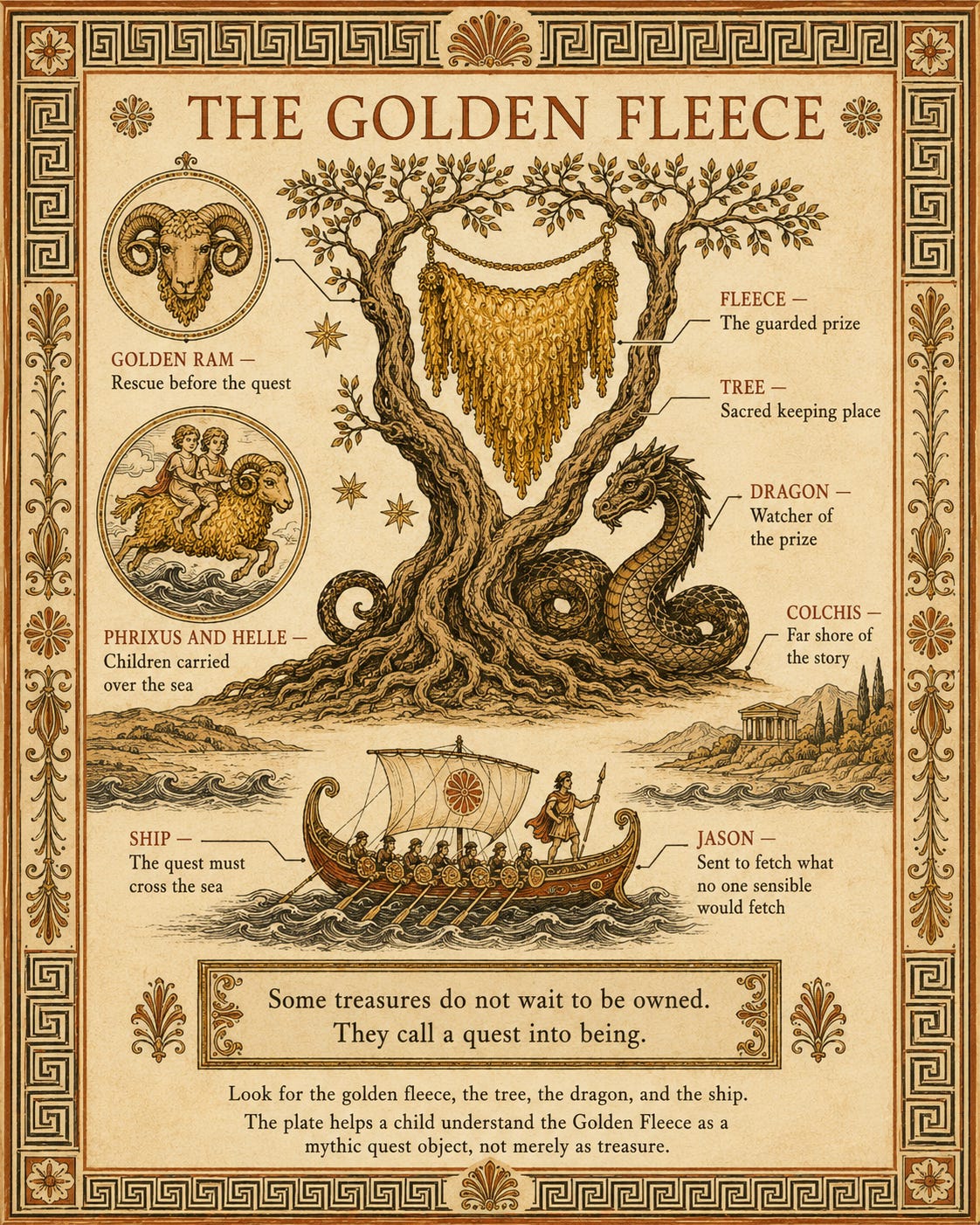
Watch for the ram, because the fleece begins as rescue before it becomes a prize.
Watch for the ship, because this is not a walking story. It is a sea story, and the sea makes every plan less certain.
Watch for the crew, because Jason’s quest is one of the great company adventures of Greek myth.
Watch for Colchis, because far countries in Greek myth are never only places on a map. They are where familiar rules begin to loosen.
Watch for the tree, because the fleece is kept like something sacred.
Watch for the dragon, because the prize is not unguarded.
Watch for the king, because kings often create impossible tasks and then pretend they are being reasonable.
And watch for help.
In Jason’s story, help will matter very much. Not all help is simple. Not all helpers are safe. Sometimes the person who makes success possible also changes the cost of success.
But that belongs to the Tale.
For now, remember the fleece.
When You Read the Tale
When you read Jason and the Golden Fleece, do not think of the fleece as merely the thing Jason wants.
Think of it as the bright centre of a whole moving world.
Behind it is the golden ram.
Behind the ram are Phrixus and Helle.
Around it is Colchis.
Beneath it is the dragon.
Before it is the ship.
And moving toward it is Jason, who will soon discover that a quest is not made great because the prize is beautiful. A quest is made great because of what the prize asks from everyone who comes near it.
The Golden Fleece is small enough to hang from a tree.
It is large enough to pull a whole ship across the sea.
One Thing to Remember
The Golden Fleece is not just treasure.
It is the bright thing that makes the ship leave shore.