
The Chimaera
After Bellerophon has flown above the fire, meet the monster made from lion, goat, serpent, and flame.

After the Tale
Now that Bellerophon has risen above the fire, now that Pegasus has carried him where ordinary feet could not go, we can look back at the creature waiting below.
That matters.
Some monsters in Greek myth can be faced on the ground. A hero may stand before them with sword, spear, shield, courage, and the very useful hope that the monster is not faster than he is.
The Chimaera was not that kind of monster.
The Chimaera made the ground itself dangerous.
The Short Answer
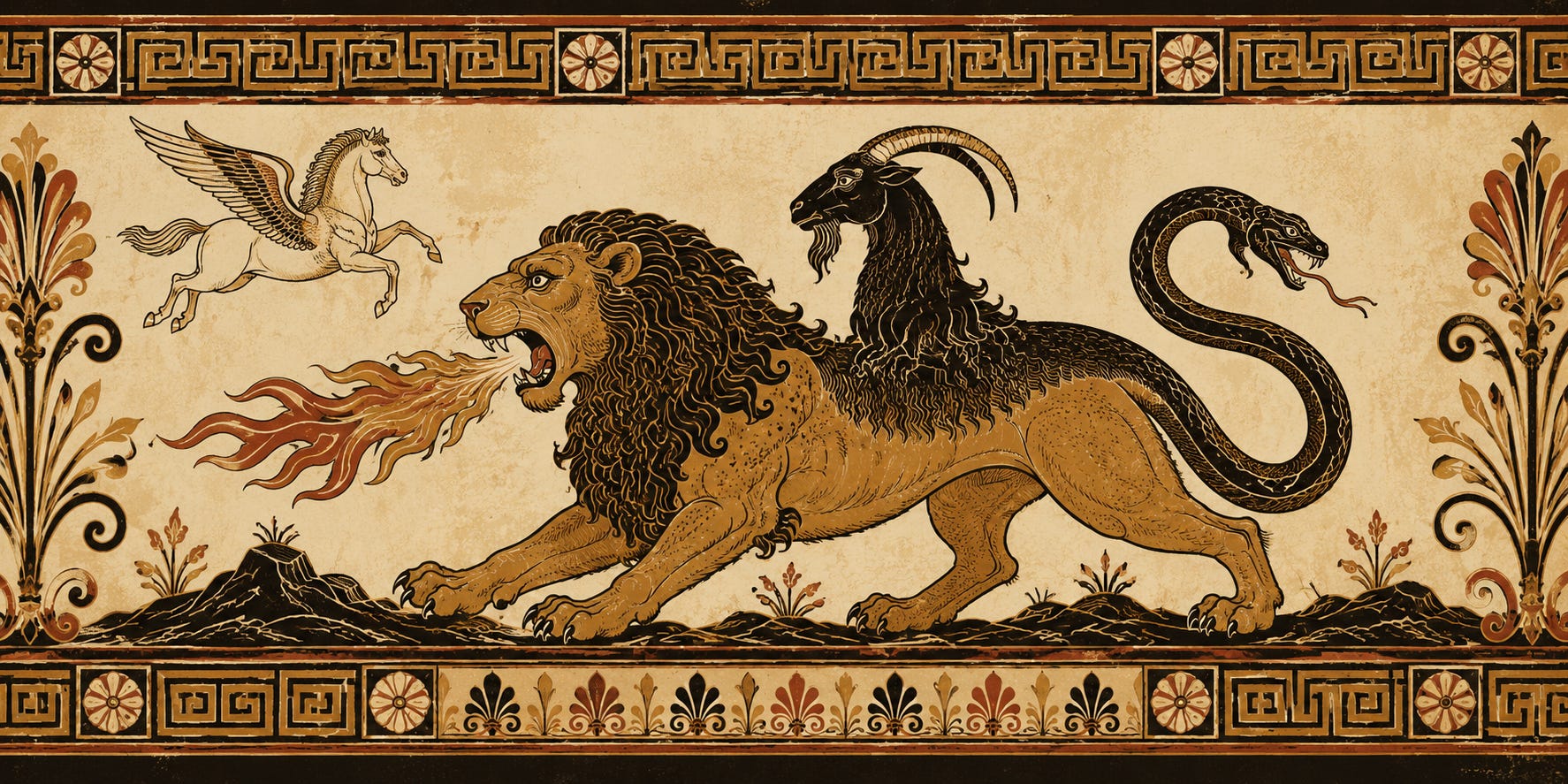
The Chimaera was a fire-breathing monster in Greek myth. In many tellings, it had the front or body of a lion, a goat rising strangely from its back, and a serpent for a tail.
That is the part most people remember first.
Lion.
Goat.
Serpent.
Fire.
But the Chimaera was not frightening only because it was a strange mixture of animals. Greek myth has many strange mixtures. A horse with wings. A man with the body of a horse. A woman with snakes for hair. A bull-headed creature hidden in a maze. The Greeks were not short of impossible shapes.
The Chimaera was frightening because each part of it was dangerous in a different way.
A lion can leap.
A serpent can strike.
Fire does not even need to touch you before you understand the warning.
The Chimaera was one monster made from several kinds of danger at once.
What the Tale Showed You
In Bellerophon and Pegasus, Bellerophon does not defeat the Chimaera because he is simply stronger than it. He is brave, yes. He is skilled, yes. But bravery alone would not be enough.
That is one of the useful things monsters teach.
They show us what kind of courage is needed.
The Nemean Lion required Heracles to come close and meet strength with strength. The Gorgons required Perseus to learn how not to look directly at what would destroy him. The Minotaur required Theseus to enter the dark and remember the way out.
The Chimaera required height.
This is why Pegasus matters so much. The winged horse is not decoration. He is not only a beautiful creature placed beside the hero to make the story shine. Pegasus changes what is possible.
On the ground, Bellerophon is too near the lion, too near the serpent, too near the fire.
In the air, he has distance.
In the air, he has movement.
In the air, he can face a monster that ordinary courage could not safely reach.
The Chimaera belongs to the burning ground.
Pegasus belongs to the answering sky.
The Body of the Monster
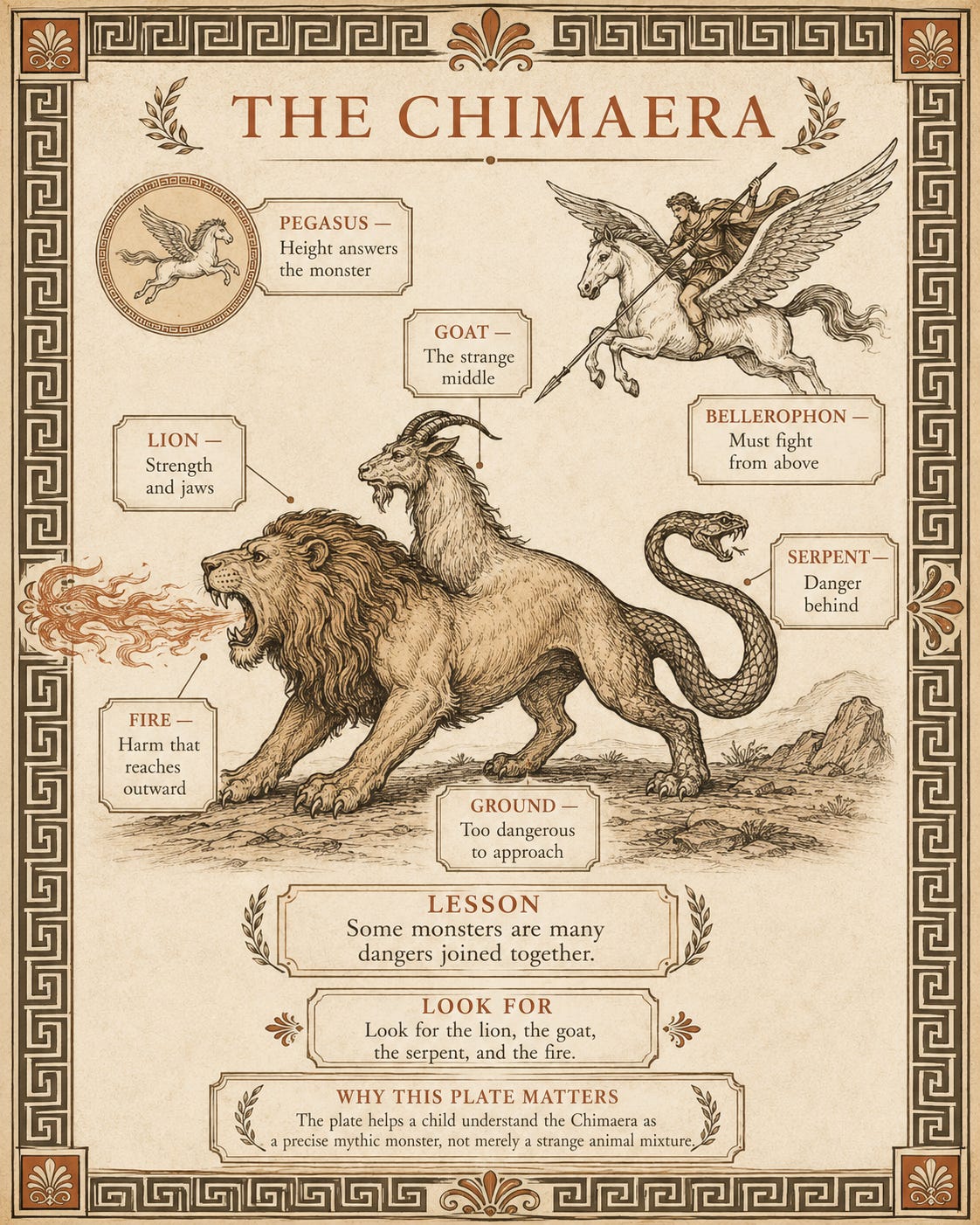
A child can remember the Chimaera by four signs.
The first is the lion.
The lion gives the monster its strength, its front, its spring, its terrible nearness. A lion is not frightening because it is ugly. It is frightening because it is beautiful and dangerous at the same time. Greek myth understands this very well. Not every danger looks broken. Some dangers are golden, powerful, and swift.
The second sign is the goat.
This is the strangest part. The goat rises from the monster’s back as a sign that this creature is wrong in its joining. The Chimaera is not one animal. It is a body that should not have been made.
That wrongness matters.
Greek monsters are often frightening because they cross boundaries. They are not this or that. They are both. They disturb the ordinary order by which people understand the world.
The third sign is the serpent.
The serpent makes even the monster’s tail dangerous. This means the Chimaera cannot be safely passed, safely escaped, or safely ignored from behind. The danger does not end where you expect it to end.
That is a very Greek kind of monster.
Just when a hero thinks he has found the edge of the danger, the edge moves.
The fourth sign is fire.
Fire makes the Chimaera more than tooth, claw, horn, or coil. Fire reaches outward. Fire changes the space around the monster. A hero does not need to be caught in its jaws to be in danger. He only needs to come too near.
This is why the Chimaera feels different from many other monsters. It is not only a body to be fought. It is a burning presence.
The monster carries its own weather of danger around it.
Why This Matters Later
The Chimaera helps a child understand that Greek monsters are not all the same.
This is important.
A monster is not simply “a dangerous thing.” Each monster has its own kind of danger.
The Gorgons are dangerous because of looking.
The Minotaur is dangerous because of the hidden centre.
The Nemean Lion is dangerous because ordinary weapons cannot pierce it.
The Chimaera is dangerous because several dangers have been joined into one body.
This is one reason Greek myths are worth learning carefully. They are not just a collection of famous names. They are a world of recognisable signs. Once a child knows the signs, the stories begin to open differently.
A thread is not just string.
A shield is not just armour.
A winged horse is not just a beautiful animal.
And a monster made of lion, goat, serpent, and fire is not just a strange creature. It is a warning that danger may come in more than one form at once.
Bellerophon needs Pegasus because the Chimaera cannot be met as if it were only a lion. He needs height because the fire changes the battle. He needs movement because the monster has too many directions of harm.
The story becomes clearer when the monster becomes clearer.
The ground burns.
The horse rises.
The child remembers both.
One Thing to Remember
Remember the Chimaera by four signs: lion, goat, serpent, fire — one monster, too many dangers.