
The Argonauts
After Jason has found the Golden Fleece, meet the ship, the crew, and the great quest that made one hero part of a larger world.

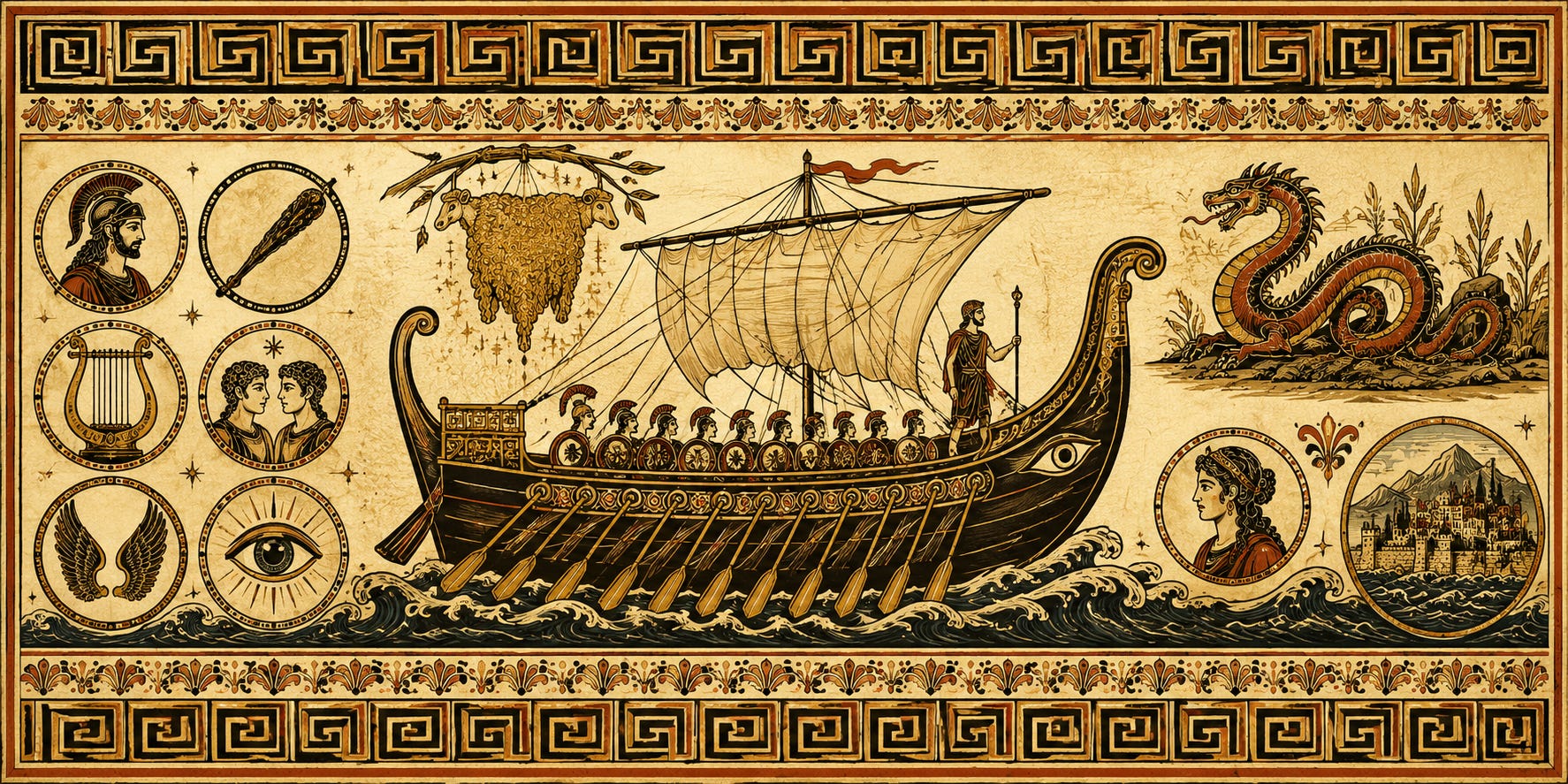
After the Tale
Now that Jason has stood before the Golden Fleece, now that the far shore of Colchis has entered the story, now that the dragon has watched beneath the tree, we can turn back and notice something that was carrying the tale all along.
Jason did not sail alone.
That is one of the first important things to know about this myth.
Some Greek heroes are remembered standing almost by themselves: Perseus before the Gorgon, Theseus inside the Labyrinth, Heracles beneath the lion. Jason is different. Jason belongs to a ship. His story is not only the story of one young man sent to fetch a treasure no sensible person would have promised to fetch.
It is the story of a crew.
And not an ordinary crew either. The Argonauts were a gathering of heroes, princes, sons of gods, singers, fighters, brothers, hunters, seers, and difficult people. This is often what happens when Greek myth puts too many magnificent people in one place.
The result is not peace.
The result is a voyage.
The Short Answer
The Argonauts were the heroes who sailed with Jason on the Argo to find the Golden Fleece.
Their name comes from the ship. They were the people of the Argo: the Argo-nauts.
That matters. The Greeks could have remembered them simply as Jason’s companions, or Jason’s helpers, or Jason’s crew. Instead, they remembered the ship in their name.
A hero may win fame.
A hero may lift the prize.
A hero may stand at the centre of the tale.
But a ship can carry the world that makes the tale possible.
What the Tale Showed You
In Jason and the Golden Fleece, you saw the quest through Jason’s danger.
He was sent to fetch the fleece from Colchis, far across the sea. The fleece was not lying about politely, waiting for a visitor. It hung in a sacred place, guarded and watched, wrapped in the kind of danger that makes a king very comfortable sending someone else to deal with it.
Jason had to sail away from home. He had to cross the sea. He had to come to a strange land. He had to stand before kings, tasks, gods, promises, and a dragon that had no interest in being reasonable.
But before any of that could happen, Jason needed a ship.
And because this was Greek myth, a ship was not merely a way to cross water. A ship was a threshold. Once Jason stepped aboard the Argo, the story became larger than one man’s errand.
The shore fell behind.
The oars went out.
The crew began to pull.
And the quest became a voyage.
The Ship with a Name
The Argo was one of the most famous ships in Greek myth.
In many tellings, it was built by a skilled craftsman named Argus, with help from Athena, who was very good at helping heroes in ways that were practical, exact, and not always comfortable. Some stories even say that a piece of sacred oak was set into the prow, so that the ship carried a strange wisdom of its own.
That may sound unusual.
It is unusual.
A ship that can carry heroes is already remarkable. A ship that can carry advice is something else again.
The Argo was made for a journey beyond the ordinary map. It had to cross dangerous waters, pass strange peoples and islands, survive storms, and carry home a prize that kings had dreamed about. It was not only a vessel. It was a moving house of heroes.
Think of the Argo as a wooden road.
On land, a road lies still and waits for feet.
At sea, a ship must become the road itself.
A Crew of Many Powers
The Argonauts were not all the same kind of hero.
This is important.
A weaker story might gather a crew and make everyone simply brave. Greek myth usually knows better. Courage is useful, but it is not the only thing a dangerous world requires. Some dangers need strength. Some need song. Some need sharp eyes, quick hands, a steady oar, a brother nearby, or someone who can see land before anyone else believes it is there.
Heracles was there in many tellings, carrying the kind of strength that makes ordinary problems look embarrassed. If something needed lifting, breaking, dragging, or persuading to stop being monstrous, Heracles was a useful person to have nearby. He was also, being Heracles, not the easiest person to fit into anyone else’s story.
Orpheus was there too: the singer whose lyre could bring order where shouting could not. On a ship full of heroes, the strongest person is not always the one with the loudest weapon. Sometimes the necessary person is the one who can keep rhythm when fear begins to spread.
Castor and Polydeuces were there: twin brothers, skilled and brave, later remembered among the stars. They belong to the kind of Greek story where brotherhood, horses, fists, ships, and divine favour begin to tangle together.
Zetes and Calais were there: winged sons of the North Wind. Some heroes carry swords. Some carry bloodlines. These two carried weather in their family.
Lynceus was there too, famous for his sight. A great quest needs someone who can see what others miss. This is true on ships, in caves, in labyrinths, and, inconveniently, in families.
Atalanta appears in some tellings and not in others. The Greeks did not always agree about who stood on every plank of the Argo. That is one of the things to know about very old stories: they grow branches. In some branches, Atalanta sails. In others, she does not. Either way, she belongs to the larger heroic world around Jason — the world of hunters, contests, speed, pride, danger, and courage under pressure.
And then there is Medea.
Medea was not one of the heroes who first set out from Greece aboard the Argo. She belonged to Colchis, the far shore. But after Jason reached that shore, the quest could not be understood without her. She brought help no sword could have provided. She brought knowledge, danger, decision, and a shadow that would follow the story long after the fleece was taken down from the tree.
So the Argo did not carry one kind of power.
It carried strength.
It carried song.
It carried sight.
It carried speed.
It carried brothers.
It carried divine blood, human pride, old promises, bad judgement, courage, quarrels, and the bright dangerous belief that the impossible might be reached if enough extraordinary people pulled in the same direction.
That is why the ship matters.
Why So Many Heroes?
Jason needed such a crew because the quest was too large for one man.
But there is a deeper reason.
The Argo gathers a whole heroic generation into one moving shape. It is like a small floating map of Greek myth. On that ship are heroes whose stories stretch backward and forward: heroes with famous parents, heroes who will have famous children, heroes who belong to other hunts, other wars, other disasters, and other songs.
The Argonauts show a child that Greek myth is not made of separate little boxes.
Heracles does not belong only to his own labours.
Orpheus does not belong only to the Underworld.
Atalanta does not belong only to the race or the boar hunt.
Jason does not belong only to the fleece.
The heroes cross one another’s roads. Sometimes they sail together. Sometimes they quarrel. Sometimes one hero’s story passes through another hero’s life like a ship seen briefly from shore.
This is one of the great pleasures of Greek myth.
The world begins to join up.
The Far Shore
The Argonauts sailed from Greece toward Colchis.
Colchis was the far shore of the story: distant, strange, wealthy, dangerous, and guarded by powers that did not belong to Jason’s home. To a child reading the tale, Colchis should feel far away in the old mythic sense. Not just many miles away. Far in the mind.
It is the kind of place where a golden fleece might hang from a tree.
It is the kind of place where a dragon might keep watch.
It is the kind of place where a king might smile and set impossible tasks.
To reach such a place, the heroes had to cross water. In Greek myth, water is rarely only water. Seas separate homes from dangers, childhood from trial, known lands from stranger ones. Once a hero sails away, the world becomes larger and less obedient.
The Argo carried the Argonauts across that change.
The ship moved them from the world they knew into the world that would test them.
Signs and Symbols
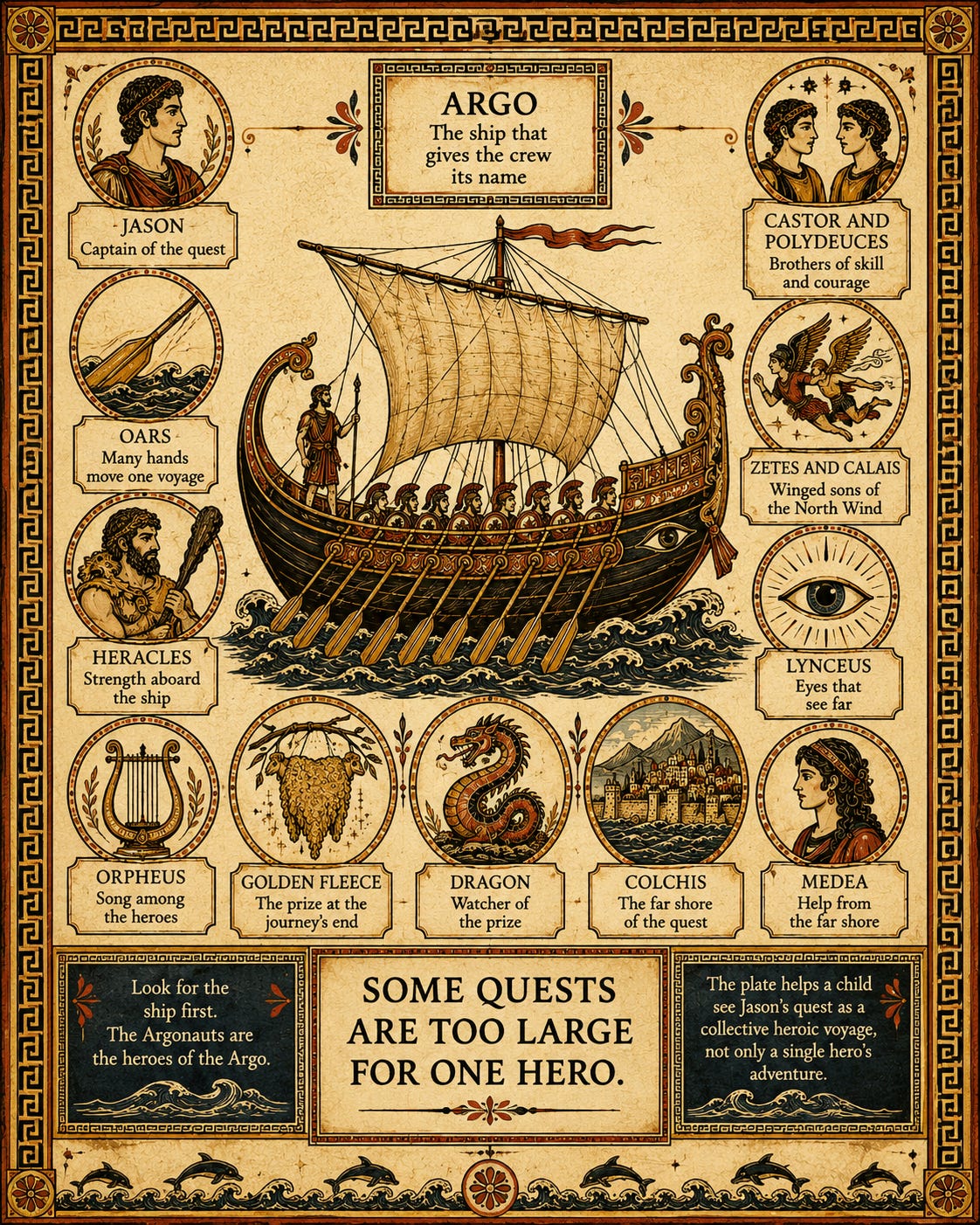
A child can remember the Argonauts by looking for these signs.
The Argo is the first sign. The ship gives the crew its name. When you see the Argo, think of a quest large enough to need more than one hero.
The oars are the second sign. One oar does not move such a ship. Many hands must pull together, even if the people attached to those hands are not always peaceful.
The sail is the sign of wind and distance. A sail belongs to the part of a story where land has been left behind and the next shore has not yet appeared.
The Golden Fleece is the prize that calls the voyage forward. It is beautiful, dangerous, and not there for decoration.
The dragon is the watcher at the end of the road. A treasure in Greek myth often has something near it that does not believe in sharing.
The lyre reminds us of Orpheus. Not every power on the Argo is a weapon.
The club reminds us of Heracles. Some strength is so large that the story has to make room around it.
The wings remind us of Zetes and Calais, and of the strange family lines that run through Greek myth.
The twin stars remind us of Castor and Polydeuces, the brothers who belong to earth, horses, courage, and the sky.
The far shore reminds us of Colchis, where the quest becomes stranger than a simple sailing adventure.
What Else the Myths Say
The stories of the Argonauts were told in many ways.
Different poets and storytellers remembered different names in the crew. Some included one hero and left another out. Some made the ship more wondrous. Some gave more space to the dangers along the way. Some cared most about Jason. Some cared more about Medea. Some were interested in the voyage itself: the islands, monsters, storms, kings, and strange meetings that happened before the fleece was even reached.
This does not mean the story is broken.
It means it is old.
Very old stories are not always like a single road paved from beginning to end. They are more like a harbour. Many ships have entered. Many voices have spoken. Some names remain fixed. Some move. Some details change because the story has been carried for a long time by many mouths.
For The Alexander Series, the thing to remember is simple enough.
Jason’s quest belongs to a ship.
The ship belongs to a crew.
The crew belongs to the larger heroic world.
Why This Matters Later
The Argonauts matter because they teach the child how wide Greek myth can become.
At first, a child may meet one hero at a time. Perseus with his shield. Theseus with his thread. Odysseus in the cave. Atalanta running for her freedom. Heracles beneath the lion. Orpheus with his lyre. Jason before the fleece.
But then the world opens.
The heroes are not standing in separate rooms. They belong to one old, crowded, quarrelsome, glittering world. A singer can sail with fighters. A strong man can begin one quest and leave before the end. A girl from one strange shore can change the fate of a prince from another. A ship can carry names that later become stars, fathers, kings, warnings, and songs.
This is why the Argo is one of the great images of Greek myth.
It is not only a ship.
It is the old heroic world gathered into wood, sail, rope, oar, and danger.
One Thing to Remember
The Argonauts remind us that some quests are too large for one hero.
Jason found the fleece.
But the Argo carried the world that made the quest possible.