
Pegasus
Before Bellerophon takes the bridle, meet the winged horse of Greek myth: born from danger, bright with wonder, and never quite tame.

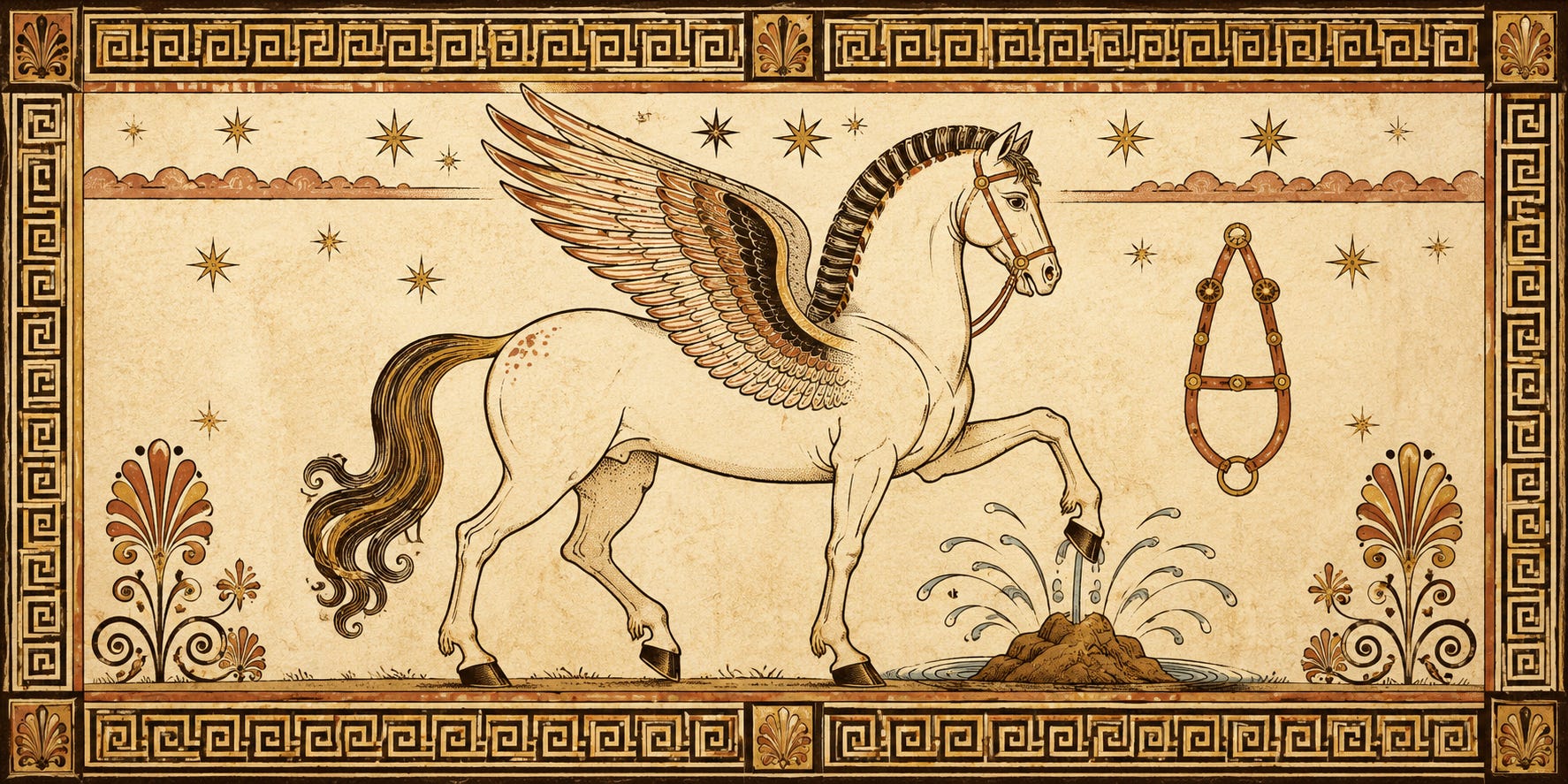
Before the Tale
Before Bellerophon sees the monster, before the Chimaera fills the road ahead, before the sky itself becomes part of the battle, there is Pegasus.
A horse is already a marvellous creature.
It has thunder in its hooves, heat in its body, and a mind of its own about gates, roads, strangers, and whether you have any business touching its neck. A horse can carry a person farther than human feet can go. It can turn a road into speed.
Now give that creature wings.
That is Pegasus.
Not a pet.
Not a cloud with hooves.
Not a pretty idea someone has decorated with feathers.
Pegasus is the winged horse of Greek myth: swift, bright, powerful, and not quite tame. He belongs to heroes and gods, monsters and mountains, springs and sky, danger and wonder.
When Pegasus enters a story, the ground is no longer the only road.
The Short Answer
Pegasus is the most famous winged horse in Greek myth.
He can fly. He can carry a hero where ordinary horses cannot go. He is linked with springs, mountains, poetry, divine help, and the dangerous brightness of height.
But the first thing to understand is this:
Pegasus is not wonderful because he lets a hero do whatever he likes.
He is wonderful because he makes possible what human feet could never do — and that is exactly why he must be approached carefully.
In Greek myth, a gift is rarely simple. A shining thing may help you. It may also test you. A god may give you what you need, but not always in the way you expected. A creature may carry you higher than courage alone could manage, but height does not become safe because you have been allowed into it.
Pegasus is one of those gifts.
He is wonder with wings.
And wonder has rules.
Where Pegasus Comes From
The old myths say Pegasus came from the story of Medusa, after Perseus had done the terrible thing he had been sent to do.
That is enough for us to know here.
Greek myth often lets something bright rise from something frightening. It does not always clean the world before beauty appears. Sometimes the beautiful thing comes from a place where fear has already been.
Pegasus is like that.
His beginning belongs to the dangerous edges of myth: Gorgons, gods, heroes, sea, blood, and the strange births of the old world.
That does not make Pegasus ugly.
It makes him Greek.
The Greeks did not think wonder had to begin in comfort. They knew that marvels could come from terror, that brightness could rise after a dreadful thing, and that the world was often stranger than human beings found convenient.
Pegasus carries that strangeness in his body.
He has hooves for the earth.
He has wings for the sky.
He belongs to both, and entirely to neither.
What Kind of Creature Is He?
A winged horse is not only a horse that can fly.
That would already be enough. Most people would stop there. Many would point. Some would shout. A few would immediately try to climb on, which is one of the many reasons myths have to keep happening.
But Pegasus is more than speed with feathers.
He is a creature of crossing.
He crosses the line between earth and air. He crosses the line between animal strength and divine wonder. He crosses the line between what a hero can do alone and what a hero can do only with help.
That matters.
Many Greek heroes are strong. Some are clever. Some are brave. Some have the good fortune to attract divine attention, which is useful, provided the god or goddess has chosen that day to be helpful rather than interesting.
Pegasus brings something different.
He changes the shape of the possible.
A monster on the ground is one kind of danger. A monster seen from the sky is another. A road that cannot be passed on foot may be crossed from above. A hero trapped by the earth may suddenly have height, speed, and surprise.
Still, Pegasus does not remove danger.
He changes how danger must be met.
That is one of the first things to remember about him. Pegasus does not make a hero safe. He gives the hero a way to enter danger differently.
That is a very different gift.
The Bridle
There is one object to notice before reading the tale of Bellerophon.
The bridle.
A bridle is a small thing to set beside such wonder. Leather, metal, reins, a bit: ordinary materials, made to guide the mouth and head of a horse.
But in the story of Pegasus, the bridle matters enormously.
Because Pegasus cannot simply be seized.
A wild horse is difficult enough. A winged horse is worse. A winged horse who belongs partly to the divine world is worse again. It is not enough for a hero to want him. It is not enough to be excited. It is not enough to say, “That horse would be useful,” which is the sort of sentence heroes say just before a myth begins correcting them.
Pegasus must be approached in the right way.
In some versions of the myth, Athena helps Bellerophon by giving him a golden bridle. That is exactly the kind of help Athena often gives: not noise, not applause, not the whole task done for you, but a tool, a sign, a piece of order placed into mortal hands.
Athena does not make Pegasus less wonderful.
She gives Bellerophon the means to meet that wonder without ruining it.
The bridle is not only control.
It is order meeting power.
It is restraint meeting wonder.
It is the sign that even the sky must be entered with discipline.
Wings and Height
Children usually understand wings very quickly.
Wings mean escape. Wings mean freedom. Wings mean up.
In stories, up can feel like rescue. Up is away from the jaws, away from the fire, away from the soldiers, away from the dark mouth of the cave. Up is where the road cannot reach you.
But Greek myth is careful about height.
Height can save.
Height can also tempt.
A person high above the ground may begin to forget the ground. A person carried by a marvellous creature may begin to think the marvel belongs to him. A hero who has survived one impossible danger may begin to suspect that impossible things are now his natural business.
This is not a safe suspicion.
Pegasus teaches the child to look at wings with two thoughts at once.
First: how beautiful.
Second: be careful.
That is one of the old strengths of Greek myth. It does not make beauty harmless in order to make it beautiful. It lets beauty remain dangerous.
Pegasus is beautiful.
Pegasus is dangerous.
Both things are true.
Springs and Stone
Pegasus is also linked with water.
Some stories say that when his hoof struck the ground, a spring burst out. The most famous was Hippocrene, a spring on Mount Helicon, sacred to the Muses.
This is a wonderful image.
A hoof touches stone.
Water rises.
The creature of flight becomes the maker of a spring.
The sky-horse breaks open the earth, and something clear comes out.
That is why Pegasus belongs not only to battle stories, but also to stories of song and poetry. He is not merely a way for a hero to reach a monster. He is also a sign that wonder can make hidden things flow.
Again, the myth refuses to be small.
Pegasus is useful in danger.
Pegasus is beautiful in himself.
Pegasus touches stone, and water remembers how to rise.
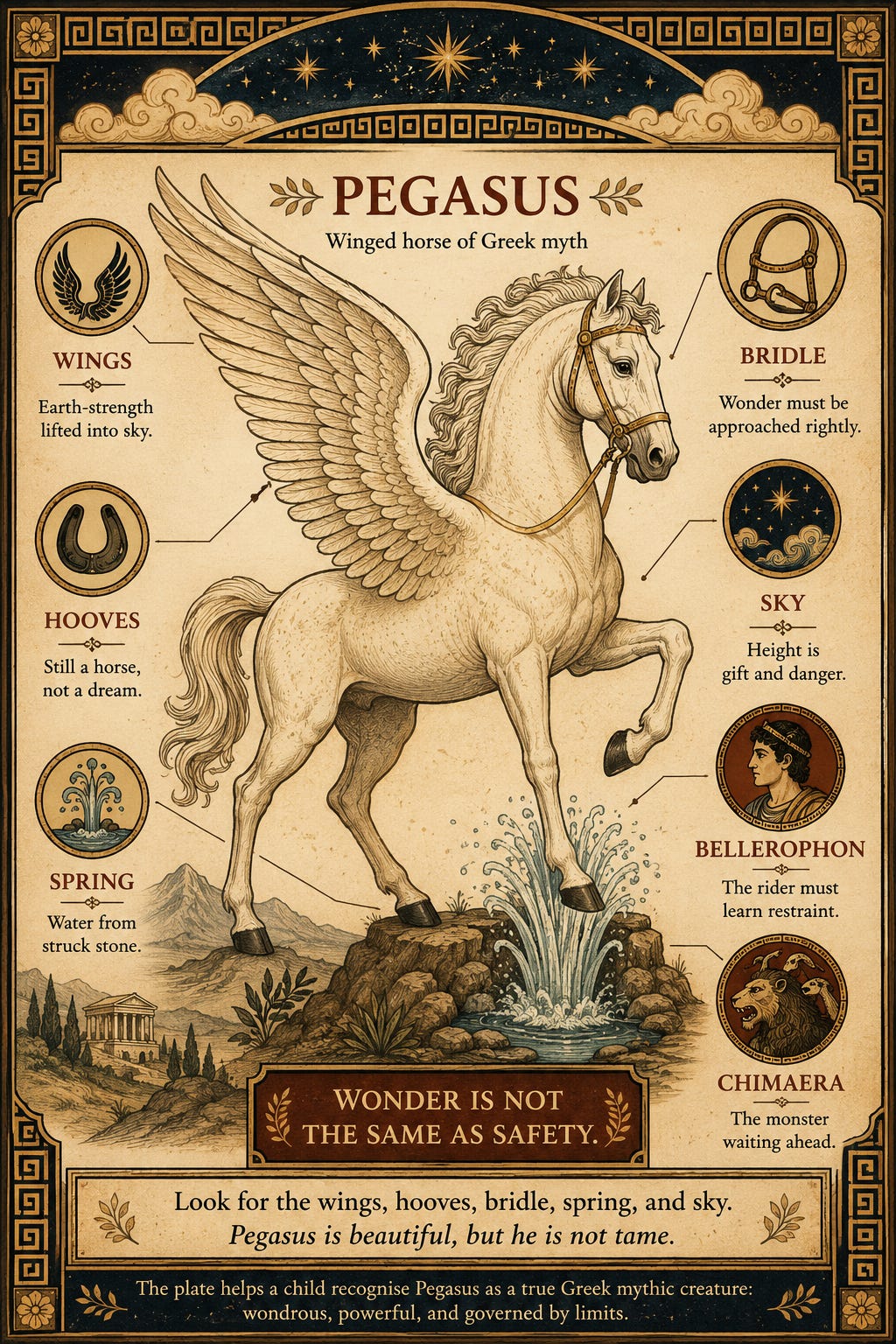
Signs to Watch For
When you see Pegasus in a picture or meet him in a story, look for these signs.
Wings
Pegasus belongs partly to the sky. He can carry a hero where ordinary roads cannot go.
Hooves
He is still a horse, not a dream. His strength belongs to the body as well as the air.
Bridle
Wonder must be approached rightly. Wanting Pegasus is not enough.
Spring
Pegasus is linked with water breaking from stone, and with the hidden places where song begins.
Sky
Height is a gift, but it is not safety.
Hero
Pegasus may carry courage, but he does not replace it.
Monster
When Pegasus appears in Bellerophon’s tale, it is because there is danger ahead that cannot be met in an ordinary way.
When You Read the Tale
When you read Bellerophon and Pegasus, watch the bridle.
Watch how the hero approaches what he cannot simply command.
Watch how the horse changes the shape of the danger.
Watch how the sky becomes a road.
And watch, too, for the harder thing: the moment when height begins to feel less like help and more like temptation.
Pegasus can lift a hero above the earth.
He cannot make pride safe.
One Thing to Remember
Pegasus is wonder with wings — but even wonder has rules.