
Orpheus and the Underworld
Orpheus enters the Underworld with no sword, no shield, and no strength except the song he refuses to leave behind.

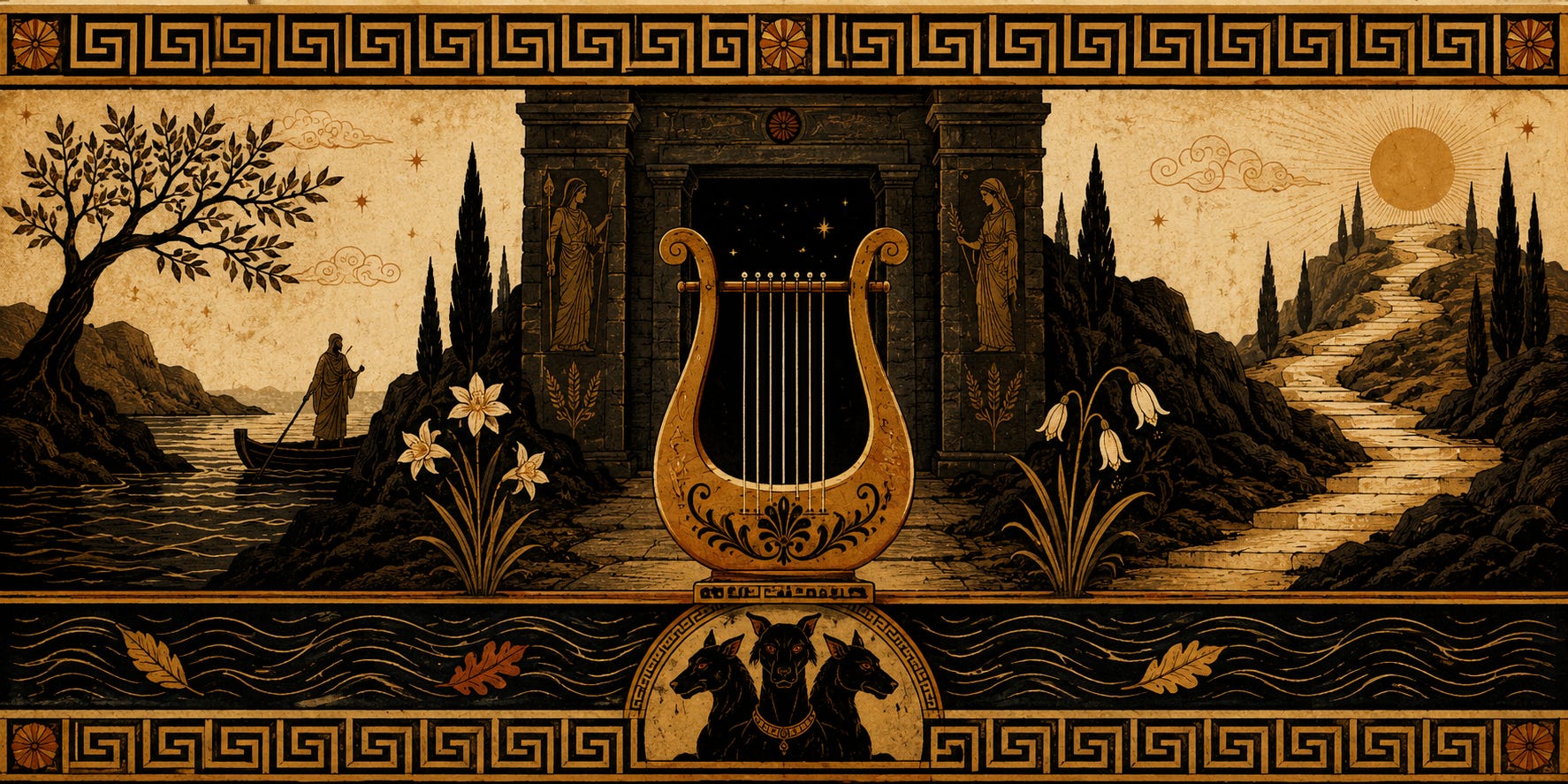
Orpheus could make almost anything listen.
Birds listened. Goats listened, though goats are not famous for politeness. Trees listened, or seemed to. Even stones appeared to settle more deeply into the earth when Orpheus touched the strings of his lyre.
The lyre was not large. It was not golden all over, or set with jewels, or the sort of thing a boastful king would hang on a wall and point at during supper. It was made of wood and string and care. But when Orpheus played it, the world remembered how to be quiet.
Wolves came out of the dark and forgot to be wolves.
Rivers slowed.
Leaves stopped quarrelling with the wind.
Once, when Orpheus sat on a hillside and played until the sun had gone red behind the trees, a whole company of men who had been arguing about a boundary stone stood still with their mouths half-open, listening. By the end of the song, none of them could remember why the stone had mattered so much.
This, for men arguing over land, was very nearly a miracle.
But Eurydice did not listen because she had to.
She listened because she loved him.
She would sit near the doorway in the evenings while Orpheus tested one string, then another, then the first string again, because Orpheus could bear almost any sadness in the world except a note that was nearly right.
“Play it,” she would say.
“I am playing it.”
“No,” Eurydice would say, smiling. “You are worrying it.”
Then Orpheus would look offended for half a breath, because singers are sometimes proud of their suffering, even when the suffering is caused by a badly tuned string. Then he would laugh, and the song would begin properly, and the room would grow still around them.
There are some happinesses that do not announce themselves as happiness.
They are only a lamp on a table, a hand resting near another hand, a voice in the doorway, a song being made in the evening while the dark gathers kindly outside.
Orpheus had such happiness.
Then, one morning, it broke.
Eurydice had gone out among the long grasses beyond the house, where the flowers grew thick after rain. She was walking lightly, gathering stems in the fold of her dress, when a snake hidden in the grass struck her ankle.
There was a cry.
There were running feet.
There was Orpheus kneeling in the grass with his lyre fallen beside him.
And then there was a silence no music answered.
By sunset, Eurydice had gone where all mortals go at last.
Not to another city.
Not to a distant shore.
Not to a house where Orpheus could follow by asking directions from travellers.
She had gone below.
The people came and stood near him, as people do when they love someone and do not know how to help. They spoke gently. They brought food he did not eat. They told him that no one comes back from the house of Hades.
This was true.
It was also not helpful.
Orpheus sat with his lyre across his knees. His fingers touched the strings, but no song came. It was not because the lyre had forgotten him. It was because, for the first time in his life, Orpheus could not bear to ask the world to listen.
For three days he sat.
On the fourth morning, he rose.
He washed his face. He took the lyre. He fastened his cloak. He stepped out of the house while the air was still grey and the birds had not yet decided whether morning was worth beginning.
A neighbour saw him on the road.
“Where are you going?” the neighbour asked.
“To bring Eurydice home,” said Orpheus.
The neighbour stared at him.
This was understandable.
“From where?” he asked, although he already knew.
“From the Underworld.”
Now, a sensible person would have said many things at this point.
No.
Impossible.
You cannot.
No living person walks into the kingdom of the dead and returns with what death has taken.
But the neighbour looked at Orpheus, and at the lyre in his hand, and found that all the sensible words had become very small.
So he only said, “Take bread.”
Orpheus took the bread.
Then he walked on.
The road to the Underworld is not marked with signposts. This is probably for the best. The Greeks liked signposts well enough for roads between towns, but no one has ever improved a country by making the way to death more convenient.
Orpheus went through olive groves and over stony hills. He passed shepherds, springs, shrines, and old trees whose roots had been patient longer than kingdoms. He slept under a ledge of rock. He ate little. He played less.
But sometimes, when the dark pressed too closely, he touched the lyre and played a few quiet notes, not a whole song, only enough to remind himself that the strings still knew his hand.
On the third evening of his journey, he came to a valley where the light seemed reluctant to enter.
The grass there grew pale. The trees were thin. No birds sang in the branches. Ahead of him, between two black stones, a path sloped downward into the earth.
Orpheus stood at the entrance.
The air that breathed from the opening was cold and very old.
He thought of Eurydice laughing at him for worrying the lyre strings. He thought of her hand reaching for flowers. He thought of the silence after the cry.
Then he stepped down.
The path narrowed. The last daylight closed behind him like a door.
Down went Orpheus.
Down past roots like old fingers.
Down past stones damp with the earth’s hidden water.
Down past hollows where his own footsteps came back to him, softer and stranger, as if someone behind him were trying to remember how walking worked.
He did not look back then.
There was nothing behind him yet but the living world growing farther away.
At last the path opened, and Orpheus stood on the bank of a river.
It was not like rivers under the sun. It did not flash. It did not sing over stones. It moved slowly, black and deep, carrying no leaves, no foam, no reflected sky.
On the far side lay a shore of dim grey earth.
On the near side, pulled half into the mud, was a boat.
In the boat stood an old ferryman.
His face was narrow. His hands were long. His eyes looked as though they had seen every grief and had stopped being surprised by any of them.
This was Charon, who carried the dead across the river.
He looked at Orpheus and frowned.
“You are breathing,” said Charon.
“Yes,” said Orpheus.
“I do not carry the breathing.”
“I must cross.”
“That is what all the dead say.”
“I am not dead.”
“That,” said Charon, “is the difficulty.”
Orpheus held out a coin. Charon did not take it.
“You cannot buy this crossing.”
“I did not come to buy it.”
“Then why show me the coin?”
“Because I was told ferrymen like payment.”
Charon looked at him for a long moment. Then, to Orpheus’s surprise, the corner of the ferryman’s mouth moved. It was not quite a smile. It may only have been an ancient habit of the face.
“You were told correctly,” said Charon. “But this is not a road for the living.”
Orpheus did not argue. He sat on a stone by the river and set the lyre against his shoulder.
Then he played.
At first the river did not change.
The black water continued its slow movement. The boat knocked softly against the shore. Charon stood still, one hand on the pole.
Orpheus played of morning before loss.
He played of a room lit by one lamp.
He played of laughter in a doorway, of flowers after rain, of a hand that had once rested close to his and then was gone.
The river slowed.
The boat stopped knocking.
Across the water, shapes gathered on the far shore: the shades of the dead, pale and quiet, turned their faces toward the sound. Some had forgotten their own names. Some had forgotten the warmth of bread, or the colour of the sea, or the exact shape of their mother’s face.
But they remembered listening.
Charon lowered his head.
When the song ended, the river lay so still it seemed carved from black stone.
The old ferryman held out his hand.
Orpheus placed the coin in it.
“Get in,” said Charon.
The boat crossed without a ripple.
On the far shore, the shades parted to let Orpheus pass.
None of them touched him. None spoke. But their eyes followed the lyre.
Beyond the river stood a gate.
It was made neither of wood nor iron. It seemed made of darkness given shape. Before it lay Cerberus, the hound of Hades.
He was enormous.
Three heads rested on three great paws. His ears twitched. His breath came hot from three mouths. Around his neck, shadows moved like snakes.
When Orpheus approached, all three heads lifted.
Three pairs of eyes opened.
A growl moved through the ground.
Orpheus stopped.
He had no sword. This was just as well, because a sword against Cerberus would have been a very brief idea.
He had no shield. He had no spear. He had no club like Heracles, who had once come this way with shoulders broad enough to make even monsters reconsider their arrangements.
Orpheus had only the lyre.
So he played.
Not loudly.
A loud song would have been foolish in that place.
He played softly, as one might play for a dog sleeping beside the hearth, if the dog were large enough to guard death and had teeth that made the bravest warriors remember unfinished business elsewhere.
Cerberus listened.
One head lowered.
Then another.
The third kept watching Orpheus for a little longer, because there is always one head in any household that takes its duties seriously.
But the song was patient.
At last the third head lowered too.
The great hound sighed. The sound stirred dust along the road.
Orpheus walked past him and through the gate.
The Underworld opened before him.
It was not fire and screaming, as some foolish people imagine when they are trying to frighten children or themselves. It was worse and quieter than that.
There were fields without sun.
Roads without dust.
Trees with dark leaves that did not stir.
Far off, a river wound through a plain where pale flowers grew. Beyond it rose the halls of Hades, vast and shadowed, with pillars like the trunks of dead forests and a roof lost in gloom.
The dead moved everywhere.
Kings without crowns.
Soldiers without spears.
Children holding the hands of mothers.
Old women who had outlived everyone and still looked surprised to have arrived.
Men who had loved gold.
Men who had loved glory.
Men who had loved nothing much and now had a great deal of time to think about it.
They were not monsters.
That made it stranger.
Orpheus walked among them, and the living warmth in him felt suddenly bright and lonely, like a candle carried through a cave.
At the far end of the hall stood two thrones.
On one sat Hades, lord of the dead.
He was not ugly. He was not cruel-looking. He was grave, dark-bearded, and still, with eyes that seemed to have measured the weight of every farewell ever spoken.
Beside him sat Persephone, queen below.
She was pale as spring seen through mist. There was sorrow in her face, but not weakness. She had eaten the food of the Underworld and knew what it meant to belong partly to darkness and partly to return.
Orpheus stood before them.
No living man should have stood there.
Hades looked at him.
“You have come far from the sun,” said the god.
“Yes.”
“Few do.”
“I know.”
“Fewer still come breathing.”
“I know that too.”
Persephone’s eyes moved to the lyre.
“And you brought a song,” she said.
“I brought the only thing I have.”
Hades leaned back against his throne.
“Many come here wanting what cannot be given.”
“I want Eurydice,” said Orpheus.
At that name, something moved in the hall. Far among the shades, a figure turned.
Orpheus felt it before he saw her.
He did not run. The hall was too grave for running. But his whole body leaned toward the place where she stood.
Eurydice.
Pale now. Quiet now. Farther from him than she had ever been.
But Eurydice.
Orpheus took one step.
Hades lifted a hand.
The step stopped.
“She is among the dead,” said Hades.
“She should not be.”
“All who are here were once thought by someone not to belong here.”
This was a hard answer.
It was also true.
Orpheus gripped the lyre until the wood pressed into his palm.
“Let me sing,” he said.
Hades said nothing.
Persephone looked at her husband. Then she looked at Orpheus.
“Sing,” she said.
So Orpheus played before the thrones of the dead.
He did not sing to impress Hades.
That would have been useless. Hades had heard every boast go silent.
He did not sing to flatter Persephone.
That would have been foolish. Persephone knew too much about leaving and returning to be fooled by pretty sorrow.
Orpheus sang the truth.
He sang of the living world, where dawn enters rooms without asking permission.
He sang of Eurydice walking through grass, of the flowers in her hands, of her smile when he tuned the same string again and again.
He sang of the silence that came after her.
He sang of the road downward, the river, the gate, the hound, the dead turning their faces toward a sound they had not expected to hear again.
He sang until the dead remembered the sun.
Tantalus forgot the water he could not drink.
Sisyphus rested his hands on the stone that always rolled back.
The daughters of Danaus lowered their empty jars.
The shades gathered, still and listening.
Even the darkness seemed to lean closer.
Hades did not move.
Persephone did.
One tear slipped down her face and disappeared before it reached her robe, as if the Underworld itself had swallowed it.
When the last note faded, no one spoke for a while.
Then Hades said, “You ask for a law to bend.”
“I ask for my wife.”
“You ask for death to give back what it has taken.”
“Yes.”
Hades’ eyes were dark and deep.
“If I granted every such song, my kingdom would empty.”
“Then grant one.”
That was not a wise way to speak to Hades.
But grief is not always wise, and courage is not always polite.
A silence passed through the hall.
Then Persephone said, “One.”
Hades turned his head toward her.
“She came too soon,” said Persephone softly.
“All come too soon to someone,” said Hades.
“Yes,” said Persephone. “But not all are followed by a song.”
The lord of the dead looked again at Orpheus.
“There will be a condition.”
Orpheus did not breathe.
“You may lead Eurydice upward,” said Hades. “She will follow behind you. You will walk before her. You will not look back.”
Orpheus listened.
“Not at the river,” said Hades. “Not at the gate. Not on the path through the earth. Not when you think you hear her. Not when you fear you do not. Not until both of you stand fully in the light of the living world.”
The words entered Orpheus one by one.
Walk before her.
Do not look back.
Not until both stand in the light.
“If you turn too soon,” said Hades, “she returns to us.”
Orpheus looked at Eurydice.
She stood far away among the dead, watching him.
“Can she speak?”
“No,” said Hades.
“Can she touch me?”
“No.”
“Can I hear her?”
Hades was silent for a moment.
“Perhaps.”
That was the cruellest answer.
Orpheus closed his eyes.
He had crossed the river. He had passed Cerberus. He had stood before Hades. He had made the dead remember dawn.
Now he had to do something harder.
He had to walk away from Eurydice and trust that she was following.
“I accept,” said Orpheus.
Hades lifted his hand.
The hall seemed to darken and open.
Eurydice stepped forward.
Orpheus saw her face once, only once. It was pale, but it was hers. Her eyes were full of him.
Then Hades spoke.
“Begin.”
Orpheus turned toward the road.
He did not look back.
At first, it was almost easy.
The hall was full of watching shades, and Orpheus could feel their eyes on him. The lyre hung at his side. He walked slowly, so slowly, because Eurydice had to follow and he did not know how lightly the dead walked.
His own footsteps sounded on the stone.
Behind him, nothing.
He kept walking.
Past the thrones.
Past the pillars.
Past the dead who parted again to make a road.
Still nothing.
Perhaps the dead made no sound.
Perhaps she was too far behind.
Perhaps Hades had tricked him.
No.
He walked on.
At the gate, Cerberus lifted one head.
Then the second.
Then the third.
All three watched Orpheus pass. The hound did not growl.
Orpheus wanted to turn then.
He wanted to see whether Eurydice had passed the hound. He wanted to know whether she was afraid. He wanted to say, I am here. Keep walking. We are going home.
But he had been told not to look.
So he played one note on the lyre.
Only one.
It trembled in the air behind him.
For a moment, he thought he heard something answer.
A step.
A small step.
Or only the echo of his own.
He walked on.
The river lay ahead.
Charon waited with his boat.
The ferryman looked at Orpheus, then at the empty air behind him, then back at Orpheus.
“Is she there?” Orpheus asked.
Charon said nothing.
“Tell me.”
“I ferry,” said Charon. “I do not comfort.”
Orpheus stepped into the boat.
It dipped beneath his weight.
Behind him, the boat dipped again.
Orpheus closed his eyes.
She was there.
Or the boat had shifted.
Or the river had moved.
He gripped the side of the boat and did not turn.
Charon pushed away from the shore.
Across the black water they went.
No ripple followed them. No wind touched them. The dead stood on the far bank and watched the living man depart with what death had almost given back.
When the boat reached the other side, Orpheus stepped out.
He waited one heartbeat.
Two.
Three.
Behind him, on the shore, something soft touched the earth.
A footstep.
It was so small a sound that another man might have missed it.
Orpheus did not miss it.
His whole body filled with joy so sudden and painful that he nearly turned from joy alone.
But he did not.
“Eurydice,” he whispered.
No answer came.
Of course no answer came.
He walked toward the upward path.
Now the way was narrow.
The ceiling pressed low above him. The stones were wet. The dark no longer felt like the solemn dark of Hades’ halls. It felt like the inside of the earth, close and blind.
Orpheus climbed.
Behind him, sometimes, there was a sound.
A foot on stone.
A breath.
A loosened pebble.
Sometimes there was nothing.
That was worse.
He began to count his steps.
Ten.
Twenty.
Thirty.
At forty, he stopped.
The silence behind him stopped too.
Or perhaps it had already been silent.
He walked again.
The path bent. The air grew warmer. Far ahead, so faint he might have imagined it, there was a greyness that was not Underworld grey.
The upper world.
Light.
He climbed faster.
Then he slowed, afraid of leaving her behind.
Was she close?
Was she stumbling?
Could the dead stumble?
Did she know he was waiting in his heart, even when he did not turn with his head?
He wanted to say her name, but he was afraid that if he spoke, she would answer. He was also afraid that she would not.
So he said nothing.
The greyness ahead became silver.
The silver became pale gold.
The smell of the living earth came down to him: dust, grass, rain somewhere far away, leaves opening themselves to morning.
Orpheus could see the mouth of the path.
The world above was there.
A little farther.
A little farther.
His foot touched the last slope.
Light lay across his hand.
He stepped out.
Sun struck his face.
He was in the living world.
He laughed once — a sound so broken and glad it was almost a sob.
Then he turned.
Too soon.
He had reached the light.
Eurydice had not.
She stood just inside the mouth of the dark, one foot still in shadow, her hand reaching toward him.
For one bright, terrible instant, he saw her clearly.
Her face.
Her eyes.
Her lips parting.
“Orpheus,” she said.
It was not anger.
That was the worst of it.
Then the darkness took her back.
Not with claws. Not with thunder. Not with a cry.
Simply as a door closes when the one who keeps the key has not changed his mind.
Eurydice faded from the light.
Orpheus leapt forward, but his hands closed on empty air.
He ran into the opening.
The path was stone.
The cold breath of the Underworld was gone.
The road below had shut.
Orpheus stood with both palms against the rock.
He called her name.
Once.
Twice.
Again.
The hillside gave back only his own voice, smaller each time.
At last he sank to the ground.
The lyre lay beside him.
For a long while, he did not touch it.
The living world went on around him, which is one of the hardest things the living world does. Ants crossed the dust. A bird landed on a branch and considered singing. Somewhere, water moved over stones. The sun rose higher, warm and ordinary, as if nothing impossible had almost happened beneath the earth.
Orpheus sat at the mouth of the closed road until evening.
Then he took up the lyre.
His fingers were shaking.
The first note failed.
The second broke.
The third held.
He did not play the song he had played before Hades.
That song had gone as far as it could go.
He played something quieter.
It had the river in it.
It had the gate.
It had the hound lowering its heads.
It had the long path upward and the footstep behind him that may have been Eurydice and may have been hope.
It had the light.
It had the turning.
It had the door closing.
Orpheus came down from the hill after sunset.
He did not bring Eurydice home.
But when he played from that day onward, the world listened differently.
The trees still leaned in.
The rivers still slowed.
The stones still settled more deeply into the earth.
Only now there was another sound beneath the music: a black river moving without stars, a great hound breathing beside a gate, a footstep almost heard behind him on the upward road.
People who heard him did not always know why their throats tightened, or why they suddenly remembered someone they had loved and lost, or why the evening seemed larger than it had before.
Orpheus did not explain.
He only played.
Some songs do not give back what was lost.
Some songs keep the door from being entirely dark.