
Orpheus’ Lyre
The small instrument that gave Orpheus a power no sword could give him: song strong enough to make the dark listen.

After the Tale
Now that Orpheus has walked the road below the world, now that he has stood before the powers of the dead, now that his song has passed through gates where most living voices do not go, we can turn back to the small thing he carried in his hands.
A lyre is not a sword.
It cannot strike a monster. It cannot force open a gate. It cannot wrestle Cerberus from the path. It cannot command Hades, who is not a god easily commanded by anyone, and certainly not by a grieving singer with dust on his feet.
That is why Orpheus’ lyre matters.
In Greek myth, not every power looks like strength. Some powers are quieter. They do not break the door. They make the keeper of the door listen.
The Short Answer
A lyre is a small stringed instrument, held in the hands and played by plucking the strings. In the Greek world, it belonged to music, poetry, memory, order, and the bright discipline of song.
Orpheus’ lyre was more than an instrument. It was the sign of his gift.
When Orpheus played, the living world listened. Animals came near. Trees leaned towards him. Stones seemed to lose some of their hardness. Rivers paused in their running. Human hearts changed. Even the Underworld, which is not easily moved, made room for his song.
But the lyre was not magic in the simple way some stories imagine magic.
Orpheus did not lift it and receive whatever he wanted.
The lyre gave shape to what was inside him.
That was its power.
What the Tale Showed You
In Orpheus and the Underworld, Orpheus does not go below the earth like Heracles, with strength in his arms. He does not go like Theseus, with a sword and a dangerous amount of confidence. He does not go like Hermes, who knows the roads between worlds because roads and crossings are his proper business.
Orpheus goes down with a lyre.
That tells us what kind of tale we are in.
The Underworld is not defeated. It is not tricked. It is not conquered. Orpheus does not smash anything, bind anything, steal anything, or frighten anyone into obedience. He enters the dark with the one power that belongs to him completely: song.
This matters because grief by itself can become wild. It can run everywhere at once. It can fill a room, a house, a road, a whole life. The lyre does something different. It gives grief strings. It gives it measure. It lets sorrow become sound instead of only silence.
That is why the shades listen.
That is why Persephone hears him.
That is why Hades, who rules the place where all mortal lives must end, does not simply turn him away.
The lyre does not make the Underworld gentle. It does not make death stop being death. But for a moment, it makes even the dark attend.
The Lyre in the Greek World
The lyre was one of the great musical signs of the Greek imagination.
It was small enough to be held, but large enough in meaning to belong beside gods, poets, singers, and heroes. It could accompany a song, a poem, a hymn, a lament, or a story remembered aloud. It belonged to hands, breath, strings, memory, and attention.
A lyre is not loud in the way a trumpet is loud. It does not announce an army. It does not shake a city wall. Its power is closer and more exact.
It asks the listener to come near.
That makes it right for Orpheus.
His gift is not the power to overwhelm the world. It is the power to bring the world into listening.
The Lyre and Apollo
The lyre belongs very strongly to Apollo.
Apollo is the god of music, light, prophecy, healing, archery, and a kind of beautiful order that is not always soft. He is not merely the god of pleasant songs. Apollo’s music is measured. It is string, hand, rhythm, breath, and attention. It is beauty held in form.
In many tellings, Orpheus receives his lyre from Apollo or learns music under Apollo’s power. That matters because Orpheus’ song is not random sound. It is not shouting. It is not only feeling. It is feeling shaped until the world can hear it.
This is one of the strange truths of Greek myth: beauty often has discipline inside it.
The song that can move trees is not careless.
The song that can enter the Underworld must know how to hold itself together.
The Lyre and Hermes
There is another god near the lyre too: Hermes.
Hermes is the god of roads, messages, crossings, thieves, clever bargains, and the quick thought that finds a way where no way seems open.
In one old story, Hermes made the first lyre from a tortoise shell and strings. He was still very young, and already he was inventing, trading, crossing boundaries, and causing the older gods some difficulty. After a quarrel with Apollo involving stolen cattle, the lyre passed into Apollo’s hands. The quarrel became an exchange. The trick became a gift.
That is a very Greek sort of transformation.
So when we see Orpheus’ lyre, we can remember two powers at once.
From Hermes, it carries making, crossing, invention, and the strange roads between worlds.
From Apollo, it carries measure, beauty, light, and song ordered strongly enough to endure.
Orpheus needs both.
He needs beauty.
He also needs a way across.
The Lyre and the Muses
Orpheus also belongs near the Muses.
The Muses are the divine powers of song, poetry, memory, dance, history, music, and the arts. They are not simply the powers of having a nice idea at a convenient moment. They are older and more serious than that.
They help human beings remember what matters.
They help memory find a voice.
In many tellings, Orpheus’ mother is Calliope, the Muse of epic poetry. This places Orpheus very close to the deep river of song and story. He is not merely a man who plays well. His life is bound to music from the beginning.
That is why his song can do things ordinary song cannot do.
It can call the world to attention.
It can make creatures listen across their own natures.
It can carry love into a place where love usually arrives too late.
But even a gift from the Muses does not make a mortal into a god.
That is important.
The Greek myths are full of gifts, but gifts are not the same as safety.
What the Lyre Can Do
Orpheus’ lyre can calm wild animals.
It can draw birds down from the branches.
It can make trees lean in as if the whole wood has turned its ear.
It can make stones seem less stony.
It can make rivers pause in their running.
It can make human beings feel what they had hidden from themselves.
It can make the dead remember life.
It can make the rulers of the Underworld listen before they answer.
That is a great power.
But it is not the same as ruling the world.
A sword may win a fight and still fail to change a heart. A lyre may change a heart and still fail to change the law of life and death. Greek myth knows the difference.
This is one reason Orpheus is so important.
He shows us a kind of power that is real, but not absolute.
What the Lyre Cannot Do
The lyre cannot make grief disappear.
It cannot make the lost safe again simply because the song is beautiful.
It cannot turn the Underworld into an ordinary road.
It cannot make Hades stop being Hades.
It cannot make a mortal life behave like a god’s command.
This may seem a sad thing to say, but it is also what keeps the myth true. If Orpheus’ lyre could do anything at all, the story would become smaller. It would only be a tale about a magical object.
Instead, it is a tale about song meeting the one gate song cannot fully master.
The lyre can carry love downward.
It can make the dark listen.
It can win a condition from the powers below.
But it cannot remove the condition. It cannot make trust unnecessary. It cannot carry Orpheus home if Orpheus himself cannot keep walking.
That is the hard place in the story.
Orpheus’ gift is great enough to open a way.
It is not great enough to walk the way for him.
Signs and Symbols
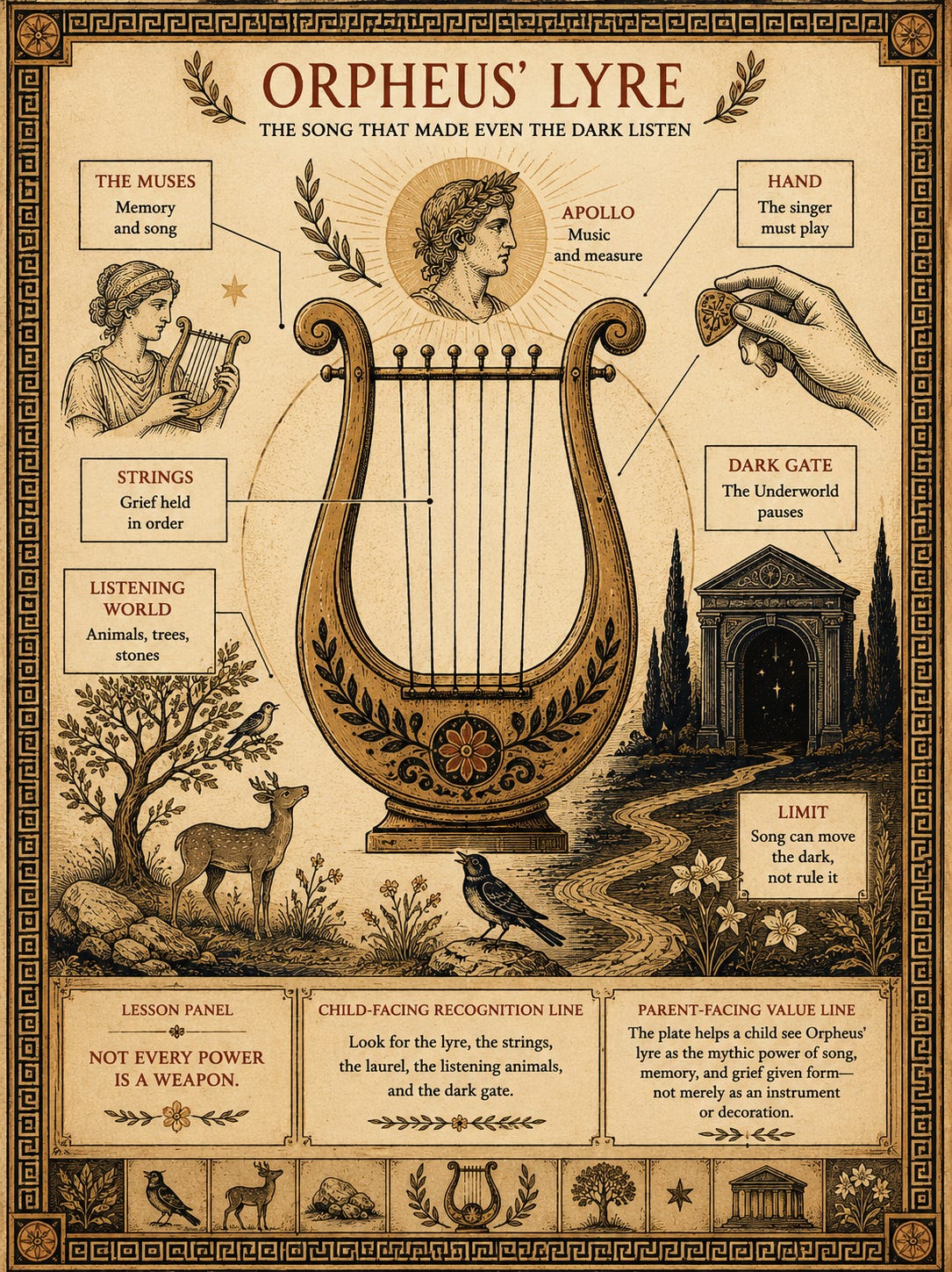
When you see Orpheus’ lyre in a picture, look for these signs.
The Lyre
The lyre is the main sign of Orpheus. It means song, poetry, music, and sorrow given shape.
The Strings
The strings show order. Without strings, there is no music. There is only wood, silence, and the memory of a song that has not begun.
The Hand
The hand matters because music is not only a gift. It must be played. Orpheus’ power lives in attention, practice, courage, and touch.
The Laurel
Laurel belongs to Apollo. Near the lyre, it reminds us of music, measure, light, and divine art.
The Muse
A Muse near Orpheus reminds us that song is tied to memory. The singer remembers what others cannot bear to say.
Listening Animals
Animals gathering near the lyre show that Orpheus’ music reaches beyond human language. The song is understood before it is explained.
The Bending Tree
A tree leaning towards the music shows the living world moved by song. It is not scenery. It is listening.
The Dark Gate
The gate of the Underworld reminds us that Orpheus’ song went where living songs do not usually go.
The Broken or Silent String
A broken string is a warning. Song has power, but it also has limits.
Why This Matters in the Tales
The Alexander Series has many kinds of power in it.
Perseus has a shield bright enough to save his life.
Theseus has a thread small enough to remember the way out.
Odysseus has a name clever enough to hide inside.
Atalanta has speed.
Daedalus has craft.
Heracles has strength.
Orpheus has a lyre.
This helps us see something important about Greek myth. The old stories do not only ask who is strongest. They ask what kind of power each person carries, and whether that power is enough for the place they must enter.
A shield is not useful in the same way as a thread.
A thread is not useful in the same way as a club.
A club is not useful in the same way as a song.
Orpheus’ lyre teaches us that some doors cannot be broken open. Some monsters cannot be fought in the usual way. Some griefs cannot be struck, tricked, or escaped.
Some things must be sung before they can be borne.
One Thing to Remember
Orpheus’ lyre could make the dark listen, but it could not make the dark stop being dark.