
Old Stories, Young Hands
Introducing The Little Mythologist, a printable Greek mythology workbook for children who are ready to meet myth through stories, symbols, colouring, and wonder.

There is a moment, when a child meets a myth, when the story becomes more than something heard.
It becomes an image.
An owl in the branches of an olive tree.
A thread held carefully in the dark.
A shield polished bright enough to help a hero look without looking.
A wooden horse waiting silently before the gates.
Children understand this more quickly than we sometimes expect. They know that things in stories are rarely only things. A lyre is not only a lyre. A labyrinth is not only a maze. A pair of wings is not only a pair of wings. The old stories teach through objects, animals, paths, gifts, warnings, mistakes, and signs.
That is one of the reasons I have made The Little Mythologist.
The Alexander Series began with a simple belief: Greek myths can be retold for children without making them silly, thin, or careless. Children do not need the old stories flattened into noise. They do not need monsters turned into jokes, heroes made smug, or gods treated as decorations. They need clarity. They need care. They need the door opened gently.
But once the door is open, many children want to do more than listen.
They want to point.
They want to notice.
They want to colour.
They want to ask.
They want to keep something in their own hands.
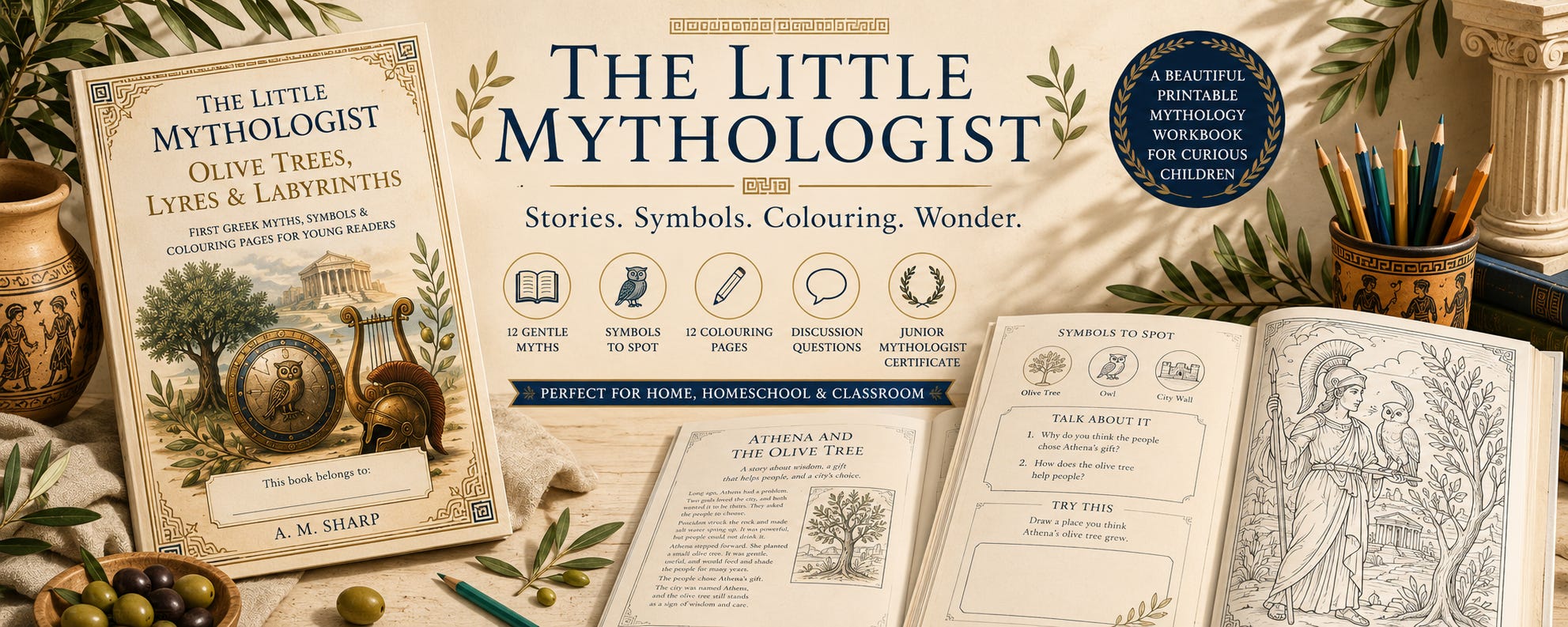
The Little Mythologist: Olive Trees, Lyres & Labyrinths is a new printable workbook created for that moment.
It is a first Greek mythology notebook for young readers — a 32-page printable PDF with twelve gentle myth retellings, twelve bold colouring pages, symbol-spotting, discussion questions, creative prompts, activities, and a Junior Mythologist Certificate.
Each myth is met twice.
First through words.
Then through line.
The story page gives the child a clear, careful retelling. Not a textbook summary. Not a comprehension test. Not a busy worksheet. A story held simply enough for young readers, but seriously enough for the myth to keep its dignity.
Then the colouring page returns the child to the same story through image. The child looks again — this time for the olive tree, the owl, the city wall; the lyre, the tortoise, the winged sandals; the sheep, the cave, the ship. Colouring becomes a kind of attention. The hand remembers what the ear has heard.
This matters because mythology is not only a chain of events.
Myth is symbolic memory.
A child who notices Athena’s olive tree is not only learning that Athena gave a gift to a city. The child is beginning to understand that wisdom can be useful, generous, and life-giving.
A child who colours Ariadne’s thread is not only remembering Theseus in the labyrinth. The child is beginning to see that courage often needs guidance.
A child who sees Perseus looking into the shield is not only meeting a monster story. The child is learning that some dangers must be faced carefully, indirectly, with help, and with thought.
These are small beginnings. But childhood is made of small beginnings.
The workbook includes twelve Greek myths, arranged as a first journey through old stories:
Athena and the Olive Tree
Hermes and the Tortoise Lyre
Demeter and Persephone
Midas and the Golden Touch
Arachne and Athena
Atalanta Runs for Her Freedom
Perseus and Medusa
Theseus and the Minotaur
Daedalus and Icarus
Bellerophon and Pegasus
Odysseus and the Cyclops
The Trojan Horse
The stories have been adapted with care for children aged 6–10. They preserve mythic seriousness, but avoid graphic violence, frightening detail, adult themes, and heavy explanation. The aim is not to remove all danger from myth. That would make the stories false. The aim is to hold danger in a form young children can approach.
Show the pressure, not the trauma.
Show the symbol, not the wound.
Show the choice, not the spectacle.
Show the consequence, not the punishment.
That is the governing spirit of the workbook.
Greek myths contain courage, cleverness, pride, fear, mistakes, warnings, kindness, danger, and wonder. Children can meet these things. They meet them every day in smaller forms: in friendships, in choices, in jealousy, in fear of the dark, in wanting too much, in learning to listen, in wanting to be brave.
Myth gives these inner experiences a shape.
A horse.
A shield.
A thread.
A wing.
A gate.
A tree.
This is why I wanted The Little Mythologist to feel beautiful enough to keep. Not disposable. Not noisy. Not like schoolwork disguised as fun. A child’s completed pages should be able to live in a folder or binder like the beginning of a personal mythology notebook.
There is a Parent / Teacher Guide. There is a simple “How to Use This Workbook” page. There are story-and-colouring pairs, closing activities, and a certificate at the end. It can be used at home, in homeschool, in a classroom, with a tutor, or as quiet enrichment for a child who loves old stories.
No grown-up needs to be an expert in Greek mythology. The rhythm is simple:
Read the story.
Notice the symbols.
Talk about the myth.
Try one small creative prompt.
Colour the matching page.
Keep the finished work.
That is enough.
Sometimes we overcomplicate children’s first encounters with old stories. We rush towards explanation. We turn myth into facts, or morals, or content. But a child’s first relationship with myth is often more elemental than that.
The child sees the horse before the war.
The apple before the choice.
The wings before the fall.
The thread before the way out.
Those images stay.
And when they stay, the stories stay with them.
The Little Mythologist is my attempt to make something useful, beautiful, and immediately usable for families who want Greek mythology in their children’s lives — not as noise, not as trivia, but as a quiet beginning in symbolic imagination.
For children who want to be trusted by stories.
And for grown-ups who want ready-to-print ways to keep those stories alive.
Old stories still belong to children.
They belong in the listening ear, yes.
But also in the noticing eye.
In the colouring hand.
In the question asked at the table.
In the page kept carefully afterwards.
That is where myth begins again.
The Little Mythologist: Olive Trees, Lyres & Labyrinths — First Greek Myths, Symbols & Colouring Pages for Young Readers is now available as a printable workbook for children ages 6–10.
It includes twelve Greek myth retellings, twelve matching colouring pages, symbol-spotting, gentle questions, creative prompts, activities, and a Junior Mythologist Certificate.
A free sample spread from Athena and the Olive Tree is also available here:
The_Little_Mythologist_Sample.pdf