
Heracles and the Lion
A Greek myth retold with danger, warmth, and wonder: a tale of strength, fear, and the cave where weapons are no longer enough.

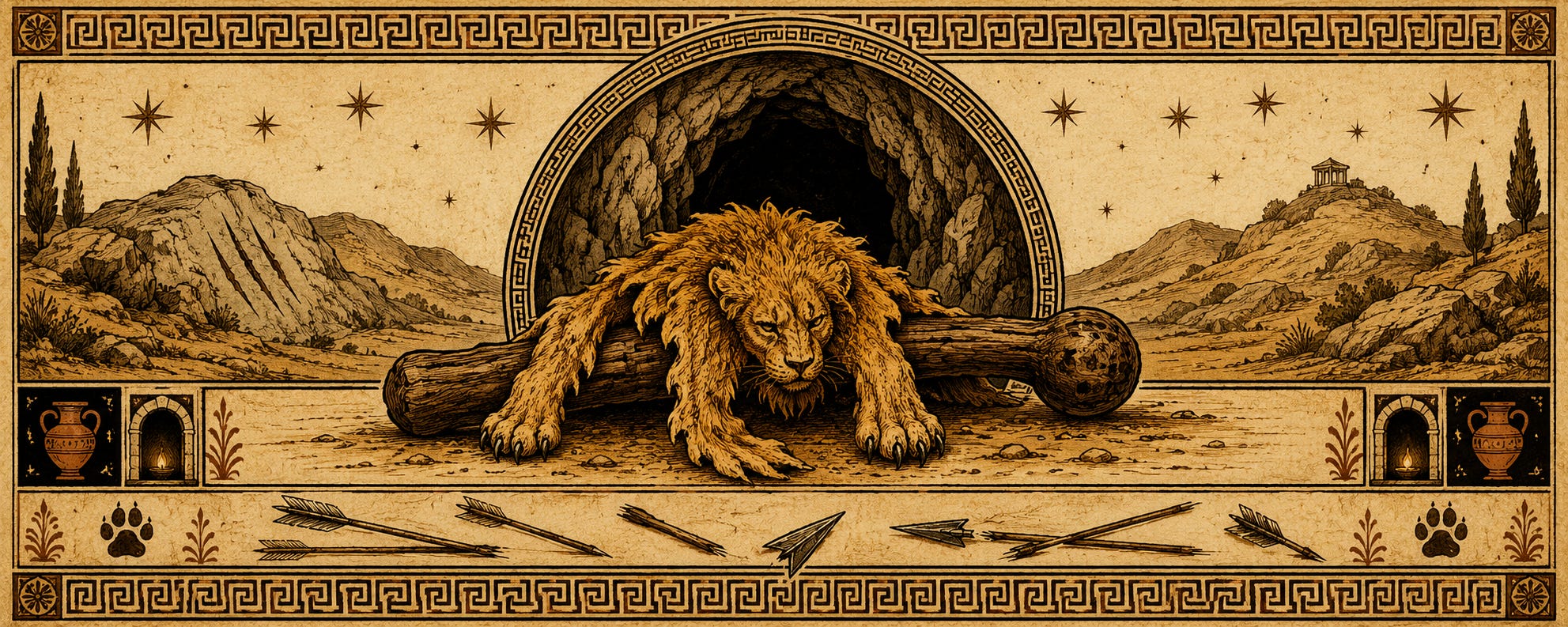
In Nemea, people had begun to close their doors before sunset.
That is a strange thing for a village to do when the sky is still bright, when goats are still nosing at the dust, when children should still be chasing one another between the houses, and when old men should still be sitting outside pretending not to enjoy giving advice.
But in Nemea, the doors closed early.
The sheep were brought in before the shadows grew long. The dogs stopped barking at dusk and crept beneath the tables. Mothers called their children inside with voices that tried very hard to sound ordinary.
And when something moved in the hills, no one said, “Perhaps it is only the wind.”
They knew better.
There was a lion in Nemea.
Not an ordinary lion, though an ordinary lion would have been quite enough for most sensible people. This lion had a hide no arrow could pierce, claws that marked stone, and a roar that made even brave men remember urgent business somewhere else.
It had come down from the hills and made the valley smaller.
That is what fear does, if it is allowed to stay. It makes the world smaller. First the children do not go near the olive grove. Then the shepherds do not take the far path. Then the doors close before sunset. Then everyone begins listening for the sound they dread most.
The people of Nemea had almost forgotten what it felt like not to listen.
So when Heracles came along the road, carrying his great club over one shoulder, they watched him from their doorways.
He was not difficult to notice.
Heracles was taller than other men, wider across the shoulders, and strong in a way that made even heavy things seem briefly embarrassed to be heavy. His arms looked as if they had been made for lifting stones, bending bronze, and doing the sort of work that other men wisely tried to do with teams of oxen.
But he did not arrive laughing.
He did not arrive boasting.
Heracles knew something many people forget when they tell stories about strong men.
Being strong is not the same as being safe.
He had been sent to Nemea by King Eurystheus, who was very good at commanding dangerous deeds from a comfortable distance. Kings are often brave about monsters when the monster is several hills away and someone else is walking toward it.
Heracles had been given a task.
Kill the lion.
Bring back proof.
That was all.
It sounded simple, which is usually the first sign that it is not.
An old shepherd came out to meet him. He kept one hand on the doorpost, as if the house might need to be held in place.
“You are Heracles,” he said.
“I am.”
“You have come for the lion.”
“I have.”
The shepherd looked toward the hills.
“They all came for the lion.”
Heracles turned his head slowly.
“All?”
“Hunters. Soldiers. Men with bronze helmets and fine spears. Men who said they had faced boars, bulls, bandits, wolves, and one another.” The shepherd looked back at him. “The lion did not seem impressed.”
Behind him, a little girl peered from the doorway. Her mother gently drew her back, but not before Heracles saw the child’s face.
She was not curious.
She was measuring him.
Children do that. They are very good at asking without words:
Are you really enough?
Heracles looked at the hills again.
“Where does it sleep?” he asked.
“There is a cave beyond the broken ridge,” said the shepherd. “Two mouths. One on the near side. One on the far.”
“Good,” said Heracles.
The shepherd gave him a tired look.
“Only if you are the lion.”
This was fair.
Heracles thanked him and walked on.
The road soon became a track. The track became a scar of pale dust between stones. Grass grew less often. The birds became quieter. Even the insects seemed to have made arrangements to be elsewhere.
Heracles climbed toward the broken ridge.
He saw marks on the ground.
A deep print in the dust.
A branch torn from a tree.
A stone scored by claws.
Then he found a bronze spearhead lying half-buried near a thorn bush. The shaft was gone. The metal point was bent.
Heracles picked it up, turned it between his fingers, and said nothing.
A little farther on, he found an arrow.
It had not broken.
It had simply failed.
Its point was blunted flat, as if it had struck a wall.
That was when Heracles first understood the shape of the task.
The lion was not only large.
The lion could not be reached in the ordinary way.
He climbed higher.
By the time he reached the ridge, the sun had moved westward and the valley below him was beginning to change colour. The houses of Nemea looked very small from there. Smoke lifted from the roofs. Doors were closing.
Heracles stood still.
Then he heard it.
Not a roar.
That would have been easier.
A low sound came from somewhere beyond the stones. A breathing sound. Heavy. Slow. Patient.
Heracles lifted his bow.
The lion came from between two rocks.
It did not leap at once. It did not need to. It walked into the open as if the hillside belonged to it, which, for some time, it had.
Its mane was dark gold. Its shoulders moved like rolling earth. Dust clung to its paws. Its eyes were bright and unhurried.
Heracles drew the bowstring to his ear.
The lion looked at him.
That is not a pleasant thing, being looked at by a creature that has already decided what sort of meal you are.
Heracles released the arrow.
It flew straight.
It struck the lion’s side.
And sprang away.
Not slowly. Not weakly. It sprang away as if the lion’s hide were not skin at all, but bronze under fur.
The lion did not even turn its head.
Heracles took another arrow.
This one he aimed at the shoulder.
It struck.
It fell.
The lion blinked.
Heracles shot again. And again.
The arrows struck and failed, struck and failed, struck and failed, until the ground between them was scattered with useless shafts.
Then the lion roared.
The valley heard it.
Doors shook in Nemea. Dogs flattened themselves against floors. The little girl at the shepherd’s house pressed her hands over her ears.
On the ridge, Heracles did not cover his ears.
He dropped the bow.
He took the club in both hands.
Now, a club is not a subtle thing. Heracles’ club was even less subtle than most. It was made from hard wood, weighted by years of use, and large enough to make a sensible opponent reconsider the whole business of fighting.
The lion came.
Heracles swung.
The club struck the lion’s head with a crack that echoed against the ridge.
The lion staggered.
That was something.
Not enough.
But something.
Heracles swung again. The lion twisted aside with dreadful quickness. Its paw tore the earth where Heracles had stood a heartbeat before. He stepped back, felt loose stone shift beneath his heel, and caught himself just in time.
The lion came low.
Heracles brought the club down.
Again the lion staggered, shook its mane, and backed away.
For the first time, it looked annoyed.
This was not as comforting as you might think.
An annoyed lion is still a lion.
The fight moved across the ridge. Dust rose around them. Stones leapt and rolled. Heracles struck when he could. The lion struck when it chose.
Then Heracles hit the lion with all the force in his body.
The club broke.
For a moment, everything stopped.
Heracles stared at the split wood in his hands.
The lion stared at Heracles.
Then the lion turned and ran.
Not away.
Toward.
Toward the darker side of the ridge.
Toward the cave.
Heracles followed.
He ran past thorn, rock, and dry grass. He saw the lion vanish through a black opening in the hillside.
Then silence.
Heracles stopped outside the cave.
The entrance was not large enough for comfort. It was wide enough for the lion. It was wide enough for Heracles. That was all.
Cold air breathed from it.
Behind him, the sky was still open. Above him, birds circled far away. Below him, somewhere beyond the ridge, people were waiting to know whether the doors would ever open again before sunset.
In front of him was the dark.
Heracles looked down at the broken club in his hand.
Arrows had failed.
The club had failed.
The lion’s hide could not be pierced.
The cave waited.
Outside the cave, he still had the sky.
Inside, he would have only the dark, the lion, and himself.
Now, the shepherd had said there were two mouths to the cave. That mattered. A lion with two ways out of a cave is not trapped. It is simply resting while you make a very poor decision.
Heracles was strong.
He was also not foolish, which is more useful than people admit.
He found the second opening on the far side of the hill. It was narrower, but clear enough for the lion to slip through. Heracles dragged stones to it. Large stones first. Then smaller ones. Then thorn branches. Then more stones. He worked until the second mouth was shut.
By the time he returned to the first entrance, the sun was almost gone.
The cave looked darker than before.
That is because it was.
Heracles took one breath.
Then he went in.
The first thing he lost was the sky.
The second thing he lost was room.
Inside the cave, the walls came close. Stone brushed his shoulders. The air smelled of dust, old bones, wild heat, and the deep animal smell of a creature that had never been afraid of anything in its life.
Heracles moved slowly.
His broken club was useless now, so he let it fall behind him.
The sound was small.
Too small.
In the dark, small sounds become large in the mind. A scrape of sandal on stone. A drop of water. Breath. Another breath.
Not his.
Heracles stopped.
Somewhere ahead, the lion breathed.
You may think courage is loud.
It is not.
At the beginning, courage is often very quiet, because it is trying not to waste breath.
Heracles put out one hand and touched the wall.
Stone.
Cold.
Real.
He moved forward.
The lion moved too.
He could not see it clearly. Only a darker shape within the dark. A shift. A low gleam. The faint curve of a mane.
Then the lion sprang.
Heracles did not have time to think.
He threw himself sideways. The lion struck the wall where his chest had been. Stone cracked. Dust burst into his mouth. He rolled, came up on one knee, and the lion was already turning.
It came again.
This time Heracles met it.
Not with a spear.
Not with an arrow.
Not with a club.
With his arms.
The lion’s weight drove him backward into the stone. Its breath was hot against his face. Its roar filled the cave so completely that there seemed to be no room left for any other sound in the world.
Heracles held on.
That was the task now.
Not to look grand.
Not to seem brave.
Not to win quickly.
Hold on.
The lion twisted. Heracles tightened his grip. The lion threw its body sideways. Heracles went with it and struck the wall hard enough to see sparks in the dark. The lion reared. Heracles drove his feet against the stone and held on still.
In that cave, the great strong man became a single stubborn word.
No.
The lion would not have the valley.
No.
It would not have the children called indoors before dusk.
No.
It would not have the shepherds listening at their doors.
No.
It would not have him.
The struggle seemed to last a long time.
Perhaps it did.
Time behaves badly in caves.
At last, the lion weakened.
Its great body shuddered. Its roar broke into a rough sound and then into breath.
Heracles held on until the danger had truly passed.
Then he let go.
For a while he stayed where he was, one hand against the cave wall, breathing hard in the dark.
No one cheered.
No trumpet sounded.
No king stepped forward to say something foolish and pleased.
There was only Heracles, the stone, the silence, and the strange emptiness that comes after fear has spent itself.
When he finally rose, he looked at the lion.
Even then, in the dark, it seemed almost impossible that such a creature could be still.
Heracles stood beside it with torn hands, bruised arms, dust in his hair, and no weapon left to lift.
He had come into the cave as the strongest man alive.
He came out carrying something stronger.
Outside, night had fallen.
The stars had come out over Nemea.
Heracles stood at the mouth of the cave and breathed the open air.
Below, in the valley, someone saw him.
At first there was no shout. People are careful with hope when they have been frightened for a long time.
Then a door opened.
Then another.
Then another.
A lamp appeared.
Then two.
Then twenty.
By the time Heracles came down from the hills, the people of Nemea were standing in the road with lamps in their hands.
No one knew what to say at first.
The old shepherd came forward.
He looked at Heracles’ empty hands.
“Where is your bow?”
“On the ridge.”
“Where is your club?”
“In the cave.”
The shepherd swallowed.
“And the lion?”
Heracles turned slightly and looked back toward the dark hill.
“The lion will trouble Nemea no more.”
The little girl stepped from behind her mother.
This time, no one pulled her back.
She looked at Heracles, really looked at him, and seemed disappointed for a moment. Perhaps she had expected him to shine. Perhaps she had expected heroes to come back from monsters looking like statues.
Heracles did not look like a statue.
He looked tired.
He looked hurt.
He looked very much as if he had been inside a cave with a lion.
Then the girl said, “Were you afraid?”
The adults around her went very still. Adults often become uncomfortable when children ask the question everyone else wants answered.
Heracles looked down at her.
“Yes,” he said.
The girl considered this.
“But you went in.”
“Yes.”
She nodded.
That seemed to settle the matter.
Later, Heracles returned to the cave.
He could not pierce the lion’s hide with any blade, because the hide was still what it had been: stronger than iron, stronger than bronze, stronger than the weapons that had failed against it. But with the lion’s own claws, he was able to cut the skin free.
He did not do it proudly.
He did it carefully.
That skin had carried fear through Nemea.
Now it would carry memory.
When Heracles put the lion skin over his shoulders, the mane fell around his head like a wild golden hood. The paws hung down his chest. The hide that no weapon could pierce now covered the man who had learned to go where weapons could not help him.
From that day on, people knew Heracles by the lion skin.
They saw him coming along a road and whispered his name.
Children remembered the mane.
Warriors remembered the strength.
Kings, especially the sort of kings who enjoyed giving impossible orders from safe rooms, remembered the proof.
But in Nemea, they remembered something else.
They remembered the evening when the doors stayed open.
They remembered lamps in the road.
They remembered that the strongest man in the world had not said, “I was never afraid.”
He had said, “Yes.”
And he had gone in anyway.
That is why the old stories gave Heracles the lion skin.
Not because he had never known fear.
Because when the cave opened before him, and the weapons had failed, and the dark was waiting with teeth inside it—
Heracles went in.