
Hera
Before Heracles faces the lion, meet Hera: queen of Olympus, guardian of marriage, and the goddess whose anger follows him.

Before Heracles meets the lion, before he learns how heavy a monster can be, there is Hera.
She is not the lion.
She is not the cave.
She is not the labour itself.
But her anger is already on the road.
Hera is one of the greatest of all the Olympian gods. She is the queen of Olympus, wife of Zeus, and goddess of marriage, queenship, women, childbirth, family order, solemn promises, and honour kept in its proper place.
She is not a small figure in the old stories. She does not stand at the edge of Olympus, cross and overlooked, while the other gods do more important things.
Hera sits on a throne.
That matters.
In Greek myth, a throne is not only a chair. It is a sign of power. Hera’s throne tells us that she belongs among the highest gods. She is magnificent, proud, watchful, and dangerous when dishonoured.
The short answer is this: Hera is the queen of the gods, and when she is angry, her anger can become part of a hero’s fate.
That is especially important before Heracles enters the story.
Heracles is one of Zeus’s mortal sons. Zeus, as you may already have noticed if you have been paying attention to Greek myth, was not always wise about promises, marriage, or the feelings of other people. Quite a lot of Greek myth begins with Zeus doing something he should not have done, and other people having to live with the consequences.
Hera often had to live with those consequences too.
She is the goddess of marriage, but her own marriage to Zeus is full of broken trust, quarrels, and wounded honour. That does not make Hera kind. It does not make her fair. But it helps us understand why honour matters so fiercely to her.
In many stories, Hera’s anger falls not only on Zeus, who has earned a fair amount of it, but also on the children Zeus leaves behind.
That is not fair.
Greek myths are not always fair. The gods in these stories are powerful, splendid, ancient, and strange — but they are not always good.
A child reading Greek myth should know this early.
A god can help a hero.
A god can test a hero.
A god can make a hero’s life almost impossible.
Hera often does the third thing.
Heracles is the clearest example. Even his name is strange. Heracles means something like “the glory of Hera.” That is a very odd name for a hero whom Hera does not love. It is as if his whole life carries her name inside it, even while her anger presses against him.
This is one of the deep strangenesses of Greek myth. A hero may be named after the very power that opposes him. A life may become great not because it is easy, but because it has to bear more than seems possible.
When people think of Heracles, they often think first of strength.
Huge arms.
A heavy club.
A lion skin over his shoulders.
A hero who can face creatures no sensible person would want to meet.
That is true, but it is not enough.
Heracles’ strength is not only strength of muscle. If it were, his story would be much smaller. He would simply be the man who could hit harder than other men.
But Heracles lives under pressure. He is pushed, burdened, driven, and tested by forces far larger than himself. Hera’s anger is one of those forces. She makes his life difficult before the lion appears, and after the lion is gone, and long after any ordinary person would have thought one danger was quite enough.
That is why Hera matters here.
She does not make Heracles heroic by being kind to him.
She makes the world heavier around him.
This does not mean Hera is only a villain. Be careful with that word. Greek gods are rarely so simple.
Hera protects marriage. She guards queenship. She cares about honour, rank, vows, and the order of the household. She can be majestic. She can be loyal to what she believes is right. She can also be severe, unforgiving, and frighteningly cruel when her dignity has been wounded.
She is not a monster.
That is what makes her more frightening.
A monster may have claws, tusks, teeth, or a terrible hide. A monster may live in a cave or a forest or a place people avoid. A monster can often be seen coming.
A goddess does not need claws.
Hera’s power works through command, pressure, memory, and divine will. Her anger can cross distances. It can wait. It can return. It can turn a hero’s road into a long trial before he understands what road he is walking.
So, before Heracles faces the Nemean Lion, remember this: the lion is not the first thing weighing on him.
Hera’s signs are worth knowing.
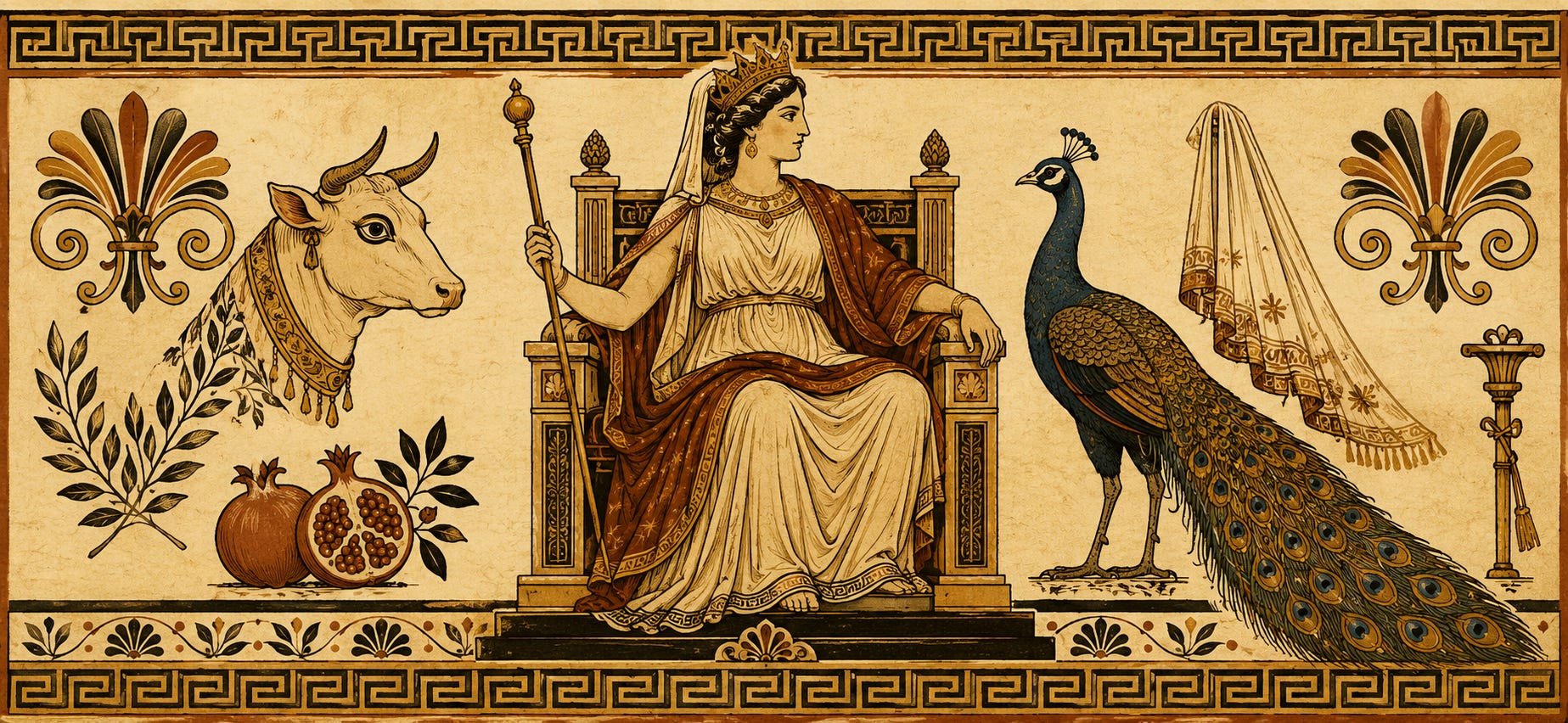
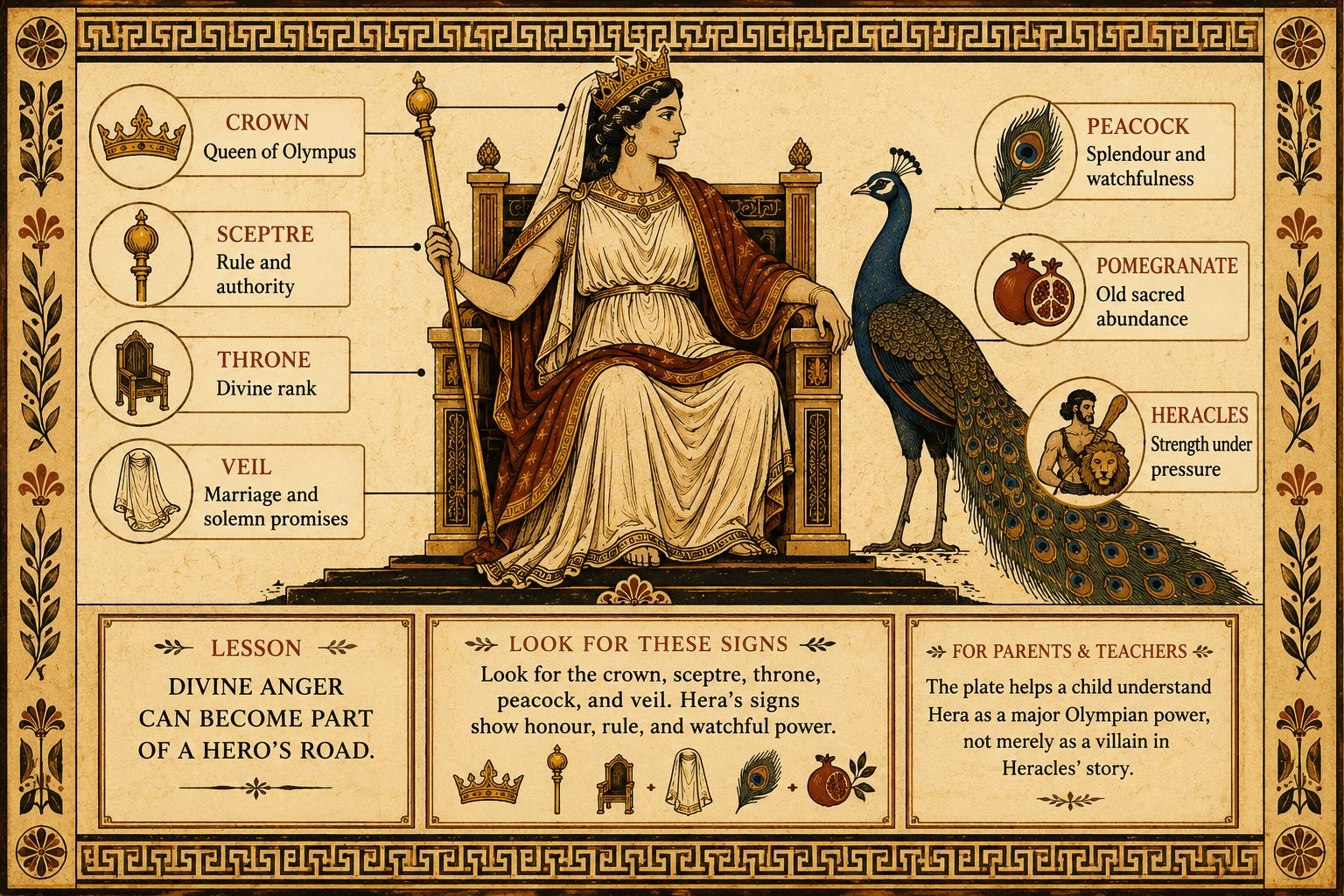
Look first for the crown or diadem. Hera is queen of Olympus. The crown tells us that she rules, that she possesses rank, and that she expects her honour to be recognised.
Look for the sceptre. A sceptre is the sign of authority. Hera is not merely beautiful or important. She has power.
Look for the throne. Hera seated on a throne is Hera in her full dignity: royal, still, watchful, impossible to ignore.
Look for the veil. The veil belongs to marriage, ceremony, and solemn promises. Hera’s world is a world of vows — and of anger when vows are broken.
Look for the peacock. In later art especially, the peacock becomes Hera’s splendid bird: royal, brilliant, watchful, covered with eyes. Even when it is beautiful, it looks as if it sees everything.
Look for the cow. This is one of Hera’s older signs. The Greeks sometimes called her “cow-eyed,” not as an insult, but as a way of speaking about majesty, beauty, and a large, watchful gaze.
Look for the pomegranate. Like many of Hera’s signs, it belongs to marriage, fertility, sacred abundance, and old powers of life.
These symbols help a child see Hera clearly. She is not a random angry goddess. She is royal order, marriage honour, watchful splendour, and wounded dignity made divine.
And that makes her dangerous to Heracles.
When you read Heracles and the Lion, do not look only at the lion.
Yes, the lion matters. Of course it matters. A lion that cannot be wounded by ordinary weapons deserves a reader’s full attention.
But remember the invisible weight too.
The monster has claws.
Hera’s anger has no claws at all —
and still it follows him.
Heracles must face the lion with his hands, his courage, and his enormous strength. But his greater story is larger than one fight. Again and again, he must bear a life made difficult by a goddess who will not forget him.
That is why his strength matters.
Not because he is never afraid.
Not because trouble bounces off him.
Not because the gods are fair.
His strength matters because the pressure is impossible, and still he stands inside it.
One thing to remember:
Hera is not the monster Heracles fights. She is the pressure that makes his strength matter.