
Daedalus and the Wings
A Greek myth retold with wonder, danger, and sorrow for children who are ready for the sky’s own rules.

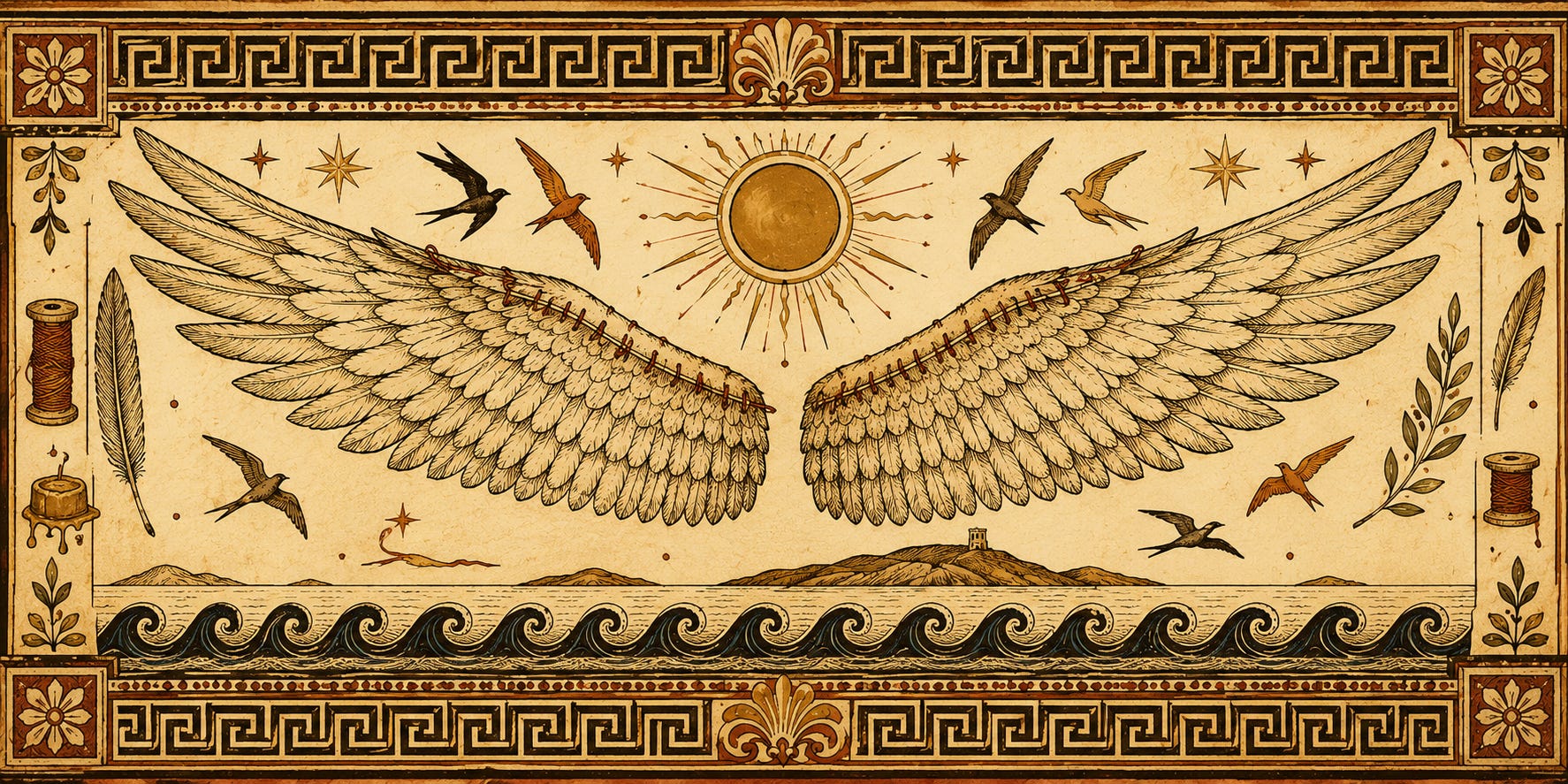
Daedalus could hear the sea, but he could not reach it.
That was one of the worst things about being kept on Crete. If there had been no sea at all, perhaps he might have borne it better. If the island had been a wall of mountains, or a desert, or some shut-up place where the world ended in dust, he might have looked at the horizon and said, There is nowhere to go.
But the sea was there.
Every morning it flashed beyond the walls. Every evening it darkened under the last light. It breathed in and out against the rocks as if it knew the way to every shore in the world and was quietly refusing to tell him.
Daedalus stood at the high window and watched it.
Behind him, Icarus was trying to make a boat from two pieces of broken wood, a strip of linen, and far too much confidence.
“It will not float,” said Daedalus, without turning round.
“You have not even looked.”
“I have heard enough.”
Icarus frowned at the little boat. He blew on its scrap of sail. The mast fell over at once.
Daedalus did not smile, though he wanted to.
A child should never have to learn captivity by the sound of locked doors. Icarus had learned it anyway. He knew the tread of the guards outside their room. He knew which window caught the morning wind. He knew how many steps it took his father to cross from the workbench to the wall and back again.
That, more than the locked door, troubled Daedalus.
He had made many things in his life. Doors. Hinges. Toys that seemed almost alive. Statues that could startle a person in bad light. Tools, wheels, secret fittings, clever joints, devices so neat that kings leaned close and forgot to be afraid of them.
And once, for King Minos, he had made the Labyrinth.
It is not a comfortable thing to have built a prison so well that even its maker is remembered for it.
Minos had not forgotten either.
A king who keeps secrets does not let the maker of those secrets walk away.
So Daedalus and Icarus were kept on Crete, high above the sea, with guards at the doors, ships watched in the harbour, and no road out that did not end under the king’s eye.
“I could build a better boat,” Icarus said.
“You could build a wetter boat.”
“I mean if you helped.”
“If I helped, the guards would notice.”
“They notice everything.”
“No,” said Daedalus. “They notice doors. They notice roads. They notice ships.”
Icarus looked up.
“What do they not notice?”
Daedalus turned from the window.
It was a dangerous question. Most useful questions are.
He did not answer it that day.
Instead, he watched.
He watched the guards, proud of their spears and bored by the sky. He watched the ships, whose sails were counted and forbidden. He watched the gates, the walls, the paths, the harbour road, the cliffs, the doors, the locks.
And then, because Daedalus was Daedalus, he watched the birds.
They came and went as if Minos did not exist.
Swallows stitched the air above the courtyard. Gulls hung over the sea with their wings spread like white hands. Small brown birds hopped near the roof-tiles, tilted their heads, and departed whenever the world became inconvenient.
No guard stopped them.
No king counted them.
No door knew what to do with them.
For three days Daedalus said almost nothing.
That usually meant something was beginning.
Icarus knew the difference between his father’s ordinary silence, which meant do not interrupt me yet, and his deep silence, which meant something impossible has begun to look slightly less impossible than before.
On the fourth day, Daedalus asked for wax.
The guard outside the door squinted at him.
“Wax?”
“For mending.”
“What is broken?”
Daedalus looked slowly around the room: the stone walls, the barred window, the locked door, the life narrowed to a table, a bed, a bench, and a boy trying not to look too often at the sea.
“Many things,” he said.
The guard did not enjoy clever answers, but he enjoyed asking Minos questions even less. By evening, Daedalus had wax. Not much, but enough to begin. A little later he acquired thread. Then scraps of linen. Then more wax. Then, through patience, barter, dropped crumbs, and the help of birds who had no idea they were assisting one of the greatest makers in Greece, he gathered feathers.
Small feathers first.
Then larger ones.
Then long, strong flight-feathers stolen from moulting gulls, caught on roof-corners, lifted from ledges, tucked under loose stones, hidden in folded cloth.
Icarus found the first great feather himself.
It was caught on the outer sill, trembling in the wind.
“Father.”
Daedalus looked up.
Icarus held it out as if a piece of the sky had come loose.
Daedalus took it.
For a moment he said nothing.
Then he laid it on the table with the others, and the thought became a shape.
After that, the room changed.
It was still locked. The guards still stood outside. The sea still shone beyond reach. But now there was work.
Work is not freedom, but it can keep despair from sitting too close.
Daedalus sorted the feathers by size. He laid the smallest along the inner curve, the strongest at the outer edge. He softened wax in a little dish near the lamp. He twisted thread and tested knots with the seriousness of a man judging rope above a chasm.
Icarus watched every movement.
“Are they for birds?”
“No.”
“For a machine?”
“In a way.”
“For us?”
Daedalus pressed a line of wax with his thumb.
“For us.”
Icarus went completely still.
Then he began asking questions so quickly that not even Hermes, who was god of messages and therefore no stranger to unnecessary speed, could have kept up.
“How will they lift us? How many feathers does a person need? Will my arms go through them? Will it hurt? Will the wax melt? Can we steer? Will we fly over the palace? Will Minos see us? Will the guards shoot at us? Can we go higher than the gulls?”
“Stop,” said Daedalus.
Icarus stopped for almost one whole breath.
“Can we?”
Daedalus looked at him then. He saw the brightness in the boy’s face, the hope that had arrived too suddenly, like sunlight through a door flung open after a long winter.
Hope is a beautiful thing.
It is also difficult to manage indoors.
“We are not playing at birds,” Daedalus said. “We are trying to leave alive.”
“I know.”
“No. You are beginning to know. That is different.”
Icarus bit his lip, which was what he did when he wanted to argue and also wanted not to be sent away from the workbench.
Daedalus softened his voice.
“The wings must obey the air. So must we. If we fly too low, the sea-spray will dampen the feathers and drag us down. If we fly too high, the sun will soften the wax.”
“I will remember.”
“You must do more than remember. You must obey while the wind is shouting and the sky is open and every part of you wants to forget.”
Icarus nodded solemnly.
Children can be very solemn when danger is still only words.
Daedalus returned to the wings.
Day by day, the shape grew.
First one wing.
Then its fellow.
Then two smaller wings for Icarus, made lighter, narrower, fitted to the reach of his arms. Daedalus measured him carefully. Shoulder to wrist. Wrist to fingertip. Across the back. Around the chest. Again and again, because a wrong measurement in a room is annoying, but a wrong measurement in the sky is not forgiving.
When the first wing was finished, Icarus touched it with one finger.
It trembled.
Not like a dead thing.
Like something waiting.
Daedalus saw his son’s face and looked away. There are moments when a father must not let the child see how much he is afraid of the thing they both need.
The night before they flew, neither of them slept much.
The room was full of wings.
The guards outside muttered, yawned, shifted their spears, and thought of breakfast. They did not think of the sky. Very few people do, when they have been told to watch a door.
Before dawn, Daedalus fastened the wings to himself.
The straps crossed his chest. The feathers brushed the floor. He flexed his arms and felt the pull, the resistance, the awful possibility of the thing.
Then he turned to Icarus.
“Stand still.”
“I am standing still.”
“You are quivering.”
“That is a kind of standing.”
“No,” said Daedalus. “It is a warning.”
But his hands were gentle as he fitted the smaller wings to his son’s shoulders.
This was the moment the whole tale had been moving toward, though neither of them could have said so.
A father fastening wings to his child beneath a dangerous sky.
Thread, wax, feather, breath.
Love made into an object.
Fear hidden inside a knot.
Daedalus tightened the last strap.
“Listen to me.”
“I know. Not too low. Not too high.”
“Say all of it.”
Icarus straightened.
“Not too low, because the sea will weigh the feathers down. Not too high, because the sun will soften the wax. Stay near you. Follow the path of the birds.”
“And if you are frightened?”
“Stay near you.”
“And if you are delighted?”
Icarus hesitated.
That was the better question.
Daedalus waited.
“If I am delighted,” Icarus said slowly, “I stay near you.”
Daedalus placed both hands on his son’s shoulders.
“The sky has rules of its own.”
Icarus nodded.
At the window, the first light lifted.
They climbed out before the guards understood that escape could have feathers.
For one terrible instant, they were not flying.
They were only falling.
The room vanished behind them. The wall rushed upward. The air struck Daedalus hard in the chest. Icarus made a sound — not quite fear, not quite laughter — and then Daedalus beat his arms downward with all the strength he had.
The wings caught.
The fall changed.
The air held.
They rose.
Below them, a guard shouted. Another guard dropped his spear. Someone ran toward the door of the room they were no longer in, which was a very sensible thing to do if one still believed doors mattered.
Daedalus did not look back.
“Steady!” he called.
“I am steady!” Icarus called, though he was not.
But he learned quickly.
The first strokes were clumsy, breathless, full of jolts and slips. Then the wings found their rhythm. The air moved under them. The sea opened below in a great dark glittering sheet. Crete drew back, no longer a prison but an island, then a shape, then a memory surrounded by blue.
For a little while, the wings worked.
Remember that.
Whatever sorrow came later, the wings worked.
Daedalus flew, and Icarus flew beside him. Not in a dream. Not in a painting. Not in one of those impossible stories people tell because the world has been dull too long.
They flew.
The gulls wheeled around them, astonished and offended.
Icarus laughed.
Daedalus looked over, and despite everything — despite Minos, despite the Labyrinth, despite the guards, despite the danger pressing above and below — he laughed too.
Because the world had opened.
Because the sea could be crossed without a ship.
Because for once in his life, Daedalus had made a thing that did not hide, trap, or serve a king.
It carried.
“Not too high!” he called.
“I know!”
“Stay with me!”
“I am!”
They flew on.
The sun climbed.
At first it was only a pale disc over the edge of the sea. Then it brightened. Gold touched the waves. Gold touched the feathers. Gold touched Icarus’s hair and made him look, for one breath, less like a boy escaping prison and more like someone the sky had been expecting.
He rose a little.
“Icarus!”
“I am here!”
“Lower!”
Icarus dipped obediently.
For a time.
Joy is a dangerous wind. It does not feel like danger when it first enters the chest.
Icarus had been shut behind walls. He had watched birds come and go as if the world belonged to them. He had slept under a king’s command and woken to the sound of guards. Now the air took his weight. Now the sea flashed below him. Now the sky was not something seen through bars, but something touching his face.
He rose again.
Not because he was wicked.
Not because he wished to frighten his father.
Not because children in old stories exist to demonstrate tidy lessons for adults.
He rose because the sky was open.
Daedalus saw it.
“Icarus!”
The boy heard him. Perhaps he meant to answer. Perhaps he meant to dip lower in the next breath. Perhaps he thought there was still time.
There is often still time, until suddenly there is not.
The sun warmed the wax.
One feather loosened.
Then another.
Icarus looked at his wing.
Daedalus was already turning, already beating toward him with a terror no invention could mend.
“Father?”
It was not a loud cry.
That made it worse.
The wing shuddered. The beautiful order of feather, thread, and wax came apart. The air that had held him a moment before no longer knew how.
Daedalus reached.
He did not reach him.
The sea received Icarus.
Daedalus called his name until his voice broke against the wind.
There are griefs a story must not dress too finely.
This is one of them.
Daedalus circled above the water.
Feathers drifted on the waves.
The sun shone.
The sea moved as it had always moved, though the world beneath Daedalus had changed completely.
At last, because the sky does not hold even sorrow forever, Daedalus flew on.
Every stroke was heavier.
The wings that had been escape were now also memory. Each feather pulled at him. Each beat of his arms asked him to keep living in the world where his son had fallen out of reach.
By the time he came to land, he was no longer the same man who had left Crete.
He had escaped Minos.
He had escaped the locked room.
He had escaped the island.
He had not escaped the cost of the wings.
People would later speak of Daedalus as the great craftsman, and that was true. They would say he built the Labyrinth, and that was true. They would say he made wings and flew away from Crete, and that was true too.
But if you listen carefully to the story, you will hear another truth beneath all the cleverness.
Daedalus could make almost anything.
He could make a prison so cunning that men lost themselves inside it.
He could make wings so marvellous that a father and son rose from an island into the morning air.
He could make a way out where there was no road, no gate, no ship, and no permission.
But he could not make the sky gentle.
He could not make joy careful.
He could not make love fast enough to catch a falling child.
So remember the wings.
Not as a lesson held up by a stern finger.
Remember them as Daedalus made them: feather by feather, thread by thread, with hope in his hands and fear in his heart.
They were beautiful.
They were dangerous.
For a little while, they carried them both.