
Cyclopes
After Odysseus escapes the cave, discover why a Cyclops is not only one eye in the dark.

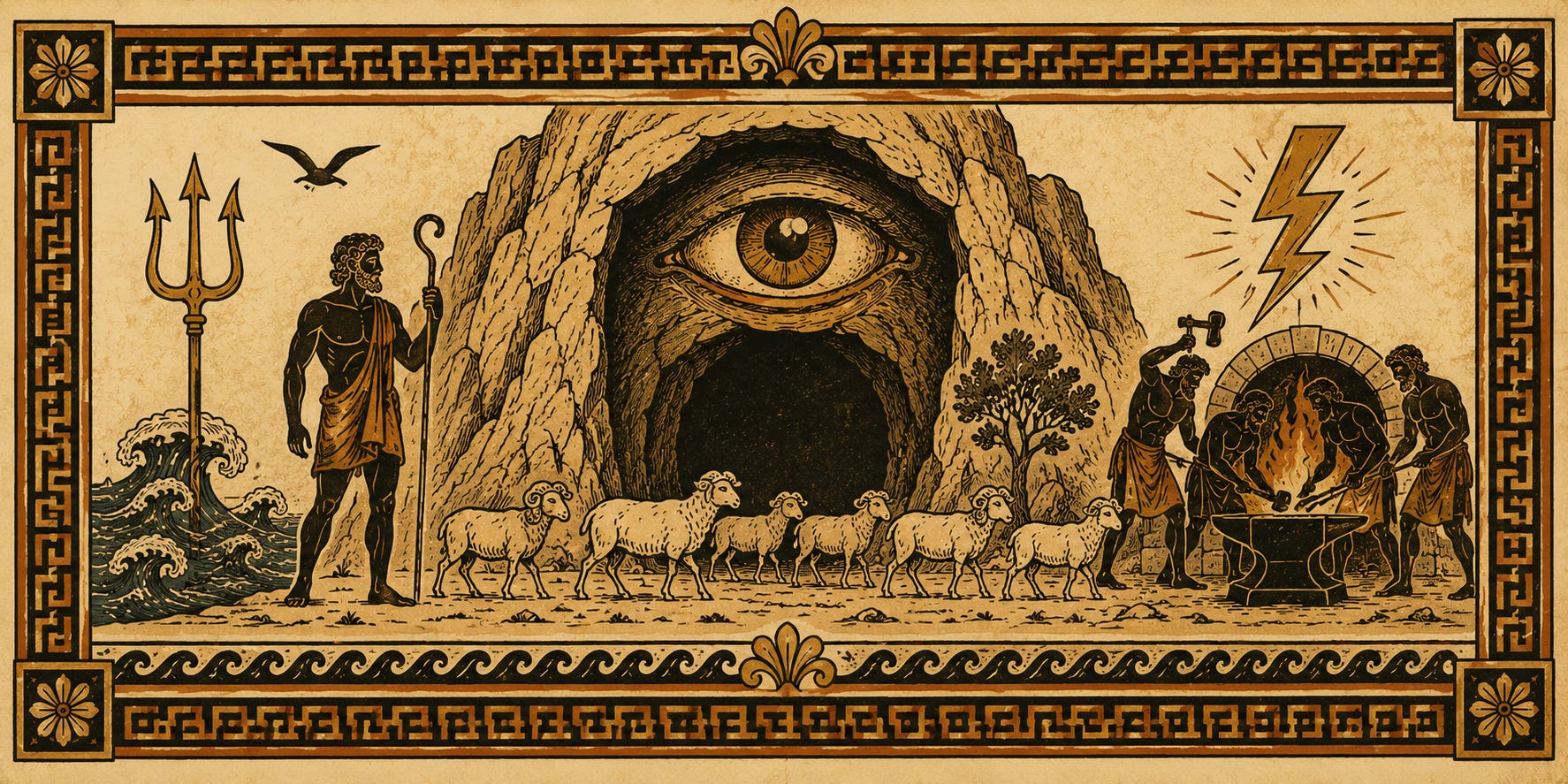
After the Tale
Odysseus has escaped the cave.
The sheep have gone out into the morning. The ship has pulled away from shore. The single eye has been left behind in the dark.
Now we can turn back and ask a stranger question.
What was the Cyclops?
You have met Polyphemus: huge, one-eyed, strong enough to move a stone no ordinary men could shift, and dangerous enough to make a cave feel smaller than a locked room.
But Greek myth is rarely simple for long.
A Cyclops is not only “a giant with one eye.” That is the beginning of the answer, not the end of it. Some Cyclopes are wild, lonely, lawless beings like Polyphemus. Others belong to older stories — stories of fire, thunder, deep earth, and weapons made for gods.
So before we leave the cave behind, we should look once more.
Not for too long.
But long enough to understand what was looking back.
The Short Answer
Cyclopes are one-eyed giants in Greek myth.
Their name means something like “circle-eyed” or “round-eyed,” because each Cyclops has one great eye in the middle of the forehead.
But Cyclopes are not all the same.
Some are wild giants who live apart from human law, human cities, human ships, and human tables. Polyphemus, the Cyclops who traps Odysseus, belongs to this kind of story.
Other Cyclopes are older, stranger, and more powerful. They are divine craftsmen: mighty beings who work with fire, metal, thunder, and hidden force. In some stories, they help make the weapons of the gods.
So a Cyclops may be a monster in a cave.
A Cyclops may also be a maker of thunder.
That is a very Greek sort of difficulty.
What the Tale Showed You
In Odysseus in the Cave of the Cyclops, the Cyclops you met was Polyphemus.
He lived in a cave, not a city. He kept sheep and goats. He made cheese and drank milk. He was not foolish in the way of an animal. He knew his work. He knew his flock. He could close his cave with a stone so huge that Odysseus and all his men could not move it.
That was part of the fear.
Polyphemus was not frightening only because he was large.
He was frightening because he lived outside the rules that protect people from one another.
In the Greek world, a stranger at the door mattered. A traveller might be tired, hungry, lost, shipwrecked, or under the protection of Zeus, who watched over guests. A proper host would offer food and shelter before asking too many questions.
Polyphemus did not care.
He had no council, no king, no city, no table of welcome, no shame before the gods, and no wish to behave like a host. He had strength without courtesy. He had a home without hospitality. He had food, fire, and shelter — all the things that usually make a house safe — but in his cave they became part of the danger.
That is why Odysseus could not simply be brave.
Bravery cannot move a stone that large.
He had to be clever.
What Else the Myths Say
The Cyclopes are older than Odysseus’ adventure.
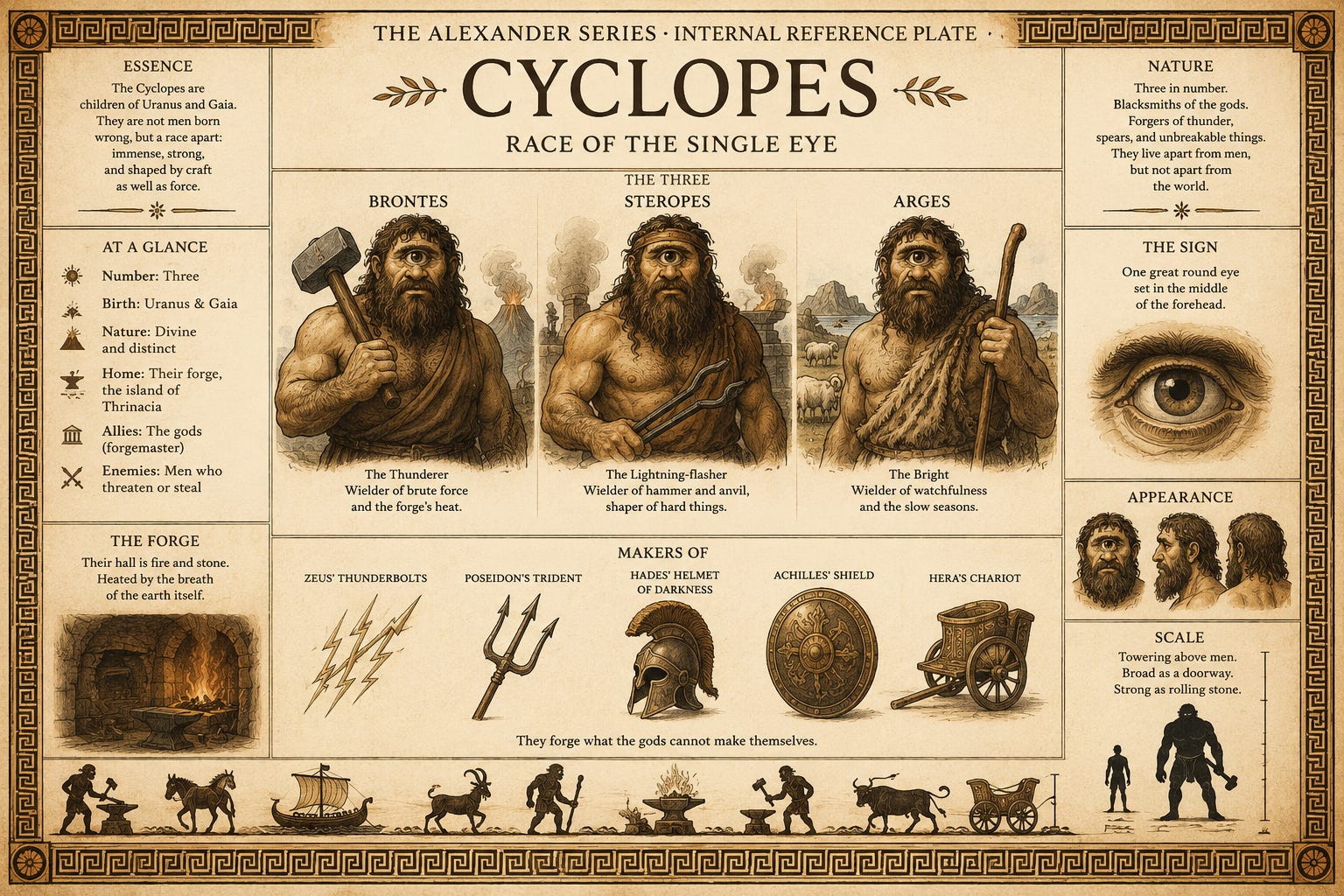
In some ancient stories, the first Cyclopes were the children of Gaea, the Earth, and Uranus, the Sky. Their names were Brontes, Steropes, and Arges — names connected with thunder, lightning, and brightness.
They were not shepherds in caves.
They were powers of making.
These older Cyclopes belonged to the deep beginning of the world, when gods fought gods and the shape of things was still being decided. They were imprisoned, released, and remembered for their terrible skill.
They made weapons for the Olympian gods: Zeus’s thunderbolt, Poseidon’s trident, and Hades’ helmet of darkness.
That means Cyclopes do not belong only to monster stories.
They belong to the making of divine power.
Think of that carefully.
The one-eyed giant in the cave is part of the same wide mythic family as the beings who helped arm the gods. One kind of Cyclops stands outside human law. Another kind works in the hidden fire where the weapons of heaven are made.
The myths do not tidy this for us.
They leave it strange.
Polyphemus and Poseidon
Polyphemus is not only a monster Odysseus defeats.
He is also the son of Poseidon.
This changes everything.
If Polyphemus were only a dangerous giant, Odysseus’ escape might be the end of the matter. The men would row away, the cave would shrink behind them, and the adventure would become a tale told safely at home.
But Greek myth does not always allow danger to stay where you leave it.
Odysseus wounds Polyphemus. Then, worse still, he names himself. He wants the Cyclops to know who has beaten him.
That is when the cave opens into the sea.
Polyphemus calls on his father, and his father is not a small god of a small place. Poseidon rules the sea itself: the water between Odysseus and home, the waves beneath every ship, the storm that can remember an insult.
So the Cyclops matters twice.
He is the danger inside the cave.
He is also the son whose anger summons the god outside it.
Odysseus escapes one eye in the dark.
But the sea has begun to watch him.
Signs and Symbols
You can usually recognise the Cyclopes by these signs:
ONE EYE
The clearest sign.
One great round eye
in the middle of the brow.
GIANT STRENGTH
Cyclopes are enormous.
Their bodies belong to a world
larger than ordinary men.
THE CAVE
For Polyphemus, the cave
is not a safe house.
It is a trap with food inside.
SHEEP AND GOATS
Polyphemus is a shepherd.
His flock becomes part of both
the danger and the escape.
THE STONE DOOR
The stone at the cave mouth
shows why strength alone
cannot save Odysseus.
THE FORGE
The older Cyclopes
belong to fire, metal,
and the making of divine weapons.
THE THUNDERBOLT
In older myths, Cyclopes help make
the thunderbolt of Zeus:
power shaped into a weapon.
POSEIDON
Polyphemus’ father.
The reason the cave’s trouble
does not stay in the cave.
Important Stories
The Cyclopes appear in more than one kind of Greek story.
The most famous Cyclops is Polyphemus, the one-eyed shepherd who traps Odysseus and his men. His story belongs to The Odyssey, where cleverness must defeat strength because strength alone has no way out.
The older Cyclopes — Brontes, Steropes, and Arges — belong to stories about the first generations of gods. They are linked with thunder, lightning, fire, and the weapons of Olympus.
Later, people also used the word “Cyclopean” for enormous stone walls that seemed too large for ordinary human builders. When stones were so huge that no one could imagine normal hands lifting them, the Greeks could say: perhaps the Cyclopes built these.
That is another way myth works.
It looks at something too large for ordinary explanation and gives it a giant’s shadow.
The Two Kinds of Fear
Polyphemus is a Cyclops of the wild edge: lonely, strong, dangerous, and outside human law. He shows what happens when power has no hospitality and no shame.
The older Cyclopes are different. They are not gentle, but they are makers. They belong to the deep workshop of myth, where fire and force become the tools of gods.
One kind of Cyclops traps men in a cave.
Another kind makes the thunderbolt.
Both are frightening.
But they are frightening in different ways.
That is why The Greek World matters. It helps you see that a monster in one tale may have roots reaching far back into older stories. A cave may open into a family. A single eye may belong to a shepherd, a smith, a giant, or a force from the beginning of the world.
The first answer is simple.
The second answer is stranger.
Why This Matters in the Tales
Cyclopes matter because they show how large the Greek world really is.
In the tale, Polyphemus is the monster Odysseus must escape. That is enough for the adventure. A child does not need to know every old story about Cyclopes before feeling the terror of the cave, the cleverness of Nobody, and the relief of the sheep moving toward the light.
But afterwards, the world grows.
Now you know that the Cyclops is not just a monster with one eye. He belongs to a wider pattern: giants, old powers, makers, shepherds, cave-dwellers, god-children, and beings too large to fit neatly into human rules.
You also know why Odysseus’ victory is not simple.
He wins the cave.
He loses the safety of the sea.
That is one of the great truths of Greek myth: escaping one danger may awaken another. A hero can be right to fight and still wrong to boast. A monster can be defeated and still have a father. A name can save you when it is hidden, then endanger you when it is shouted.
Odysseus survives because he is clever.
He suffers because he wants the Cyclops to know it.
One Thing to Remember
A Cyclops is not only one eye in the dark; sometimes it is the old world looking back.