
Bellerophon and Pegasus
A winged horse, a fire-breathing monster, and the danger of mistaking height for wisdom.

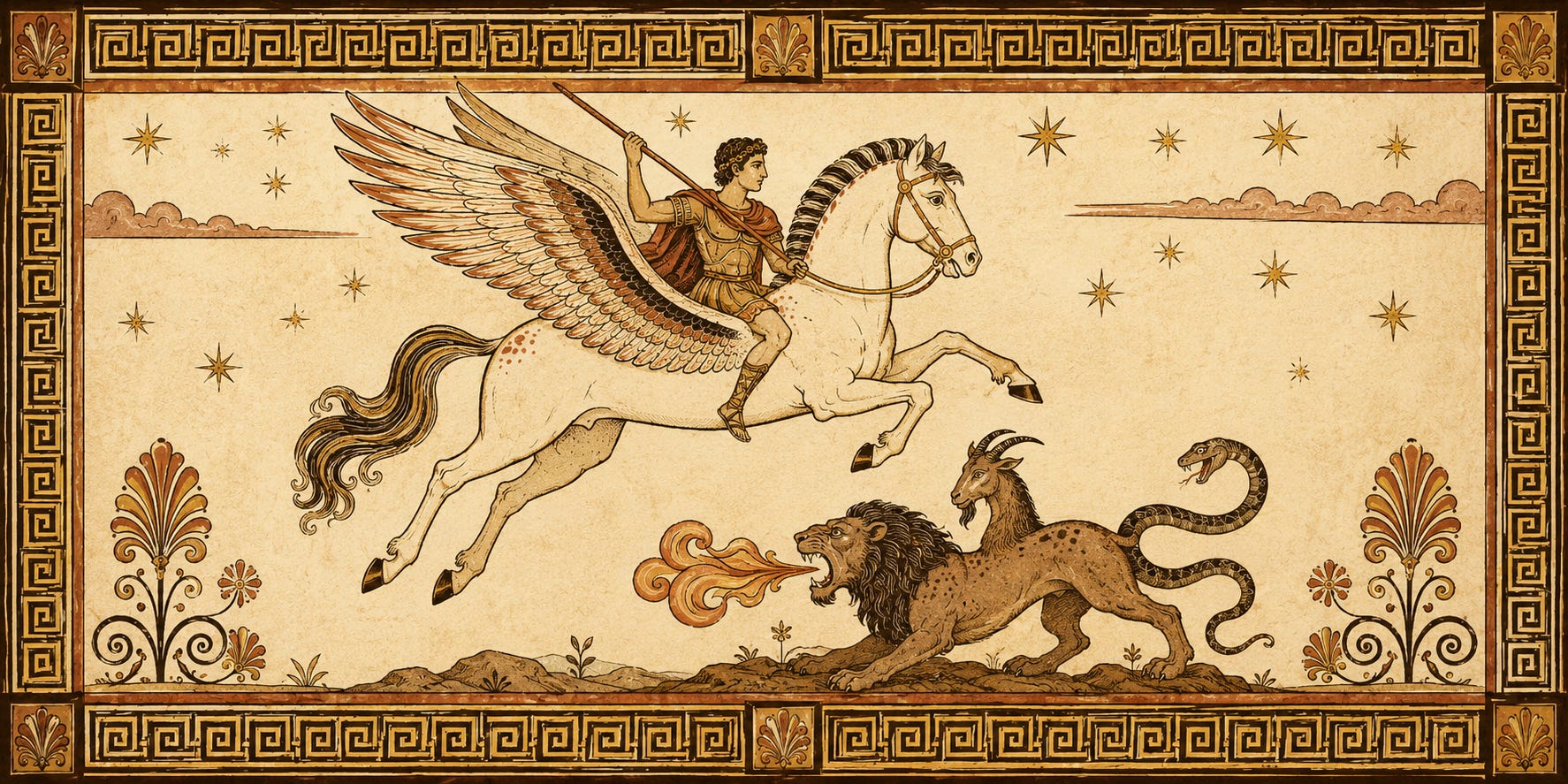
An Alexander Series Tale
Bellerophon came to the palace with dust on his sandals, a good horse under him, and no idea that a sealed message can be sharper than a spear.
The palace stood on a hill above the road. Its gates were bronze. Its floors were polished stone. Its servants moved softly through the halls, as if loud footsteps might disturb something sleeping in the walls.
Bellerophon noticed this at once.
This is not always a good sign.
In a happy house, people may laugh, quarrel, call from one room to another, drop a bowl, and let a door close with an honest bang.
In a dangerous house, even the cups seem careful.
Bellerophon had come as a guest. He was young, strong, and not yet wise enough to distrust every smile offered by a king.
The king’s name was Proetus. He received Bellerophon kindly. He gave him food. He gave him wine. He gave him a place by the hearth.
Then, after the proper number of polite words had been spoken, he gave him a message.
It was written on a folded tablet and sealed tight.
“Carry this to King Iobates,” said Proetus. “He is my wife’s father, and a good friend to this house. You must not open it on the road.”
Bellerophon took the tablet.
He did not know what it said.
That was the point of sealing it.
He did not know that inside, in neat royal words, one king had written to another:
Kill the man who carries this.
That is the sort of sentence a coward writes when he wants murder to arrive looking like paperwork.
Bellerophon bowed. He was young enough to think obedience and honour were the same thing.
Sometimes they are.
Sometimes they are not.
He left the palace the next morning.
The road to King Iobates was long. It crossed dry hills, olive groves, sleeping villages, and high places where the wind moved through grass with a sound like whispering. Bellerophon rode beneath the sun with the sealed tablet at his side.
He thought he was carrying a recommendation.
He was carrying a trap.
King Iobates received him with even more kindness than Proetus had done.
This was worse.
Iobates read the message in private. When he came out, his face was calm. Too calm. He looked at Bellerophon as one looks at a cup already cracked but not yet fallen from the table.
“My guest,” he said, “you have travelled far. You shall rest here.”
For nine days Bellerophon ate at his table.
For nine days he slept under his roof.
For nine days the king gave him gifts and spoke gently.
This was not mercy.
It was guest-law.
A man who had eaten at your table could not easily be killed in your hall, even if another king had requested it in excellent handwriting.
So Iobates did what kings sometimes do when they wish to be cruel without staining the carpet.
He gave Bellerophon a task.
“There is a monster in the hills,” he said on the tenth morning. “It burns the fields. It scatters the flocks. No shepherd goes near that place now. No hunter returns from it. Children wake crying when the wind blows from that direction.”
Bellerophon listened.
The king’s voice remained mild.
“The creature is called the Chimaera. I ask you to destroy it.”
You must imagine the silence after that.
Bellerophon did not answer at once. He was brave, but bravery does not mean the head becomes empty. A person may be brave and still notice when someone has asked him to do something impossible.
“What sort of monster is it?” he asked.
Iobates looked toward the far hills.
“The kind that should not be,” he said.
That was not helpful.
But it was true.
Bellerophon rode out that afternoon.
The king had given him men to guide him part of the way, but none of them intended to go near the Chimaera’s valley. One remembered a sick aunt. Another said his sandal strap was untrustworthy. A third claimed that the road ahead was bad for horses, which was quite possibly true, though not in the way he meant.
At last Bellerophon went on alone.
The hills changed as he climbed.
First the grass thinned.
Then the trees blackened.
Then the birds stopped singing.
There are silences in the world that feel peaceful, and there are silences that feel as if every living thing has hidden itself and is waiting for you to become clever enough to do the same.
This was the second kind.
Bellerophon dismounted.
His horse would not go further. Its ears flattened. Its body trembled. It stared up the slope and refused the next step.
Bellerophon did not strike it.
A horse sometimes knows what a man is still trying not to admit.
He led it back to a stand of trees and tied it where the air was cleaner. Then he climbed higher on foot.
That was when he saw the stones.
They were scorched black, though there was no hearth nearby. A broken spear lay in the dust, its metal bent by heat. Farther up the slope, a stream moved through ash.
Then the Chimaera roared.
It was not like a lion.
It was not like a bull.
It was not like anything Bellerophon had heard before.
It was a sound made of hunger, heat, and wrongness.
The air shook.
Bellerophon stepped back.
This was sensible.
He had come with a sword, a spear, a shield, and a young man’s belief that courage would somehow arrange the rest.
Courage did not arrange the rest.
The monster was too strong to face on foot. Its breath carried fire. Its body moved with more than one kind of animal power. Even the ground near it seemed unsafe.
Bellerophon understood then that he did not need a better spear.
He needed a different road.
That evening, he came down from the hills and found an old man sitting beside a spring. The old man had a stick across his knees and the patient look of someone who has spent many years watching young men discover that strength is not a complete plan.
“You have seen it,” said the old man.
Bellerophon sat beside the water. His mouth tasted of ash.
“I have seen enough,” he said.
The old man nodded.
“That is wiser than seeing too much.”
Bellerophon looked into the spring. The water moved quietly from the rocks, bright in the last light.
“No horse can carry me near it,” he said. “No man can reach it from below.”
“No ordinary horse,” said the old man.
Bellerophon turned.
The old man did not smile, but his eyes had a small brightness in them.
“There is a horse,” he said, “who does not belong only to the earth.”
Bellerophon waited.
The old man lifted his stick and pointed toward the high country beyond the spring.
“Pegasus comes sometimes where the water rises. White as light on stone. Wings enough to startle the sky. Hooves strong enough to wake a spring from rock. Many have seen him. None have held him.”
“Where can I find him?” asked Bellerophon.
The old man looked at him for a long moment.
“That is the wrong first question.”
Bellerophon frowned.
“What is the right one?”
“How can I approach him without ruining the wonder?”
Bellerophon did not like this answer.
He was tired. He was frightened. He was beginning to understand that a king had sent him to die. People in such circumstances do not always welcome advice that sounds like a riddle.
But he was not foolish.
Not yet.
So he bowed his head and asked, more quietly, “How can I approach him?”
The old man looked toward a small shrine near the spring. It was simple: a stone platform, a carved owl, an olive branch laid before the image of a goddess.
“Athena may know,” he said.
That night Bellerophon slept beside the shrine.
He did not sleep well. The ground was hard. The night insects were loud. His thoughts were louder. Whenever he closed his eyes, he saw scorched stones and heard the Chimaera’s roar.
Near dawn, when the world was neither dark nor light, he dreamed.
In the dream, a woman stood beside the spring. She wore a helmet. Her eyes were calm in the way deep water is calm before one remembers that it is deep.
She did not say, “Do not be afraid.”
This is one reason to trust Athena. She rarely wastes words on impossible commands.
Instead, she held out a bridle.
It was golden, but not loudly golden. It shone like sunlight that had learned discipline.
“Pegasus cannot be seized,” she said. “But he may be met.”
Bellerophon reached for the bridle.
“When he lowers his head,” said Athena, “do not think he has become small.”
Then he woke.
The bridle lay in his hands.
For a while, Bellerophon did not move.
The first light touched the spring. Somewhere above him, a bird called once and fell silent.
He looked at the bridle.
A man who receives a gift from a goddess should be grateful.
He should also be careful.
Divine gifts are not toys. They are answers, and answers can be dangerous if you forget the question.
Bellerophon rose.
He washed his face in the spring. He placed a hand on the small owl carved into the shrine stone.
“Thank you,” he said.
It was not a long prayer.
Athena had never required people to be wordy.
Then he waited.
He waited through morning.
He waited through the heat of noon.
He waited while flies moved over the water and the stones grew warm beneath him.
Pegasus did not come.
By afternoon, Bellerophon’s legs ached from stillness. His hand had tightened so often on the bridle that the leather had left marks across his palm.
Still he waited.
This was harder than fighting, in some ways. A sword gives a young man something to do with fear. Waiting gives fear the whole room.
The sun began to lower.
Gold touched the upper stones.
The spring darkened beneath the trees.
Then Bellerophon heard wings.
Not bird wings.
Larger.
Slower.
Like sails taking wind.
He did not stand.
He did not shout.
He did not even breathe as much as usual.
Pegasus came down from the high air.
He was not like anything Bellerophon had imagined, because imagination is poor with certain things. It can make a horse larger, whiter, faster. It can add wings. It can set light along the mane.
But it cannot quite prepare the heart for the living creature.
Pegasus stood at the edge of the spring.
He was white, but not blank white. His body held the colour of cloud, milk, foam, bone, and morning. His wings folded along his sides, each feather edged with shadow. His mane lifted in the small wind made by his own arrival.
His hooves touched stone.
The spring trembled.
Bellerophon remained still.
Pegasus turned his head.
His eye was dark and bright.
There are moments in stories when everything depends on whether a human being can resist doing the most obvious thing.
The obvious thing was to leap.
The obvious thing was to grab.
The obvious thing was to say, Mine.
Bellerophon did none of these.
He remembered Athena’s words.
Pegasus cannot be seized. But he may be met.
Slowly, Bellerophon rose.
He held the bridle in both hands, not like a trap, but like an offering of order.
Pegasus stepped back once.
Bellerophon stopped.
The spring moved between them.
Neither creature spoke.
Then Pegasus lowered his head.
Bellerophon’s hands shook as he lifted the bridle. The gold touched the white face. The leather settled into place. Pegasus breathed out, warm and strong, and the breath moved over Bellerophon’s fingers.
The winged horse had accepted the bridle.
He had not become small.
Bellerophon understood this only partly.
He would understand it better later.
When he first climbed onto Pegasus, he nearly fell off the other side.
This is not usually mentioned in songs.
Songs prefer the clean moment: hero, horse, wings, sky.
But the first truth of riding Pegasus was that Bellerophon had no idea what he was doing.
The horse moved beneath him like strength thinking for itself. The wings opened. The air changed. The ground dropped.
Bellerophon shouted once.
It was not a heroic shout.
Pegasus rose.
The spring became a shining coin below them. The trees became dark marks. The road became a thread. The hills opened in every direction. Wind struck Bellerophon’s face so hard that his eyes watered.
He clung with his knees. He held the reins too tightly.
Pegasus tossed his head.
Bellerophon loosened his grip.
This was the first lesson.
A rider may guide.
A rider must not clutch at wonder as if fear were a right.
They flew until the sun lowered and the stars began to show. Bellerophon learned the rhythm of Pegasus’s wings. He learned that flight is not floating. Flight is labour, balance, trust, and terror held in the same breath.
By dawn, he was ready.
Not fearless.
Ready.
There is a difference.
They climbed toward the Chimaera’s hills.
Smoke moved between the rocks. Below them, the valley lay black and red in the morning light. Something huge shifted near the broken stones.
The Chimaera came out.
Bellerophon had thought it would be easier to see the monster from above.
It was not.
From above, he saw how wrong the creature was.
Its forepart had the power and head of a lion. A goat’s head rose terribly from its back. A serpent’s shape twisted behind it. Flame moved in its mouth and along the stones before it.
The Chimaera looked up.
Fire came with it.
Pegasus swerved.
Heat rushed past Bellerophon’s leg. He smelled singed leather. The air itself seemed to have teeth.
He wanted to pull back.
Pegasus climbed before the thought had finished.
This was the second lesson.
Sometimes courage is not the rider’s first thought. Sometimes courage is what the creature beneath him knows before he does.
They circled.
The Chimaera roared again. Flame leapt upward. Pegasus tilted his wings and slipped sideways through the air.
Bellerophon raised his spear.
It was tipped with heavy metal. Athena’s bridle had brought him to Pegasus, but Athena did not throw the spear for him. Divine help, when it is good help, does not remove the mortal part of the task.
“Now,” Bellerophon whispered.
Pegasus folded one wing, dropped suddenly, then opened both wings with such force that the fall stopped in one hard breath above the monster.
Bellerophon threw.
The spear went down into the fire.
For a moment nothing happened.
Then the monster’s own heat turned against it.
The fire that had made it terrible found no free road out. The Chimaera staggered. The valley shook. Pegasus climbed hard through the hot air, and Bellerophon lay low against his neck as smoke rolled beneath them.
When the smoke cleared, the Chimaera did not rise again.
Bellerophon and Pegasus landed on a ridge above the valley.
For a while, neither moved.
Bellerophon slid from Pegasus’s back. His legs nearly failed beneath him. His hands were burned in small places. His face was grey with ash.
He laughed once.
It was not pride yet.
It was release.
Pegasus lowered his head to the ground and breathed.
Below them, the valley lay quiet.
Not peaceful. Not yet.
Quiet.
That was enough.
When Bellerophon returned to Iobates, the king stared as if a dead man had become inconveniently alive.
This was satisfying.
The people came out first.
Shepherds, farmers, children, old women, servants who had lost brothers, men who had stopped travelling that road, mothers who had slept badly when the wind blew from the hills.
They saw Bellerophon.
They saw Pegasus.
Then someone shouted.
The shout became many shouts.
King Iobates had planned to send Bellerophon into death. Now he was obliged to welcome him back as a hero.
This is one of the difficulties of using monsters to solve political problems.
Sometimes the hero returns and everyone notices.
There were feasts.
There were songs.
There were gifts.
Bellerophon was given honour, horses, gold, a place at the king’s side, and eventually a princess for his wife. His name travelled faster than any messenger. People spoke of him in markets, courts, stables, fields, and harbours.
Bellerophon the brave.
Bellerophon who rode Pegasus.
Bellerophon who killed the Chimaera.
Bellerophon beloved of the gods.
The first time he heard that last phrase, he lowered his head.
The tenth time, he smiled.
The hundredth time, he began to believe it in the wrong way.
Praise is dangerous because it begins outside you and then learns the road in.
At first Bellerophon remembered the whole story.
He remembered the sealed tablet.
He remembered the old man by the spring.
He remembered waiting.
He remembered his hands shaking.
He remembered Pegasus stepping back.
He remembered Athena’s bridle lying in his palms like an answer he had not earned.
But applause is very good at editing.
After a while, he remembered the story differently.
Not falsely at first.
Only incompletely.
He began to leave out the pauses.
He left out the waiting.
He left out the fear.
He left out the old man.
He left out the goddess.
He left out the way Pegasus had lowered his head only when Bellerophon had learned not to lunge.
More tasks came. Bellerophon performed them. More dangers rose. Pegasus carried him through them. Men who had once looked past him now bowed. Kings who would have sent him to die now called him friend. Songs grew larger. Children played at being him in the dust, holding sticks for spears and shouting at invisible monsters.
Bellerophon began to hear only one sentence.
Bellerophon rose.
And once that sentence entered him, it began to ask for more.
One evening, after a feast, he walked alone to the stable where Pegasus stood.
The winged horse lifted his head.
Bellerophon looked at him in the lamplight.
The bridle hung nearby.
“You carried me above fire,” Bellerophon said.
Pegasus watched him.
“You carried me where no other man could go.”
The horse’s ears moved slightly.
Bellerophon stepped closer.
“Why should the road end there?”
Pegasus did not answer.
Horses are wise in this way.
Bellerophon looked upward, past the stable roof, past the palace, past the dark outline of the hills, toward the stars.
Olympus was not visible from there.
It did not need to be.
Some places become more dangerous when a man can only imagine them.
“The gods have helped me,” he said. “Perhaps they expect me.”
That was the wrong sentence.
The next morning, before the palace woke, Bellerophon saddled Pegasus.
The air was cold. The stars were fading. The world had that grey stillness that comes before dawn, when everything seems possible because nothing has yet had to answer for itself.
Pegasus stood very still.
Bellerophon placed the bridle before him.
For the first time, Pegasus did not lower his head.
Bellerophon paused.
A better man might have stopped then.
Bellerophon had been a better man once, or at least a man closer to becoming one.
But praise had been speaking to him for a long time.
He pulled.
Pegasus resisted.
Bellerophon set the bridle in place.
Then he mounted.
“Up,” he said.
Pegasus did not move.
Bellerophon pressed his heels against the horse’s side.
“Up.”
Pegasus rose.
Not joyfully.
Not like the first flight from the spring.
He rose because the bridle still lay upon him, and because even wonder may be misused for a little while.
The palace fell away beneath them.
The fields became squares.
The rivers became silver lines.
The mountains lifted around them like sleeping giants.
Higher, said the thought in Bellerophon.
Pegasus climbed.
The air thinned.
Higher.
The world widened until it no longer looked like a place where ordinary people lived, argued, cooked, wept, planted grain, lost shoes, scolded children, and waited for news from the road.
From that height, the earth looked very small.
This is dangerous for the proud.
They mistake small-looking for small.
Bellerophon looked upward.
He thought of Olympus. He thought of the gods. He thought of arriving among them with the bridle in his hand and Pegasus beneath him.
He did not think of the spring.
He did not think of Athena’s warning.
He did not think of the Chimaera’s fire or the people who had thanked him.
He did not think of the earth as home.
Pegasus faltered.
The air changed.
No thunder spoke.
No god appeared with a long speech.
The sky did not need to explain itself.
Pegasus reared.
The bridle slipped.
Bellerophon reached for the mane, but his hand closed on air.
He fell.
Not like a star.
Stars know where they belong.
He fell like a man who had forgotten the earth, and the earth received him hard.
We do not need to stay with that moment.
The important thing is this: Bellerophon lived.
He lived, but he was changed. The fall left pain in his body and silence around his name. The songs did not know what to do with him after that, because songs like a hero more easily when he has stopped at victory.
Bellerophon did not stop at victory.
That was his sorrow.
Pegasus did not return to his hand.
Some say the winged horse flew upward and came at last among the gods. Some say Zeus kept him near the thunder. Some say that when lightning crossed the sky, Pegasus was not far away.
Bellerophon heard these stories.
He did not correct them.
Years passed.
He walked more slowly. He spoke less. He learned the shape of roads from the ground again. Sometimes children asked if he had truly ridden Pegasus. Sometimes men asked if the Chimaera had really breathed fire. Sometimes people looked at him as if the broken part of a hero were more interesting than the whole of another man.
He answered when he could.
But not always.
One evening, when he was older, Bellerophon stood outside as the first stars appeared.
A sound moved above him.
Wings.
Large wings.
He looked up.
For a moment, high against the darkening sky, he saw a white shape crossing the last light. It moved without saddle, without bridle, without command.
Free.
Bellerophon did not call out.
He did not raise his hands.
He did not say, Mine.
He watched until the white wings became a mark of light, and then not even that.
The sky had given him a road once.
It had not given him a throne.