
Artemis
Before Atalanta runs, meet the goddess of the bow, the deer, the wild path, and the life that has not agreed to be caught.

Before Atalanta runs, before the golden apples shine on the path, before anyone mistakes speed for something that can be won, there is Artemis.
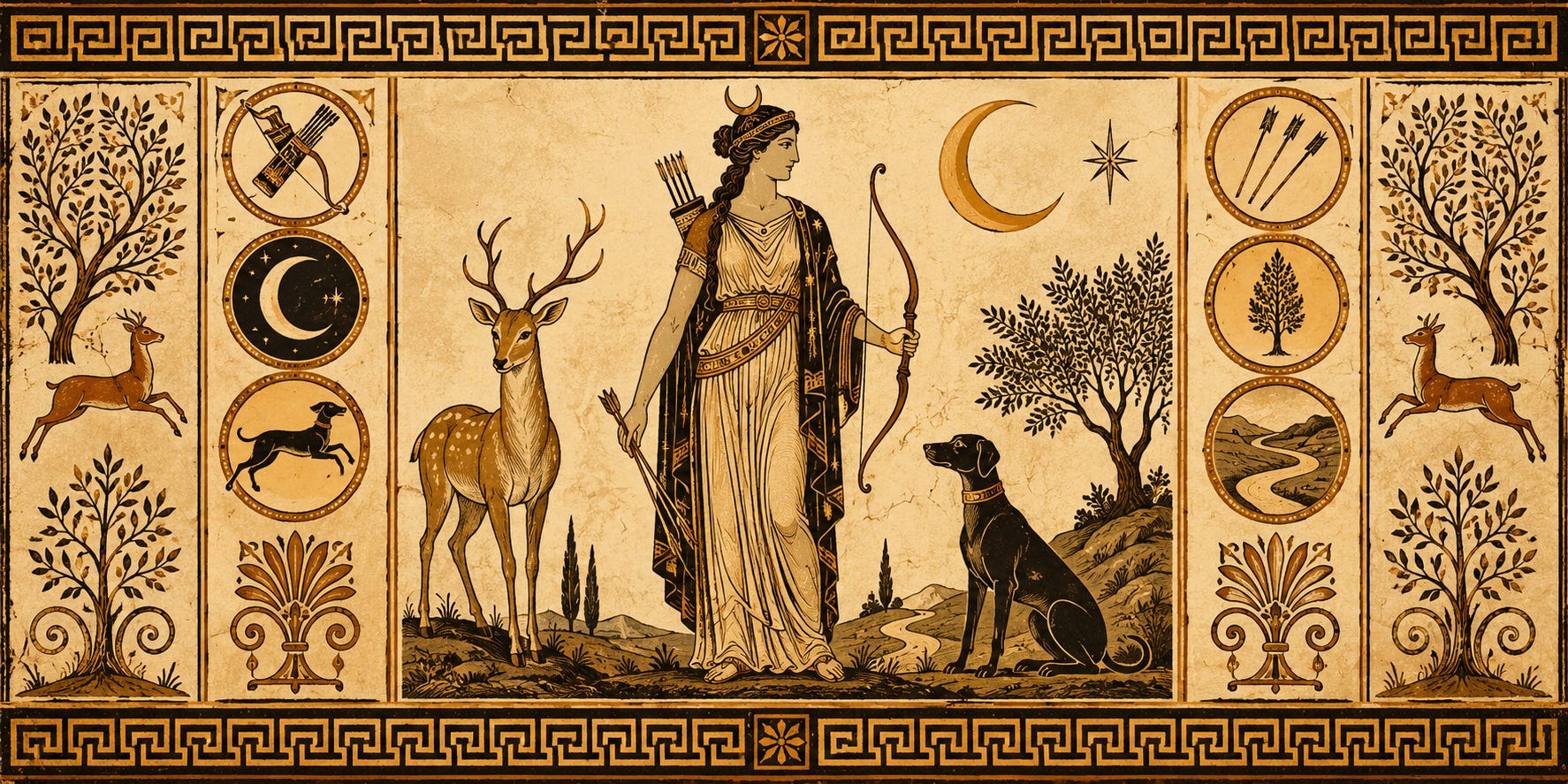
She stands at the edge of the story with a bow in her hand, a deer at her side, and the wild behind her.
This matters.
Atalanta is mortal. She can be tired. She can be tricked. She can lose. But when she runs, something of Artemis’s world runs with her: the quick foot, the watchful eye, the forest path, and the life that has not agreed to be caught.
The Short Answer
Artemis is the goddess of the hunt, wild animals, young creatures, moonlit paths, swift arrows, and fierce maiden freedom.
She is the daughter of Zeus and Leto, and the twin sister of Apollo. Like Apollo, she carries a bow. Unlike Apollo, she belongs most strongly to the wild: the mountains, the forests, the sudden clearings, the hidden tracks, the places where animals hear you before you see them.
Artemis protects what is young and wild, but she is not gentle in the soft way people sometimes mean gentle. She can be watchful, generous, and severe. She can guard a child, a deer, a girl, or a path through the trees. She can also punish those who insult her, spy on her, forget her, or treat the wild as if it belongs to them.
In Greek myth, that is an important thing to remember.
Artemis is not the goddess of a tame forest.
The Wild Is Not Empty
To someone careless, the wild may look empty.
There are trees. There are rocks. There is grass. Perhaps there is a bird somewhere making a sound. A person from a palace might look at a forest and think nothing much is happening there.
Artemis would know better.
To Artemis, the wild is full.
It is full of hoofprints in damp earth, broken twigs, hidden nests, low dens, lifted heads, listening ears, dark water, cold stars, and paths no human foot has made. It is full of creatures who do not announce themselves. It is full of things that move before you are ready.
A deer can vanish between two trees.
A hare can break from cover like a thought escaping.
A bird can rise so suddenly that even a brave person takes one step back.
Artemis knows this world. She does not need a road. She does not need a gate. She does not need anyone to tell her which way to go.
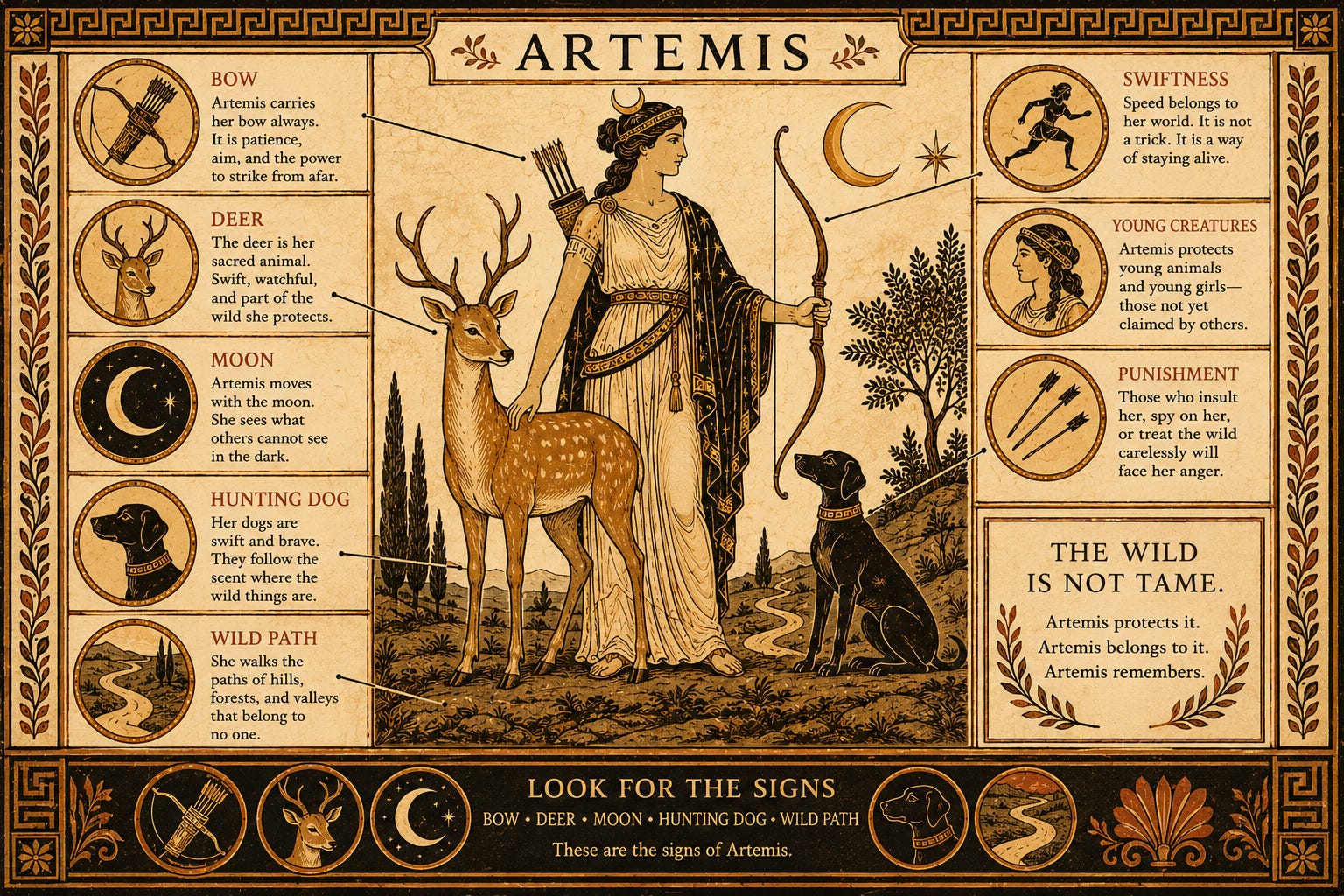
That is why her signs are so easy to remember.
The bow.
The deer.
The moon.
The hunting dog.
The wild hill.
The path that does not belong to anyone.
The Bow
Artemis carries a bow.
A bow is not like a sword. A sword belongs to closeness. It means the enemy is near enough to touch. A bow belongs to distance, patience, aim, and silence.
To use a bow well, you must wait. You must watch. You must see clearly before you move.
That is one reason Artemis is dangerous.
She does not have to rush. She does not have to shout. She does not have to explain herself. A goddess with a bow can answer an insult from very far away.
In some stories, her arrows bring sudden death. In others, they bring punishment, warning, or fear. The point is not that Artemis is cruel for no reason. The point is that she is a goddess, and Greek gods are not always safe company.
They are powerful.
They remember.
They expect honour.
The Deer
The deer is one of Artemis’s clearest animals.
A deer is beautiful, but not helpless. It listens with its whole body. It stands still only until stillness is no longer wise. Then it runs.
This is important for Atalanta.
In Artemis’s world, swiftness is not a trick. It is a way of staying alive.
A deer does not run because someone has given permission. It runs because its body knows the path before danger closes around it. It runs because the forest opens. It runs because standing still would be foolish.
Atalanta will run like that.
Not because she wants applause.
Not because she wishes to impress men who have come to watch her.
She runs because running is part of who she is.
The Moon
Artemis is often linked with the moon.
Not always in the same way in every story, because Greek myth is old and full of different tellings. But the moon belongs naturally beside her: cold light, night paths, silver edges on leaves, animals moving when the human world has gone indoors.
The sun makes things bright.
The moon makes things watchful.
Under moonlight, the forest is not less alive. It is differently alive. Shapes change. Sounds grow larger. A branch can look like a hand. A stone can become an animal until it decides not to be one.
Artemis belongs to that kind of seeing.
She is not confused by darkness.
Young Creatures and Untaken Lives
Artemis is often near young creatures.
Young animals. Young girls. Lives not yet folded into the houses, bargains, marriages, duties, and arrangements of adults.
This does not mean Artemis keeps everyone safe forever. Greek myth is not that tidy. But it does mean that Artemis often stands near those who have not agreed to be claimed.
That is one reason she matters before Atalanta.
Atalanta’s story is not only about speed. It is about what other people do when they see speed and decide it must be captured, tested, won, or brought indoors.
Artemis’s world does not think that way.
In Artemis’s world, a wild thing is not valuable because someone has managed to possess it. A deer is not made better by being caught. A path is not made truer by being fenced. A girl’s swiftness is not an invitation for others to decide where she must stand.
This is not a lesson.
It is simply the shape of the old story.
Artemis Is Not Always Gentle
It would be a mistake to imagine Artemis as merely kind.
She can protect. She can guide. She can stand near the young, the swift, and the wild. But she can also be terrible when insulted.
In Greek myth, gods care about honour. They care about offerings, promises, boundaries, and respect. This can seem strange to us, and sometimes unfair. But the myths do not let us pretend the gods are ordinary people with better manners.
They are gods.
If a king forgets Artemis, he may discover that the fields are not as safe as they looked yesterday.
If a hunter boasts too loudly, he may find the forest listening.
If someone treats the wild as a thing to be used, entered, or stared at without reverence, Artemis may answer.
And when Artemis answers, she does not always answer softly.
You will see this again when you come to the story of the Calydonian Boar Hunt. That terrible hunt begins because Artemis has been forgotten, and Artemis is not a goddess one forgets safely.
Artemis and Atalanta
Atalanta is not Artemis.
That matters too.
Atalanta is mortal. She has a beginning, a body, a fear, a hunger, and a fate. She can be misunderstood. She can be admired for the wrong reasons. She can make a choice in a moment and feel the whole world change because of it.
But when Atalanta runs, the story remembers Artemis.
It remembers the forest path.
It remembers the deer.
It remembers the bow.
It remembers the girl who has not agreed to be caught.
Atalanta’s speed is not decoration. It is not a party trick. It is not there so that men may praise it and then take it from her.
Her speed is her life moving.
That is why the race matters.
When people come to race Atalanta, they do not only challenge her feet. They challenge the life she has made for herself: the running, the wildness, the right to remain uncaught.
That is why Artemis belongs at the edge of the Tale.
When You Read the Tale
When you read Atalanta Runs for Her Freedom, watch what people do when they see her speed.
Some admire it.
Some fear it.
Some want to test it.
Some want to win it.
But Artemis’s world is older and stranger than that. It knows that not everything beautiful has been placed in the world to be owned. It knows that some things are most themselves while moving away.
So look for the signs.
The path.
The bow.
The deer-like speed.
The men who think a race can settle what they do not understand.
The golden apples shining where no apple should be.
And before the apples fall, remember Artemis.
She does not make the wild safe.
She reminds mortals that the wild has laws of its own.